


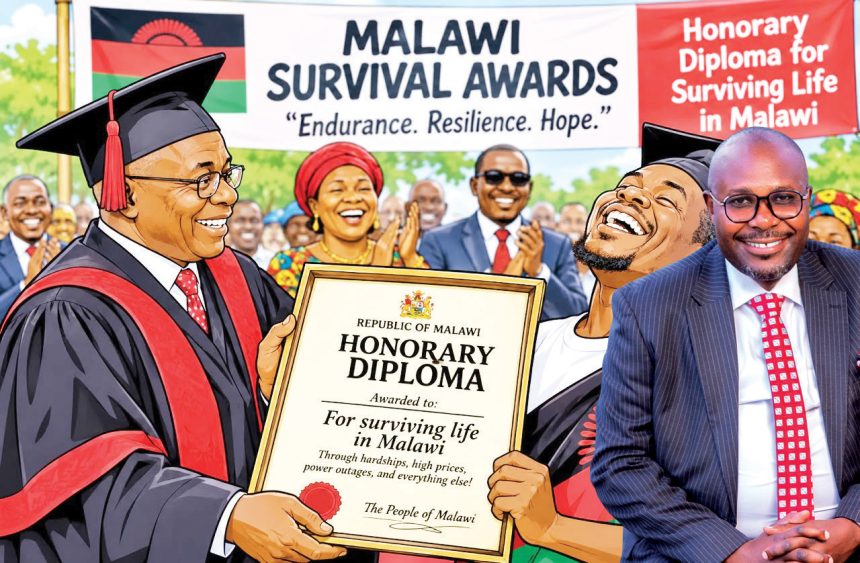
I have come to the conclusion that surviving in Malawi should be recognised as an academic achievement. Forget your bachelor’s degree, master’s degree or doctorate. If you have successfully lived in this country for the past five years without developing a permanent headache, losing your mind or relocating to another planet, you deserve an Honorary Diploma in Resilience and Survival Skills.
Actually, I think the University of Malawi should introduce a special programme called Bachelor of Survival Studies. Admission should be automatic for every Malawian who has endured our public service delivery system.
Let me explain.
You wake up early in the morning, stretch your hand towards your bedside table and reach for your phone to check messages. The phone is dead. You thought you had left it charging overnight, but electricity decided to take an extended holiday. Apparently, the Electricity Supply Corporation of Malawi had other priorities.
- Advertisement -

You put the phone aside and head to the bathroom. There is no water. You cannot brush your teeth, wash your face or even perform the basic rituals of welcoming a new day.
- Advertisement -
Then comes the first toilet visit. You finish your business, reach for the flush button and discover that water has also gone missing. You stare at the toilet as though it has personally betrayed you.
That is when reality hits you. Welcome to Malawi!
By this time, if you are among the millions of middle-aged citizens who are managing hypertension, it is time to take your Nebilong or Amlozaar blood pressure medication. Unfortunately, your tablets are running out.
You consider visiting the hospital for a refill, but immediately remember your last experience. The pharmacy had run out of essential blood pressure medicines. Apparently, there was no foreign exchange with which to import them.
- Advertisement -
Now, imagine being told that the country has no forex to import medicine that keeps you alive. You are not sure whether to laugh, cry or start writing your own obituary.
Talking of forex, your child is studying abroad, and school fees are due. You visit the bank, explain your predicament and receive the familiar national greeting: “We don’t have forex.”
You also have an international trip coming up. The bank cannot help you, so you turn to the parallel market. The exchange rate is so frightening that you begin to wonder whether you are buying United States dollars or purchasing shares in a foreign government.
But this is Malawi. You must learn to improvise.
And forex is only one subject in our national survival curriculum.
Try going to the bank at the month-end. The queues are long enough to qualify as a national monument. The ATMs are either not working or have run out of cash. Meanwhile, the central bank phased out cheques, leaving Current Account holders wondering how exactly they are supposed to access their own money.
Imagine having K5 million in your Current Account but being restricted to withdrawing K1 million per day, even as a platinum customer.
Your money is in the bank, but accessing it feels like applying for a visa to another country.
You then proceed to a hotel for lunch. The hotel has stopped receiving cash, apparently in the spirit of digitalisation. Unfortunately, its point-of-sale machine is not working.
This is the Malawi paradox. We have developed an extraordinary appetite for modernisation without first developing the infrastructure that makes modernisation possible.
We want a cashless economy without reliable digital payment systems. We want digital banking without dependable internet. We want electronic transactions when electricity itself has become a luxury.
Our ambitions are first-world, but our infrastructure is still negotiating with the 20th Century.
And then there are our roads!
Driving on Malawian roads requires more than a driving licence. It requires courage, spiritual protection and a full prescription of painkillers.
Some potholes are so old that they should be declared historical monuments. Others are so deep that you need geological equipment to establish their actual depth.
In some places, enterprising young men have turned pothole repair into an informal employment programme. They break bricks, throw them into the craters and collect a small fee from grateful motorists.
We have effectively decentralised road maintenance to roadside entrepreneurs.
Meanwhile, some roads have deteriorated so badly that driving at night feels like participating in a blindfolded obstacle race.
Our cities are not doing much better.
Look at some of the buildings occupying prime commercial land in our major cities. Land that should accommodate modern architectural masterpieces and impressive skyscrapers is occupied by structures that look like oversized warehouses.
There is nothing wrong with modest buildings but, surely, our cities deserve better planning, better design and a stronger vision for urban development.
Somehow, we have become comfortable with mediocrity. We have normalised things that should ordinarily provoke national outrage.
We have learned to celebrate the availability of electricity as though it were a special national event. When water flows from the tap, we rejoice. When an ATM works, we consider ourselves blessed. When a hospital has essential medicines, we almost want to organise a thanksgiving service.
What kind of country makes ordinary public services feel like extraordinary privileges?
Perhaps it is time we introduced a new national award: The Malawi Medal of Survival.
Recipients would qualify by demonstrating an ability to wake up without electricity, brush their teeth without water, find medicine without forex, withdraw their own money despite banking restrictions, drive through potholes without damaging their vehicles and complete a business transaction when the internet is down.
A distinction would be awarded to anyone who manages all these things in one day without being admitted to hospital.
Malawians have survived enough.
If the government cannot immediately guarantee us reliable public services, perhaps it should at least consider awarding us honorary diplomas.
And judging by the examination questions, we are all graduating with distinctions!