






90 percent of Africa’s cultural legacy resides outside the continent; audiovisual restitution is a battle for memory as urgent as artefact restitution, writes Ana Carbajosa.
When film director Alain Kassanda set out to tell the story of his grandparents in colonial Belgian Congo, he wanted to collect films from the period.
The images he found spoke of Belgians civilising the local population – building roads and schools, and depictions of black folklore.
“The Congolese always appeared as ghosts. It was racist propaganda in which the Congolese perspective was never shown,” says Kassanda.
- Advertisement -

To make matters worse, he had to pay 25,000 euros to be able to access those graphic files distributed by various Belgian institutions.
- Advertisement -
“They recorded us without our consent and now we have to pay for what they stole from us. They took the images in the same way they stole pieces of art that are now in European museums. The restitution happens in the first place by having access to those files,” he charges, visibly angry during an interview in a bar in Tarifa, on the sidelines of the 20th edition of the African Film Festival (FCAT), held at the end of April in the Andalusian town of Tangier.
Kassanda talks about physical restitution, that of access to the material.
There is a more elusive battle, no less relevant: the fight for the graphic memory of the African continent. His film about his grandparents, Colette et Justin, premiered last year, and in it images are recontextualized through what some African filmmakers call the “reappropriation” of narrative.
It is the fight for representation of the images of a deformed and exoticised Africa on the screen at the hands of the colonial powers. Something that, in the heat of the artefacts restitution movement that is sweeping the continent, gains new strength.
- Advertisement -
The report commissioned by Paris in 2018 to Felwine Sarr and Benedicte Savoy claims that 90 percent of the cultural legacy of sub-Saharan Africa resides outside the continent.
“Audiovisual restitution is also the fight for memory. The colonisers were fully aware of the power of memory, and they dominated peoples who were not collectively aware of the importance of memory, which was above all oral,” argues the Moroccan director, Ali Essafi.
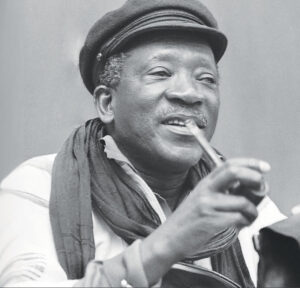
The accusation was famously made by the Senegalese director, Ousmane Sembène. Considered the father of African cinema, Sembéne snapped at his French colleague, Jean Rouch: “You look at us as if we were insects.”
“Africa has been the continent [narrated] by others, by the colonisers,” adds Farah Clémentine Dramani-Issifou, an expert in the decolonisation of the visual arts, who also attended the event in Tarifa.
Dramani-Issifou has been the curator of the exhibition in Benin of the 26 works returned by France in 2021, as part of the new African policy inaugurated by Emmanuel Macron four years earlier with his famous Ouagadougou speech.
The 1934 Laval decree prevented African directors from filming in French-speaking Africa without authorisation from the authorities to prevent the spread of anti-colonial messages. Only from 1960, with the arrival of independence, did a first generation of African filmmakers emerge.
Study in France
But the umbilical cord was never completely cut.
To begin with, in those first years of independence, many filmmakers went to study in France, Russia, the United Kingdom or the USA.
“They returned to their countries to make films, but they were very influenced by aesthetics and themes that were again foreign to the cultural roots of the continent,” explains Léa Baron of Cinémathèque Afrique, an institution itself dependent on the French Institute.
It was also because many works carried out after the sixties ended up in the hands of public institutions and private distributors from outside the continent.
A comprehensive Unesco report on African cinema noted that the best African films “are almost never found in Africa, but rather in the national film archives of France, the United Kingdom and other European countries, and in Western universities with African film departments. This means that these pioneering films are not available in educational institutions across Africa,” according to the study.
Western governments and production companies financed films that are now out of reach of many Africans.
Post-production has often continued to be done outside Africa. The differences are immense between the 54 African countries, but they all share that colonial heritage, as well as economic deprivations and accumulated problems associated with the production and distribution of their own material.
There are countless initiatives to digitise and in many cases restore rights, but there is still a long way to go.
To the challenges of the past are added the challenges of the present. “African youth are obsessed with succeeding abroad and have little time to look back at their classics. They are also very exposed to trash TV,” observes the Mozambican director Pedro Pimenta, a Unesco consultant on African audiovisual affairs. The result, he complains, is that many end up making films with foreign festivals in mind instead of the African market.
All this, in a context in which Western festivals and production companies show a growing interest in African content, as shown by blockbusters like the Wakanda saga, among others. Nollywood, the very powerful Nigerian entertainment and commercial film industry, has also had a strong presence on platforms such as Netflix for a few years.
“There have never been so many Afro-futurist movies. The platforms have realized that Africa is a great market when they have already reached their limit in other continents,” says Pimenta. That presents an opportunity for the region, but experts warn that it is not without its dangers.
With the arrival of new offers, the temptation to adapt production to Western taste and the demands of those who come from abroad grows. This also influences when deciding which issues are relevant and how to deal with them.
Kassanda sums it up neatly: “Cinema is also a question of power: the power of who has the means to represent themselves.”