





Tropical Cyclone Ana roared across the country with unprecedented violence, but its most devastating blow struck at the heart of Malawi’s power grid.
In a single, catastrophic moment, the massive Kapichira Hydropower Station, supplier of nearly a quarter of the country’s electricity, was completely destroyed.
The Shire River, swollen beyond recognition, had changed course entirely. Where once turbines hummed with 129.6 megawatts (mw) of power, there was now only twisted metal and rushing water.
The emergency spillway shattered; heavy machinery worth millions of Kwacha swept away like toys. In the control room, only 2 of 5 spillway gates flickered weakly, like the last gasps of a dying giant.
- Advertisement -

As darkness fell that first night, 19 million Malawians faced a terrifying new reality; their country had been plunged into an energy crisis that would test everything they believed about progress, hope and the power of determined leadership.
- Advertisement -
But this story does not begin with the cyclone; it begins decades earlier, with a young boy named Lazarus Chakwera squinting at his schoolbooks by the fading light of a lamp, making a promise that would, one day, transform a nation.
At the World Bank Grant Signing Ceremony in January 2025, President Chakwera said: “I grew up in an area where electricity was a luxury, and I made it my personal goal to change that for all Malawians.”
Those words, spoken with the quiet conviction of someone who has never forgotten the sting of smoke in his eyes or the frustration of dreams deferred by darkness, carry the weight of a lifetime’s mission.

Young Lazarus Chakwera knew what it meant to race against the sunset. Like millions of Malawian children, his education was held hostage by the availability of kerosene, his ambitions dimmed by the economic reality of families who could barely afford light, let alone hope.
- Advertisement -
But somewhere in those long nights of flickering flames and struggling to read, a revolutionary was born.
Fast-forward to 2020, and that boy had become President of Malawi, inheriting a nation where only 12 percent of citizens had access to electricity, making it one of the least electrified countries on Earth.
Most leaders would see statistics. Chakwera saw faces. He saw the echoes of his own childhood, multiplied across 19 million people.
What happened next would become one of the most remarkable energy transformations in African history.
But before we can understand the magnitude of Chakwera’s efforts on electricity, we must return to that devastating morning, when Cyclone Ana stripped away nearly a quarter of Malawi’s electricity in a single, catastrophic blow.
The Kapichira Hydropower Station had been Malawi’s pride, a 129.6mw facility that represented hope, progress and energy security. Then the cyclone hit with apocalyptic force.
The Shire River, Malawi’s lifeline, became an agent of destruction. Waters that had powered turbines for decades suddenly changed course entirely.
The human cost was immediate and brutal. Across the country, homes went dark. Hospitals struggled to operate on backup power.
Businesses shuttered. Schools closed early each day. Load shedding-planned power outages stretched to eight excruciating hours daily, crippling an economy already struggling to find its footing.
For any leader, this would have been a career-defining crisis. For Chakwera, the boy who had grown up in darkness and sworn to banish it from his nation, this was personal.
While Malawi suffered through daily eight-hour blackouts, Chakwera faced the defining moment of his presidency. He could have made excuses, blamed the weather, pointed to climate change, asked for patience.
Instead, he made a declaration that would echo through the corridors of power from Lilongwe to Washington in the United States.
“Time for doing things with laxity is over. The country needs to up its production following cyclone disasters, and electricity is key to such productivity. It is not acceptable for a presidential deadline to be missed as a result of poor management,” he said.
Those weren’t the words of a politician making promises. They were the battle cry of a leader who understood that his people’s dreams were dying in the dark.
Within six months, a timeline that international development experts called impossible, Chakwera’s administration had mobilised both government resources and secured a $60 million World Bank Emergency Power Restoration Project. Of that amount, $44.7 million was dedicated specifically to bringing Kapichira back from the dead. It started with phase one, an emergency restoration to get the lights back on while planning for something far more ambitious.
The immediate engineering challenge was staggering yet necessarily temporary. The Shire River had to be convinced to return to its original course. Emergency repairs to the spillway system and training dike were implemented to restore power generation, but everyone understood this was a bridge solution while engineers designed something truly permanent and resilient.
Working 24 hours a day, seven days a week, local engineers raced against time while Malawi endured the longest energy crisis in its modern history. The pressure was immense. Every day that passed meant businesses closing, students falling behind, hospitals struggling, dreams fading.
Then, on April 5, 2023, something happened. The first two generators roared back to life, pumping 64.8mw back into the national grid. It was not full restoration, but it was proof that the impossible was possible. A few weeks later, a third machine joined the symphony, bringing capacity to 97.2mw.
Finally, on May 10, 2023, after 15 months of national energy crisis, the fourth and final machine was synchronised to the grid. The full 129.6mw capacity was restored. Kapichira had risen from the dead, but this was just the beginning of a larger resurrection story.
The temporary restoration proved its worth when Tropical Cyclone Freddy struck just two months later. The facility successfully protected itself through proactive spillway management, keeping the lights on across Malawi.
But Chakwera knew they could not keep taking such risks. While the emergency repairs had saved the nation from extended darkness, the President was already in phase two, a complete reconstruction from the ground up that would create a facility capable of withstanding any future storms nature might unleash.
But Kapichira was just the beginning. While the world watched Chakwera resurrect a power station from the dead, he was simultaneously orchestrating an even more ambitious transformation; one that would attract over $800 million in clean energy investments and position Malawi as Africa’s most surprising energy success story.
Then came a $350 million World Bank grant for the Mpatamanga Hydropower Project, the largest foreign investment in Malawi’s history. When operational by 2030, this 358-mw will be more than double the country’s hydropower capacity, providing electricity to over one million households while preventing 520,000 tonnes of carbon dioxide from poisoning the atmosphere.
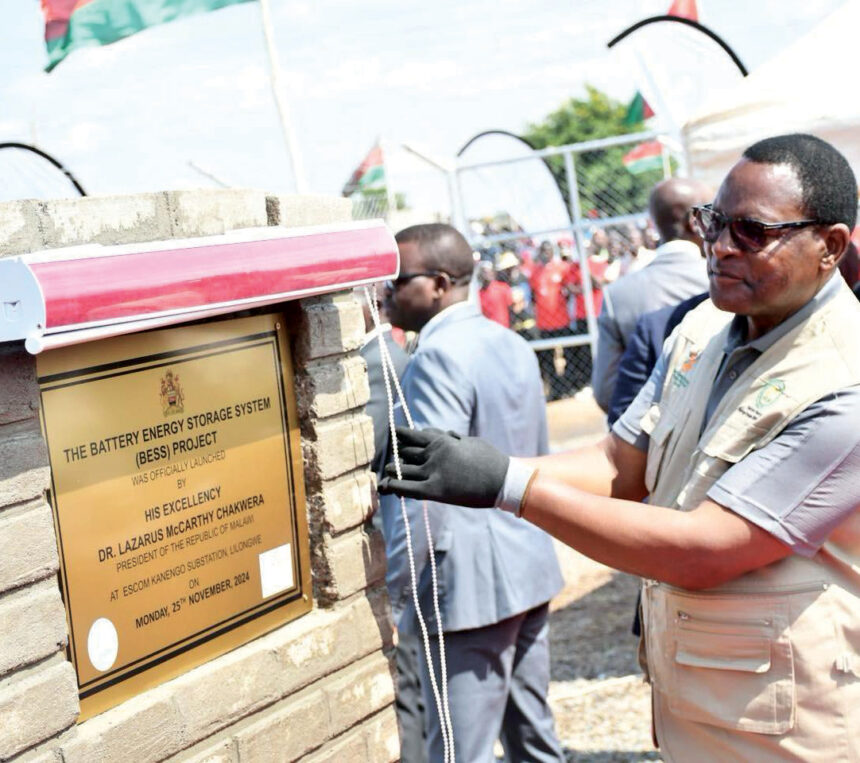
But perhaps more remarkable than the project’s size was what it represented: international confidence in Chakwera’s vision. The Global Energy Alliance for People and Planet invested $47.6 million, including funding for Africa’s first utility-scale battery energy storage system, a 20mw facility that Chakwera would later call “the very first of its kind in the whole of Africa”.
At the Salima inauguration in November 2021, Chakwera’s voice carried the emotion of a man watching his childhood dreams come to life:
“This solar power plant is a symbol of our commitment to that agenda, a commitment to building a new Malawi of access to clean and affordable energy, and I believe it is the first of many to come,” he said.
He was right. Today, solar installations across Malawi tell story after story of transformation. Each panel reflects not just sunlight, but the light of possibility in communities that had grown accustomed to disappointment.
The Malawi Energy Access Project (Meap), with its $150 million World Bank financing, became the most ambitious rural electrification campaign in the nation’s history— targeting 380,000 households through a revolutionary dual-track approach.
Energy Minister Ibrahim Matola, the chief architect of Chakwera’s energy transformation, articulated the philosophy driving this grassroots revolution.
“We firmly believe that access to reliable and affordable electricity is a fundamental right for all citizens, regardless of their geographic location,” Matola said.
The numbers tell a story of remarkable acceleration. The Electricity Supply Corporation of Malawi (Escom), which historically managed only 30,000 new connections annually, suddenly began completing 70,000 connections in 12 months.
As of June 2025, 134,484 households had been connected to the grid, representing 74.7 percent progress toward their 180,000 target.
Meanwhile, the ministry’s off-grid component, operating through the innovative Ngwee Ngwee Ngwee Fund, did not just meet its 200,000 household target; it shattered it, reaching over 240,000 installations with projections of 263,542 solar home systems by June 2025.
The Malawi Rural Electrification Programme added another layer to this transformation, connecting 282 rural sites, so far, out of 460 targeted locations, with the ambitious exercise continuing to reach even the most remote communities.
In September 2024, Chakwera travelled to Group Village Nguluwe in remote Nsanje District to commission another Marep site.
As he flipped the ceremonial switch, elderly villagers wept, not just tears of joy at gaining electricity but tears of recognition that, finally, someone remembered they existed.
Chief executive officer Maxon Chitawo explained the paradigm shift with technical precision when Egenco was carrying out one of the biggest routine maintenance services at Nkula B, Tedzani IV, and Kapichira.
“At Nkula B, the last machine was commissioned in 1992. At Kapichira, phase one was commissioned in 2000. After every 20 years maximum, hydropower plants need to undergo major maintenance or overhauling to give the plants new life,” he said.
But under Chakwera’s leadership, Egenco was not just meeting maintenance schedules; it was exceeding them with military precision. Nkula A & B maintenance was completed, restoring 135.1mw capacity while the nation held its breath.
January 2025 marked the moment when the student became the teacher. At the Mission 300 Africa Energy Summit in Tanzania, Chakwera did not arrive as a supplicant seeking aid; he went as a leader whose success other nations wanted to study and replicate.
Only 12 African countries were selected to develop National Energy Compacts under the UN-Energy initiative. Malawi’s selection represented more than recognition; it was validation that the boy who once studied by kerosene lamp had, indeed, transformed his nation into a continental energy leader.
Chakwera’s presentation of Malawi’s National Energy Compact was so compelling that Tanzania’s President Samia Suluhu Hassan called it a “game changer” for the entire continent. The compact commits Malawi to reaching 70 percent electricity access by 2030, with 96 percent renewable energy.
“Universal energy access is not an aspiration; it is an obligation to our people and future generations,” Chakwera declared to the assembled African leaders. “As leaders, we must plan energy solutions with regional configurations in mind, not just national ones,”.
His regional vision was already bearing fruit. The Mozambique- Malawi Regional Interconnector Project, under which construction began in November 2022, would soon deliver 50mw of additional power while demonstrating how energy cooperation could benefit entire regions.
Plans for interconnectors with Zambia and Tanzania showed that Chakwera’s thinking had evolved from national to continental.
The $300 million compact deal that emerged from the summit carried more than monetary value; it carried proof that the international community now saw Malawi not as a recipient of aid, but as a partner in transformation.
But perhaps the most meaningful moment came when Matola shared Chakwera’s vision for the future.
“We need to add more power to the national grid by 2030 as stipulated in the Malawi 2063 agenda. We, as a government, shall create a conducive environment for more players to invest in the energy sector because this is a catalyst to the economic growth of our country.”
Magret Robert of Lundu village in Nsanje district said she was happy to have her house connected to power under Marep 9.
Senior Chief Chimwala of Mangochi was equally ecstatic.
The transformation from 12 percent to over 25 percent electricity access in just four years is not merely a policy achievement; it is the fulfillment of a promise made by a child to himself in the darkness, multiplied across millions of lives.