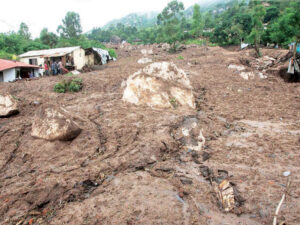
Fredson Piyapa of Kashoni Village, Traditional Authority (TA) Sunganinzeru in Mulanje, lost everything to floods induced by Cyclone Freddy that struck the district and other parts of the country in March last year.
Piyapa used to support his family through small-scale farming activities and had plans to increase his earning potential through crop and livestock farming.
However, all these plans were thwarted by the floods.
“They swept away my crops in the field and the livestock I kept just outside my house. It is by grace that my family and I are still alive today, as the floods also washed away my house,” Piyapa recounts.
He states that the waters, which broke from some springs in the mountains, took many families by surprise despite the heavy rains.
- Advertisement -
He had not seen something like that in years.
“We used to see rivers flooding, but not on this scale. The waters were not coming from the rivers as we had seen in previous years; they just burst out of nowhere, carrying logs and other large stones with them,” Piyapa recalls.
He believes the speed and volume of the runoff could have been reduced or prevented had the area had sufficient ground cover, such as trees and grass.
Piyapa states that the local community has suffered due to the indiscriminate cutting down of trees over the years and the remaining trees were washed away by the floods.
- Advertisement -
- Advertisement -
In Bango Village, also within the same TA, 49-year-old Ernest Mnyema has yet to recover from the devastation that struck the village a year ago.
Mnyema used to rear pigs in addition to engaging in small-scale farming.
“But all of this was washed away by Freddy and I am still trying to find a way to recover because the pigs and crops used to provide some income for my household.
“The pigs also served as a source of manure for my crops at a time when we could hardly afford to buy fertilisers,” Mnyema explains.
From the large gullies to damaged houses, the devastation caused by Cyclone Freddy is still visible in this rural part of Malawi.
One of the gullies used to be a field where 36-year-old Ellen Luis grew maize, pigeon peas and cassava.
Just yards away is her house, which is yet to be rehabilitated. The single mother still lives there with her six children.
“I have now joined a village savings and loans (VSL) group where, together with other women and men in this area, we buy shares to save money. I plan to use part of my savings to rehabilitate the house or possibly construct another one,” Luis says.
At the height of the devastation caused by the cyclone, the government and its development partners launched the Climate Smart Enhanced Public Works Programme to assist those affected by the destruction.
The programme also engages the affected households to create assets, build resilience to climate shocks and improve their livelihoods.
Communities in the affected areas participate in various environmental conservation activities and receive payment after 30 days of such work.
About 20,834 people are involved in land resource activities, river bank protection, watershed management and soil and water conservation in Mulanje.
Desk Officer for the project in the district, Michale Phiri, states that people are also encouraged to start small businesses and join VSL groups as a means of ensuring recovery from the natural disaster.
Through the initiative, Luis, Piyapa and Mnyema are now able to participate in conservation activities in their areas and earn a living.
“We are planting trees, constructing check dams and using manure to conserve the soil. Six years from now, I am hopeful that the area will have its vegetative cover back,” Piyapa says.
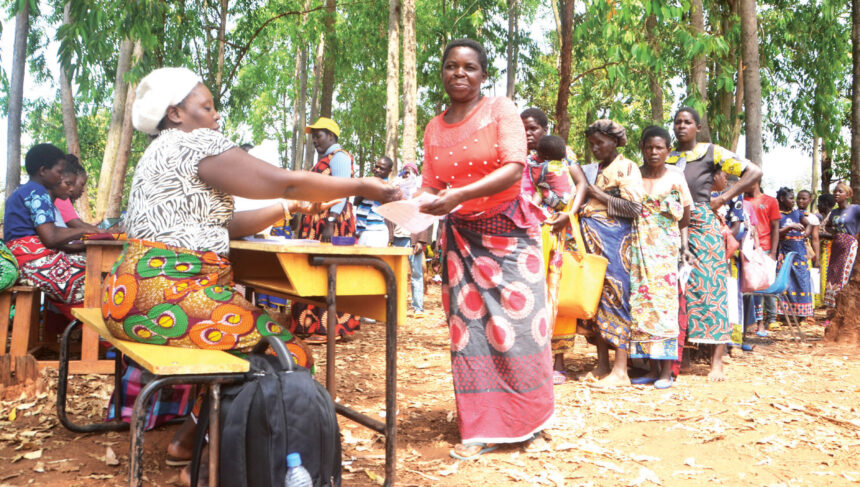
At the time we spoke to him, Piyapa had just received K38,400 for his work. He indicated he would invest part of the money into shares in the VSL group.
While stating that the money is not much, he insisted it is something he can work with to start repairs of his house and buy seed for his fields.
He and his colleagues, however, have every reason to smile as they will now start receiving K48,000 for the 30-day cycle.
“The money is intended to ensure that the affected households engage in income-generating activities to fully recover from the devastation caused by the cyclone,” Phiri says.
He also highlights the importance of involving communities in environmental conservation activities to ensure sustainability once the initiative concludes.
“We believe that many of the challenges experienced were the result of climate change stemming from negative environmental practices, so we are engaging the communities to help them understand the effects of their actions on the environment and to take action,” Phiri says.
Cyclone Freddy dropped six months’ worth of rainfall in just six days, triggering floods and mudslides that killed more than 1,200 people in the country.
The cyclone pummelled Madagascar and the Reunion Island before striking the mainland African countries of Mozambique and Malawi.