By Chimwemwe Mangazi, Jarson Malowa, Patience Lunda & Blessings Makuwira:
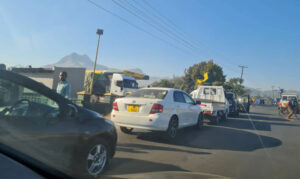
Panic buying became the order of the day in cities such as Blantyre, Zomba and Mzuzu Tuesday, after petrol ran out and consumers resorted to panic buying.
In Zomba, the problem became apparent on Monday, when long queues were a common feature at filing stations in the old capital, with motor users scrambling for petrol.
In Blantyre, petrol was the scarce commodity as diesel was as common as sunlight, as the minimum temperature was 25 degrees Celsius, with the Department of Climate Change and Meteorological Services further indicating that precipitation was at 0 percent, with the humidity rate pegged at 44 percent.
In Mzuzu City, diesel was nowhere to be seen, leaving taxi operators and industry players with hands akimbo.
- Advertisement -
The situation was no different in Balaka District, where consumers scrambled for petrol for hours on end.
This is the first time since April 2023 that the fuel supply situation has reached critical levels
In Blantyre, diesel was available and queues could be as long as two kilometres, leading to a single filling station. In Mzuzu petrol was available while motorists were queuing for diesel.
In Zomba, the problem of shortage of diesel and petrol entered the second day.
- Advertisement -
- Advertisement -
Some of the motorists and members of the public indicated that the situation is detrimental to the somewhat stability the people were enjoying.
Patrick Michongwe indicated that, already, at the news of fuel scarcity, passenger transport operators have increased transport costs within and outside Blantyre.
“Some of the taxis we take from Blantyre to Lilongwe are charging between K15,000 and K17,000 one way from between K11,000 and K12,000 previously, which is a huge inconvenience to passengers and the situation may get worse if the problem is not checked with speed,” Michongwe said.
A motorist we found on a queue in Blantyre, Apostle Mike Makwiti, said the situation has made most Malawians unproductive as they are spending hours on the queue, waiting for a turn, instead of engaging in productive activities.
In Zomba, motorists, motorcyclists and diesel operated maize mill owners struggled to access petrol and diesel.
An employee, who was rushing to Blantyre from Zomba, said he was being forced to pay double the fare he pays one-way.
“The government should fix the problem because our earnings have not improved,” he said.
In Balaka District, the pumps have been dry for the past four days.
The situation has riled drivers such as Shadreck Funenji.
“Our business has been affected as we are buying the commodity from the black market at exorbitant prices,” Funenji said.
By Tuesday morning, the most dependable filling station at the Boma only had diesel, leaving petrol users stranded.
And, in a WhatsApp response to a questionnaire, Malawi Energy Regulatory Authority (Mera) spokesperson Fitina Khonje said players in the fuel supply sector are collaborating to effectively minimise fuel supply disruptions being experienced.
“The occasional fuel supply disruptions, as we all know by now, are emanating from forex challenges being experienced by the country. The continued shortage of foreign currency is affecting importation of adequate volumes of petroleum products.
“However, licenced importers and all stakeholders in the fuel supply chain remain committed to minimising [cases of] stockout and ensuring continuity of supply. The importers of petroleum products are continuously engaging with stakeholders to find solutions to resolve this challenge and sustain supplies,” Khonje said.
However, she could not indicate the actual figure of fuel stock available at the strategic fuel reserves.
In May 2023, Minister of Information and Digitalisation Moses Kunkuyu went to town against the National Oil Company of Malawi, saying the company sat on fuel supply contracts since August last year that resulted in supply slippages.
Fuel scarcity directly affects transportation and logistics operations, as most vehicles, including trucks, buses and taxis, rely on fuel to operate.
According to Consumers Association of Malawi Executive Director John Kapito, shortages can lead to reduced or disrupted transportation services, delayed deliveries of goods, increased transportation costs and overall inefficiencies in supply chains.
Furthermore, Malawi’s economy relies on agriculture and fuel scarcity can severely impact the sector, especially for farmers who depend on fuel to run machinery such as tractors and irrigation systems, as well as transport produce to markets.