In what could be a demonstration of lack of due diligence of duty or just sheer negligence, the Ministry of Education selected students and allocated teachers to schools that exist only on paper
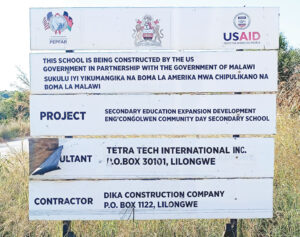
In January this year, President Lazarus Chakwera presided over a handover ceremony of 66 secondary schools “built” for students in rural Malawi under the Usaid-funded Secondary School Expansion for Development (Seed) project.
We have uncovered that some of the schools remain incomplete today yet the Ministry of Education selected students and allocated teachers to those schools.
The project in question is being implemented in a partnership of the United States Government through the United States Agency for International Development (Usaid) and the U.S. President’s Emergency Plan for Aids Relief (Pepfar).
At the handover ceremony last January, Chakwera hailed this partnership.
“A partnership that produces 66 brand new secondary schools, serving communities across 20 districts, is no ordinary partnership. A partnership that expands access to secondary education for tens of thousands of our youths is no ordinary partnership,” he said.
- Advertisement -
However, some of these schools remain incomplete, we can report.
In fact, construction on several of them has stalled for several years. Our investigation has found that eight schools in the Northern Education Division (Ned) are affected. These including Khuyu, Engcongolweni and Vibangalala in Mzimba District.
Engcongolweni Secondary School, for example, which is being constructed by Dika Construction Company stalled over a year ago over what some officials from the company said tough economic conditions in Malawi as a primary factor.
Despite assurances last year that the schools would be completed by September 2023, the project remains unfinished but government selected students to the school.
- Advertisement -
- Advertisement -
“Now because of that assurance, remember selection is done before opening of schools, we selected the first cohort of students and teachers.
“We hoped that by the time the schools were opening, the schools would be ready. When we reached September, the schools were not ready. We were confused as to what we should do,” said an impeccable source within the Ministry of Education who opted for anonymity.
Over 50 students from areas such as Chisangano, Kaluholo, Ng’ongo and Enukweni were selected to start their studies at the school.
But since there was no school to accommodate them, the students and their teachers were sent to various schools such as Thimalala and Ekwendeni CDSS in the region.
Concerned with the situation some communities in Engalaweni in Mzimba South pleaded with the teachers not to choose alternative schools, committing to search for learning space.
The students are currently learning at Mjinge Primary School where a classroom was spared for the secondary school students.
One of the parents Pressings Moyo from Chisangano said Engcongolweni Secondary School would have been a blessing as it was close to their areas.
“I now have to incur a lot of transport costs because my ward is now at Ekwendeni CDSS,” he said.
Ned manager Jennings Kaira could not be drawn for a comment as he said was on leave.
But an official from the division disclosed that the schools were routinely inspected on a monthly basis by Usaid officials, the consultant of the project, the contractor and planners from Ned. Despite these inspections, the challenges persist.
These incomplete schools are part of the first phase of the Seed project, while those in the second phase have been completed and were handed over. Students selected for the phase two schools are currently in their second term.
The phase two was being implemented in Rumphi, Karonga, Nkhata Bay and Chitipa.
Another source pointed out that the contractor—Dika Construction Limited— complained of funding challenges as foreign contractors were getting their money direct to their accounts unlike them who had to pass through the Reserve Bank of Malawi.
“There was also a time when it was agreed that the contractor should list down all the remaining equipment so that the donor through its consultants should procure the items themselves,” said the source.
Earlier, the Ministry of Education clarified that it is not responsible for implementing the Seed project or managing its finances. These aspects are handled by Usaid.
When contacted, the contractor said Usaid was better placed to comment on the issue.

In an emailed response US Embassy Public Affairs Officer Namita Biggins acknowledged the challenges.
“The US government, working in partnership with local contractors, encountered unexpected financial and technical challenges which have now been resolved.
“We anticipate the contractors will complete work at the remaining Seed school sites by December 2024 so that they can be handed over to the Ministry of Education shortly thereafter,”
Ministry of Education through its spokesperson Mphatso Mkuonela was also elusive to comment on the issues despite various efforts since Monday.
The four-year programme was launched in 2018, before it was extended to 2025.
Initially, it was expected that the project worth about $90 million would construct 250 secondary schools creating space for over 40,000 students.
However, the number of schools was sliced to 99 due to among others lack of human resources capacity, bureaucratic bottlenecks, politics, inflation and contractual differences.
The Seed project is implemented on behalf of the US Government by the USaid in partnership with the Government of Malawi through the Ministry of Education (lead institution), the Ministry of Finance and Economic Affairs, the Ministry of Health, and the Ministry of Gender, Community Development and Social Welfare.