


By Imam Wali:
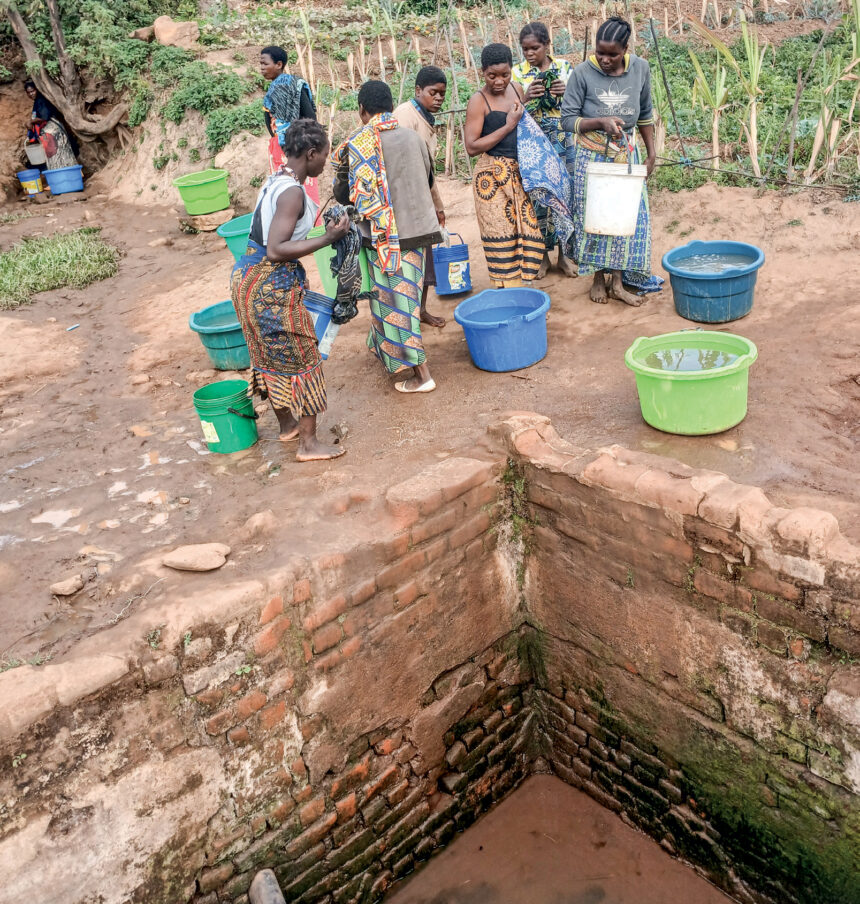
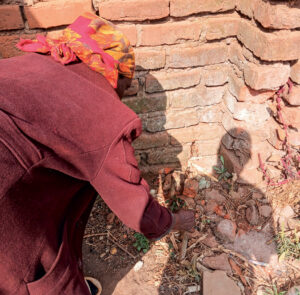
At 4am, Joyce Chimzimu lifts a 20-litre plastic pail onto her head and joins a quiet, exhausted queue of women emerging from the darkness.
They stand at the lip of an unprotected, shallow well popularly known as ‘Kwa Bento’. The water source is heavily contaminated, swarming with flies.
What makes this routine striking is its geography: the well sits across the international borderline in Mozambique.
- Advertisement -

For Chimzimu and hundreds of her neighbours at the Dedza Roadblock community—which comprises group village heads Katsekaminga and Kapalamula under Traditional Authority Kamenyagwaza in Dedza District—this gruelling cross-border trek has replaced basic human dignity.
- Advertisement -
A home tap is a service she paid for over two decades ago.
In 2005, Chimzimu paid her connection fee to the Central Region Water Board (CRWB), believing her days of walking for unsafe water were over.
For 13 years, the system worked.
Then, in 2020, the taps surrounding the Dedza Roadblock communities ran dry.
- Advertisement -
They have not dripped since.
“We started encountering this challenge in 2018 but, between 2021 and 2022, that is when the water completely stopped flowing at my house. The system just failed and we were thrown right back into a severe water crisis,” Chimzimu says
The 56-year-old says the physical burden has become too much to bear.
“I am old now. I cannot manage to go to the well to fetch water daily. Some days I have to pay aganyu [helpers] K8,000 just to haul water that lasts my household only two days either from a well or a borehole, which was constructed by ‘Ma Burundi’ [Burundians],” she says
She admits that the lack of tap water has heavily compromised local hygiene.
“Think of how mothers are managing reusable napkins. The cleanliness of a household with infants without running water severely compromises domestic hygiene, leaving crawling babies exposed to unhygienic floors and surfaces.
“The water we are using for cooking and drinking is not safe at all. We are living dangerously. Some people treat their water but others do not. We are only lucky that we have not yet caught a waterborne disease,” she notes
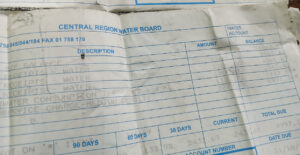
Despite the dry taps, Chimzimu says CRWB continued to send her a bill of K3,444 every month for three consecutive years after the water stopped flowing.
“I paid monthly water bills for close to three years without receiving a single drop of water. Yet I used to spend an estimated K40,000 every month on women who helped me with fetching the cross-border water. In 2022, when I lost all hope of restoration, I told them to remove their meter so that I could stop facing the billing nightmare,” Chimzimu says
To this day, she spends a significant amount of money just to purchase water.
The crisis is also robbing the community’s youth of an education.
Zai Saad, a 15-year-old Standard 8 learner at Dedza Government Primary School, has to fetch water before leaving for classes, which start at 6am and end at 4pm.
“Almost daily, before and after school, I have to fetch water that I use for bathing. It negatively affects my performance because I am always late for classes, which start at 6 in the morning and end at 4 in the evening.
“Sometimes, I am too tired to concentrate on lessons and my grades are suffering. Since I am a girl, I need water to keep myself clean at all times. We have a tap at our house but I have never seen water coming out of it. We are living dangerously,” Saad says
With no dependable supply, basic hygiene practices, such as handwashing, have largely stopped. Household flush toilets, built by families at immense cost, now sit idle.
Ruth Chisale, another resident who connected her home to the piped water system in the early 2000s, views the situation as a textbook example of institutional neglect.
“For the last six years, we have been neglected. In other parts of Dedza, people have regular access to water, while we are left to suffer every day.
“During the rainy season, when these shallow wells flood with contaminated surface runoff, our families frequently suffer from preventable diarrheal diseases. We live in constant fear of seasonal cholera outbreaks,” Chisale says
Chisale adds that, to date, water utility has provided zero engineering fixes.
Instead of fixing the supply network, the board simply removed their meters.
Under Section 34 of the Water Works Act, water boards are legally mandated to provide a continuous supply of water.
“Hygiene in the food business is paramount, and the absence of tap water puts us in a dangerous situation. The water we use must be trucked in from far away, which eats directly into our already low profits,” says one local restaurant owner.
A local lodge operator, speaking on condition of anonymity, expressed equal frustration.
“Operating a hospitality business without running water is an absolute nightmare. All we get from CRWB are empty promises while we carry water in buckets to toilets for our guests,” says the source
A four-month physical verification of over 20 households in the area confirms the true scale of the blackout: CRWB has systematically stripped water meters, leaving hundreds of people entirely unserved.
An anonymous insider within the utility board claims that years of stagnation and siltation have caused extensive internal decay in the underground pipes, leaving the core infrastructure ruined.
In a written response, CRWB Public Relations Manager Zepherino Mitumba deflected blame toward environmental factors and urbanisation, citing dropping groundwater levels and skyrocketing demand for water in Dedza Town.
“The water supply challenges affecting Dedza Roadblock are mainly associated with reduced groundwater availability and increased water demand in Dedza Town.
“Over the years, raw water yields from the Dauya and Kapesi wellfields have declined, while domestic, commercial and institutional demand has increased. For example, the yield from Dauya borehole has reduced from approximately 20 litres per second to about 5 litres per second,” Mitumba states
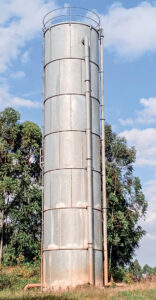
He adds that the area is located at the southern end of the supply system and receives water through a steel tank near a petroleum products filling station, which depends entirely on these declining groundwater sources.
To address the shortage, Mitumba confirms that two new boreholes have been drilled, including one at Katsekaminga specifically intended to feed Dedza Roadblock residents.
“CRWB has been pursuing additional groundwater sources to improve water supply to the affected areas. Following further hydrogeological investigations, two boreholes have now been drilled—one at Katsekaminga and another at Dauya,” Mitumba explains.
However, he provided no timeline for when water would actually start flowing.
Furthermore, Mitumba states that CRWB’s mandate stops at the meter, saying engineers will, where necessary, inspect household connections after supply resumes, with costs determined based on actual conditions.
This statement has left residents fearing they will be charged a second connection fee for a service they already paid for.
The crisis at Dedza Roadblock mirrors a broader national problem.
In March this year, the government launched an 18-month K88 billion project to upgrade the Liwonde Water Supply System. The project is being funded by the European Investment Bank and implemented by the Southern Region Water Board and is expected to benefit 188,000 people in Liwonde Township, Machinga and Balaka.
The launch came just weeks after Southern Region Water Board customers were subjected to a similar situation in February this year, when residents went four weeks without water in Balaka and Neno districts, with the board citing broken pumps and low water levels at Mpira Dam as factors that contributed to the situation.
The crisis is not limited to the centre and south.
In July this year, residents of Chibavi, Mzuzu City, petitioned the Northern Region Water Board over intermittent water supply in the area, meaning all three water boards—CRWB, SRWB and NRWB—have faced protests over dry taps in 2026 alone.
Speaking in an interview, one of the block leaders in Chibavi says when there is no water running, it puts pressure on children and women
“The erratic supply of water puts lives in danger of contracting waterborne diseases such as cholera. It also puts pressure on citizens, who wake up in the morning to search for water,” he says
Malawi committed to meeting Sustainable Development Goal (SDG) 6, which mandates universal access to safe water and sanitation by 2030.
But the country is nowhere near meeting the target.
According to WaterAid and the United Nations Children’s Emergency Fund Joint Monitoring Programme for 2024, roughly 5.7 to seven million Malawians still cover long distances to access water.
Statistics from the National Statistical Office (NSO) show that while 89 percent of the population uses an improved source, 60 percent of those sources are contaminated at the pump.
After poor handling, 93 percent of households drink contaminated water. Less than 19 percent drink water that is truly safe.
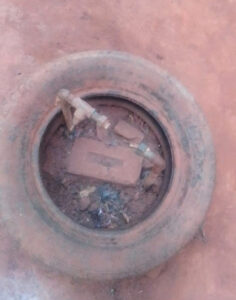
Chimzimu walking to Mozambique at 4am is the visual definition of SDG 6 failing.
Furthermore, the Malawi 2063 Vision highlights clean water as an indispensable foundation for socio-economic development.
Yet, at Dedza Roadblock, private clinics, eight restaurants, four lodges, three maize mills, bars, shops, two filling stations, the roadblock itself, a secondary school, and a day-care centre are all forced to operate without running water.
Mega projects meant to solve the crisis remain stalled.
The $315 million Salima-Lilongwe Water Supply Project promised 100 million litres of treated water a day for the Central Region by 2024, but it remains uncompleted in 2026.
Meanwhile, the proposed Diamphwi Multipurpose Dam between Lilongwe and Dedza had its feasibility study completed in 2018, but it has still received no funding.
This pattern of missed deadlines is a historical trend. Malawi missed the Millennium Development Goal target in 2015 to halve the number of people without safe water. Now, it is failing its SDG targets.
If nothing changes, the Malawi 2063 Vision will suffer the same fate.
In his remarks, governance expert-cum-Centre for Social Accountability and Transparency Executive Director Willy Kambwandira bemoans the situation.
“This is a clear injustice and a [mark of] serious governance failure. Citizens cannot reasonably be expected to pay for a public service they have not received for years. Removing meters to escape accountability for non-existent supply is a symptom of institutional failure, not customer misconduct,” he says
Water and Environmental Sanitation Network Executive Director, Safari Mbewe, calls the situation a direct rights violation.
“Dedza Roadblock is a very busy area and for people to stay eight years without water is incomprehensible. It exposes them to all sorts of water-borne diseases and outbreaks.
“Above all, it is a human rights violation as community members have a right to access potable water at all times,” Mbewe says
At 8:30am, Chimzimu finishes filling her pails at Kwa Bento. She carries her heavy load of unsafe water back across the border into Malawi.
How many more border communities will have to leave Malawi to find water before the government treats it as a right, not a privilege?