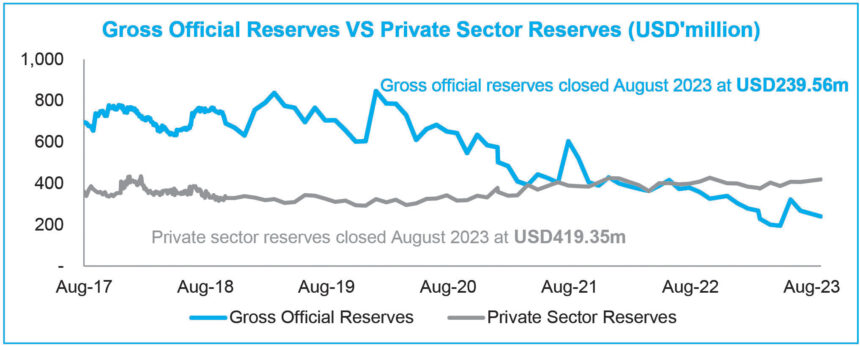
The country’s gross official foreign exchange reserves decreased by 10.6 percent to $239.56 million by August 31 2023 from $267.91 million in July 2023, a September Monthly Economic review by local financial advisory firm, Bridgepath Capital, shows.
The report indicates that gross official foreign exchange reserves decreased by 10.3 percent to 0.96 months in August 2023 from 1.07 months in July 2023, way below the internationally recommended three months’ cover.
This comes as imbalances between forex supply and demand were prevalent in the domestic foreign exchange market, evidenced by low foreign exchange supply, declining official foreign reserves and widening spread of rates on the market.
The local unit, the Kwacha, has, in turn, remained largely volatile, losing value against major trading currencies including the dollar.
Recently, the central bank introduced the forex auction system as a price discovery mechanism in the exchange rate market.
- Advertisement -
the setup was that authorised dealer banks would be submitting bids to sell foreign exchange to the central bank at prices or exchange rates freely determined by each participating bank.

In an interview Wednesday, financial market analyst Bond Mtembezeka said the drop in gross official forex reserves is in reaction to the imbalance between supply and demand where the demand for foreign exchange is high while supply remained subdued.
Mtembezeka said that the outlook is cloudy as there is little that is being done to grow the inflow of forex in the system.
“In the short term, there is little that can be done but for the medium term, we should expedite the agricultural commercialisation drive, prioritising high value crops for exports because the economy is agriculture-based,” Mtembezeka said.
- Advertisement -
- Advertisement -
In a separate interview, economist from the Malawi University of Business and Applied Sciences Betchani Tchereni said the situation was expected as Malawi is in the lean period.
He faulted continued insatiable appetite for imports coupled with squeezed levels of imports among challenges leading to the situation.
“In the short term, we need to quench our appetite for imports because there are a lot of things that are draining our resources that we can do without but in the medium term, let us hope IMF and other partners help us,” Tchereni said.
Reserve Bank of Malawi (RBM) spokesperson Mark Lungu was not immediately available for a comment.
But in a recent engagement with the media, RBM Governor Wilson Banda banked hope on a possible IMF Extended Credit Facility to reverse the situation.
Malawi is a predominantly importing and consuming nation highly dependent on exporting raw agriculture products, with tobacco as the main foreign exchange earner.