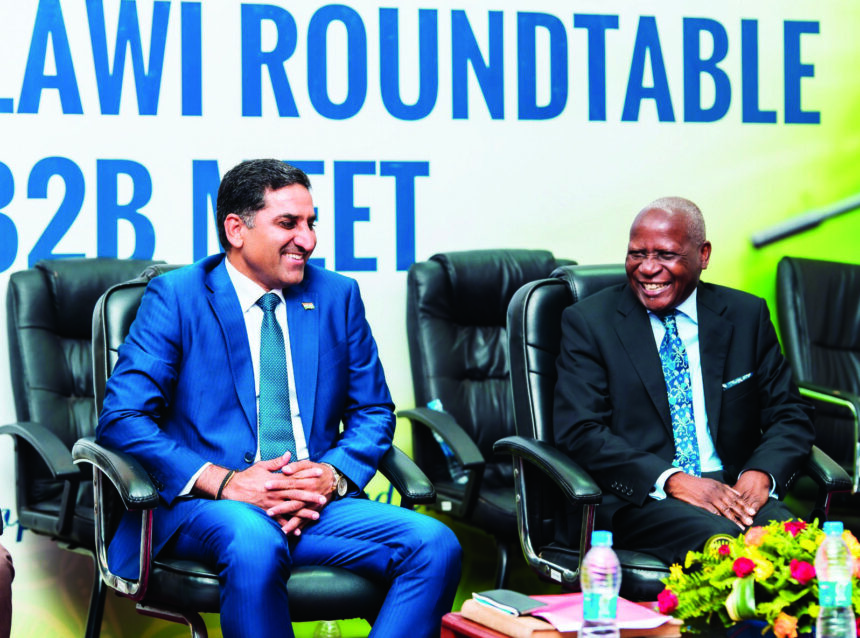
Indian High Commissioner to Malawi Amararam Gujar has said Malawi presents vast business opportunities where Indian investors can establish manufacturing operations targeting both the domestic and export market.
Gujar said this in Blantyre on Tuesday at the India–Malawi Business-to-Business meeting hosted by the Malawi Confederation of Chambers of Commerce and Industry (MCCCI).
He cited agriculture, fertiliser manufacturing, transport and fin-tech as sectors where India has advanced capacity and can expand through local investment and joint ventures.
“I encouraged my Indian delegates to look at Malawi not just as a trading partner. They should look beyond trading and invest in manufacturing by setting up their companies and joint ventures right here in Malawi,” Gujar said.
He said the move would help create jobs and boost local exports, particularly to countries in the Southern African Development Community region.
- Advertisement -
Leader of the Confederation of Indian Industry delegation, Vikas Agrawal, said India accounts for over 50 percent of Malawi’s pharmaceutical imports and there is growing interest in establishing local pharmaceutical manufacturing plants to serve both domestic and neighbouring markets.
“Malawi offers significant opportunities for applying advanced technologies to enhance food security through joint ventures in agro-processing, irrigation equipment and climate-resilient agriculture,” he said.
MCCCI President Wisely Phiri described the Malawi–India partnership as strategic, with trade between the two countries valued at about $1 billion in 2024, making India one of Malawi’s top investment partners.
Phiri said the engagement would unlock new possibilities in Malawi’s economy and pave the way for mutually beneficial and lasting partnerships.
- Advertisement -
- Advertisement -
However, he called for a more conducive business environment and supportive policies to attract more investors.
He cited punitive taxes, including the proposed K5 billion thresholds for supernormal profits, as restrictive to large investors, especially those seeking to establish manufacturing and production lines.
“When we are pushing for investors to come in, someone invests millions of dollars and then you tell them that if they make $2 million in profit, they will be charged more. Those are some of the policies we, as a chamber, have been engaging the government on,” Phiri said.
Business Minister Simon Itaye said the engagement is a practical step toward deepening ties between Malawi and India as the country accelerates industrialisation in line with the Malawi Vision 2063.
“Our interest hinges more on exports. That is why we are talking about 2063 — processing, commercialisation of agriculture and ensuring that we industrialise and export,” Itaye said.
He said Malawi is seeking partnerships that support agricultural value addition, strengthen local manufacturing, enhance access to affordable medicines and create decent jobs.
Itaye added that the government is committed to improving the business environment by simplifying regulations, promoting public-private dialogue, strengthening industrial infrastructure and facilitating trade to make Malawi a competitive investment destination.
“We are collaborating more with the Chamber of Commerce to promote trade and also look at how we can aggregate our products for export,” he said.
The Indian delegation included representatives from more than seven companies across agriculture, fin-tech, infrastructure, transport and trading sectors who engaged