







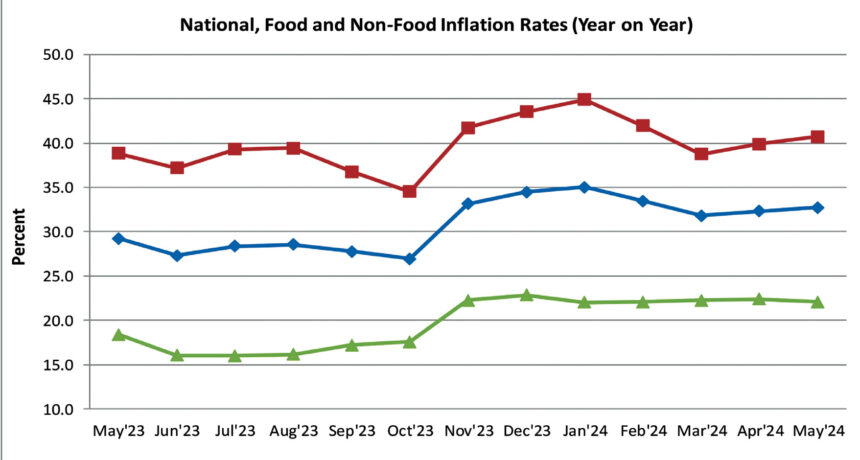
Inflation—the rate of increase in prices over a given period of time—inched up for the second successive month by 0.4 percentage points to 32.7 percent in May, figures from the National Statistical Office (NSO) show.
According to published Consumer Price Indices (CPI) for May 2024, Food and Non-Food inflation rates are at 40.7 percent and 22.1 percent, respectively.
“The national month to month inflation rate for May 2024 stands at 1.8 percent. Food inflation rate is at 2.5 percent while Non-food inflation rate is at 0.6 percent. The urban month to month inflation rate is at 2.0 percent. Urban food and non-food inflation rates stand at 3.4 percent and 0.2 percent, respectively. The rural month to month inflation rate is at 1.7 percent. Rural food and non-food inflation rates stand at 2.1 percent and 0.9 percent, respectively,” a statistical flash.
This means that Malawians continue to be stripped off buying power as commodity prices continue to rise in local markets.

In a recent interview, Economics Association of Malawi (Ecama) President Bertha Chikadza said the slight rise in overall inflation confirms that the domestic economy is still fragile.
- Advertisement -
“The effects of El Nino have not dissipated and food inflation remained elevated even in the month of March. This is what necessitated the policy rate to be maintained because inflationary pressures are still persistent. Going forward, maize prices are poised to moderate, and food inflation will moderate slightly while overall inflation is forecasted to remain elevated, with non-food inflation remaining broadly unchanged,” Chikadza said.
In a separate interview, economist Marvin Banda said inflation is expected to taper off from November onward unless there are more shocks to the macroeconomic factors that determine inflation in Malawi.
He said the month-on-month inflation is expected to decrease until we hit the trough of the agri-business cycle from whence prices begin to pick up again considering that over 53 percent of the CPI is food based.
“The rural areas are closer to a larger concentration of agricultural activities so their price effect is felt quicker than in urban areas where food is transported to.
- Advertisement -
- Advertisement -
The Agri-harvest season also has a lagged effect on food prices so with progression during the quarter we should expect decreases in month-on-month inflation,” Banda said.
Recently the Reserve Bank of Malawi (RBM) maintained the policy rate at 26 percent in an attempt to contain stubborn inflation.
A recent statement of the Monetary Policy Committee’s second meeting of 2024 published by the Central Bank, reiterates that inflation is expected to remain high, averaging 30 percent in 2024.
A recent publication by the World Bank, Africa’s Pulse, shows that Malawi has the third highest overall inflation and food-inflation rates in 2024.
Titled ‘Tackling Inequalities to Revitalise Growth and Alleviate Poverty in Africa’, the publication ranks Malawi third with overall inflation recorded at 35 percent in January and 33.5 percent in February after Zimbabwe (34.8 percent in January and 47.6 percent in February) and Sierra Leone (47.42 percent in January and 42.52 percent in February).
Malawi is also third on the list of countries with the highest food-inflation after Egypt and Sierra Leone.


