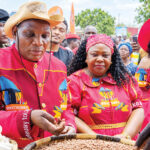


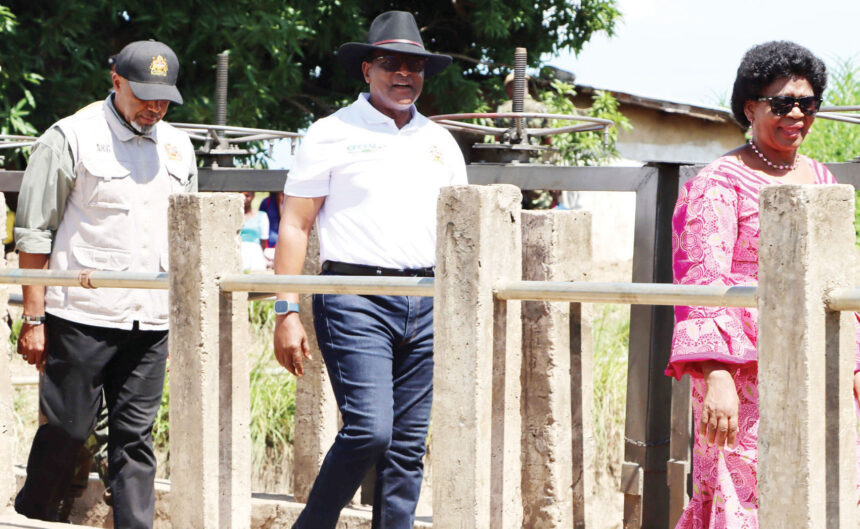
President Lazarus Chakwera has said he is hopeful that with irrigation, Karonga District could become a food basket for the Northern Region.
Chakwera made the remarks Monday at Wovwe Rice Irrigation Scheme, which was being rehabilitated by Fisd with funding from International Fund for Agricultural Development through the Programme for Rural Irrigation Development (Pride).
The President, who was in the company of Vice-President Saulos Chilima, urged farmers around the scheme to make use of it for the wellbeing of their families and the country.
“If we use these irrigation schemes properly, it will not be difficult to attain our aspirations as a nation as highlighted in the Malawi 2063 vision,” he said.
The scheme, which is about 700 hectares big, was being rehabilitated after it was destroyed by floods, reducing its production capacity to about 300 hectares.
- Advertisement -
Pride Project Coordinator Munday Makoko Pride said the scheme will benefit about 2,000 farmers in the area, which will be able to harvest rice three times circles a year.
In a cycle, farmers produce a minimum of K1 billion worth of rice, most of which is sold in Tanzania.
“The completion of this scheme means that people here will now be food secure. The rice will also be sold all over the country,” he said.
Apart from Wovwe, Pride has rehabilitated three other schemes in Karonga, namely Hara, Chonanga and Ukanga.
- Advertisement -
- Advertisement -
On the day, Chakwera also inspected Nthola Ilola Ngosi Rice project, which commenced in 2017 and is expected to be finalised in 2027.
The project involves developing 1,000 hectares of irrigable land for rice production and construction of a rice-processing factory for value addition.
Wester Kossam, Board Chairperson for the Greenbelt Authority, which is implementing the project, said its aim is to attain food and nutrition security and increase household incomes and exports.
In the morning, Chakwera visited floods survivors who are sheltering at Kambwe Evacuation Camp, where he warned against greed and corruption in the distribution of relief items.