



Clara’s story stretches the limits of credibility.
Not long ago, she struggled to keep pace with her Standard 3 classmates, her grades a testament to her perceived shortcomings.
“She consistently failed, not even making it onto the list of 80 learners who passed the end-of-term examinations,” her teacher, Esther Perekamoyo, recalls.
A typical day for Clara, 10, starts at dawn, with roosters serving as her makeshift alarm in their weathered, raw-brick home.
She prepares for school in their modest house, where the first rays of sunlight filter through the thatched roof. After completing a few household chores, Clara hurries off to school, half a kilometre away.
- Advertisement -
At school, children gather in small groups during break time, some barefoot, their feet toughened by years of walking on rough terrain.
Others carry worn-out backpacks holding their few possessions, their empty stomachs rumbling against the morning chill.
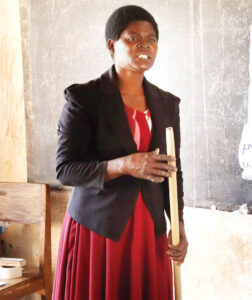
“Many come from very poor families. They lack basic necessities,” Perekamoyo explains.
Seated on the cold classroom floor, pen poised over her exercise book, Clara writes down answers to her teacher’s questions.
- Advertisement -
- Advertisement -
She gets everything right, much to Perekamoyo’s delight, who acknowledges the challenge of meeting each learner’s individual needs.
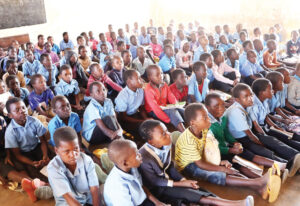
“I have over 100 learners in my class and I teach seven subjects. It is practically impossible to handle each learner individually,” the teacher whines.
A seasoned educator with a passion for nurturing young minds, Perekamoyo, who has been teaching at Clara’s school for four years now, saw potential in the little girl.
“Clara simply needed extra lessons. She has a curiosity that is infectious; that is why she is thriving,” the teacher says.
With chalk in hand and an old blackboard as her canvas, Perekamoyo stands resolute, igniting the spark of learning in her learners’ eyes with years of dedication.
In Ntcheu, known for its breathtaking landscapes, pervasive poverty grips the majority.
However, amidst this deprivation, Clara thrives, thanks to support from Save the Children, ongoing at Namanyenyezi Primary School in Mziyaludzu Zone.
Her father noticed a change in her attitude towards school.
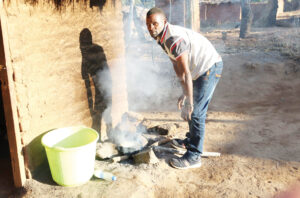
“When she started attending extra sessions, something changed. She began to enjoy studying and we supported her as best we could,” Patrick Mulireni explains.
As a rural farmer struggling to feed his family of nine, he could not afford to pay for the extra lessons elsewhere.
“She would come home with her head bowed, unable to understand why she was a constant failure. We were worried about her future,” he says with paternal concern.
On this day, we find him preparing breakfast of boiled Irish potatoes on their windswept veranda, framed by sun-baked mud walls and a weather-beaten thatched roof.
“We are caught in a cycle of poverty that seems unbreakable. We only ask for a little support so our children can flourish,” he murmurs, watching smoke curl from the fireplace.
Mulireni remembers the days Clara returned home crestfallen due to her academic struggles.
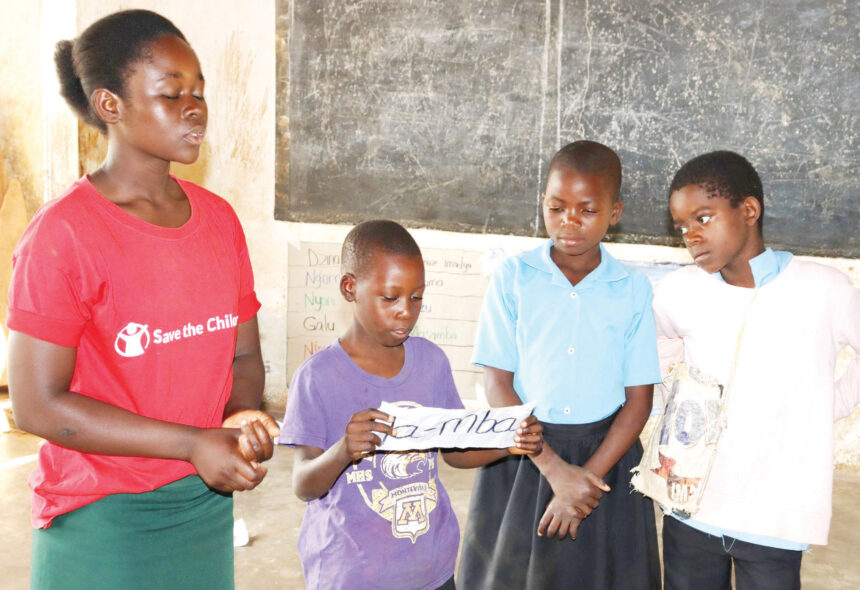
Now, with help from ‘catch-up’ clubs, where struggling learners receive extra lessons after regular school hours, the schoolgirl thrives.
“The facilitator guided me step by step,” Clara says.
She spent at least 90 minutes daily practising writing and reading, eventually graduating from the club.
Her once furrowed brow now bears a confident smile as Clara reflects on her journey from perceived failure to topping her class in examinations.
“It looked impossible. I just thought I was destined for failure,” she says.
Clara not only caught up with her classmates but soared past them in the end-of-term examinations to have her name etched on the honour roll.
Her voice steady with newfound resolve, she admits she was overwhelmed with both joy and pride.
“When I came first in last term’s examinations, I felt like I was on top of the world. It made me realise I was capable of achieving anything as long as I have enough support,” she says with a shy smile.
Save the Children initiated the after-school tutoring sessions tailored to learners like her who needed additional academic guidance.
The catch-up clubs concept exists within the organisation’s Sponsorship Abwenzi a Ana (AAA), translated as friends of children, programme to respond to an inequality and discrimination crisis for children in Ntcheu.
The lessons focus not only on academic subjects but also on building learners’ confidence.
In the classrooms, the crisp, cool air carries the faint aroma of all manner of cooked meals brought to the learners by their parents.
“Initially, we were providing refreshments to the learners in the clubs, but we noted that that would not be sustainable, so we engaged school and local leaders together with parents on that,” AAA Programme Manager Esther Gama says.
Now the parents are providing the meals for their children in the clubs.
Perekamoyo states that even after Clara has successfully been weaned from the catch-up classes, she still has a spark and hunger to perform well.
The teacher concedes that resources at the school are scarce and that many learners continue to fall through the cracks before they are enrolled for the extra lessons.
“Catch-up lessons are seeds we plant in our children’s minds. With nurturing, they grow into knowledge and skills that sustain them for life,” Perekamoyo says.
This sentiment is shared by the school’s headteacher, Florence Phangwala, who admits the school, which opened its doors in 1994, also lacks adequate teachers.
“There are just nine of us here, each handling a full class. There is little time to rest and focus can waver,” Phangwala admits, her voice cracking with frustration.
Regarding learners who were being left behind, the headteacher acknowledges struggles in attending to everyone on their own.
“Every child learns at their own pace, but some need an extra push to grasp concepts. That is where catch-up lessons come in,” Phangwala says.
She explains that the lessons are not about playing catch-up, but levelling the playing field because every child deserves a chance to succeed.

Gama says the goal of the AAA project, implemented in four traditional authorities in Ntcheu, is to ensure the children are protected from sexual violence and exploitation.
“We came in to help uplift struggling learners, knowing that education is a major tool that provides children with skills to increase employability and livelihoods chances,” Gama says.
The activity is sponsored by several donors in Italy and the United States with the budget in 2024 standing at $2.8 million (about K4.7 billion at current exchange rates).
Gama says through it, Save the Children envisages scenarios where children stay more years in school and automatically delay marriage and early pregnancies.
“After conducting an impact assessment, we found out that children with different learning challenges participating in catch-up clubs had four times chances of catching up with their colleagues than those who were not participating,” she recounts.
For Clara, it could even be 100 times, according to assessments of her performance by her instructors in the clubs.
One of them, Zefania Jamu, says in the lessons, where learners’ laughter and chatter echo against the backdrop of the quiet schoolyard, the girl discovered her worth.
“She has shown remarkable progress. Of course, other learners have significantly improved in their performance but Clara stands out,” Jamu says.
He was trained by Save the Children to be equipped with skills for handling children struggling in class and says the progress has been good so far.
The facilitator finds so much satisfaction in helping children thrive in scenarios that appear unusual.
“Hearing that a child who was struggling in class is now thriving warms my heart. I take pride in the fact that my efforts are not in vain,” Jamu narrates.
So far, the clubs have reached out to about 3,050 learners and Gama highlights the reduction in the cost of implementing the innovation as a game-changer.
She says now that parents are providing the foodstuffs to the learners, sustainability is guaranteed.
Additionally, to enable local organisations to scale up the innovations, the project is working with three of them to implement interventions that protect children’s rights.
They are Rays of Hope, Youth for Development and Productivity and Future for All. Rays of Hope is leading the ‘catch-up’ initiative in Ntcheu.
Ntcheu District Council Director of Education, Youth and Sports, Dorothy Masudi, confesses that the district lags behind in terms of education outcomes.
“School dropout rates and early marriages are rampant. Socioeconomic statuses of parents also push learners to doing work that keeps them away from school,” Masudi says.
She hails the support from organisations such as Save the Children, indicating it is changing the stories of several learners.
The education official prays the catch-up clubs innovation currently in ten schools in Ntcheu spreads to all schools in the district to meet the needs of more learners.
“Programmes like catch-up clubs are rewriting our educational narrative,” Masudi says.
Returning home after another busy school day, Clara speaks optimistically of breaking her family’s cycle of poverty.
“We are capable of wonders. We simply need a helping hand,” she says, as the hum of catch-up lessons fills the air, lessons she no longer needs.