




By Taonga Sabola in Washington D.DC., United States:
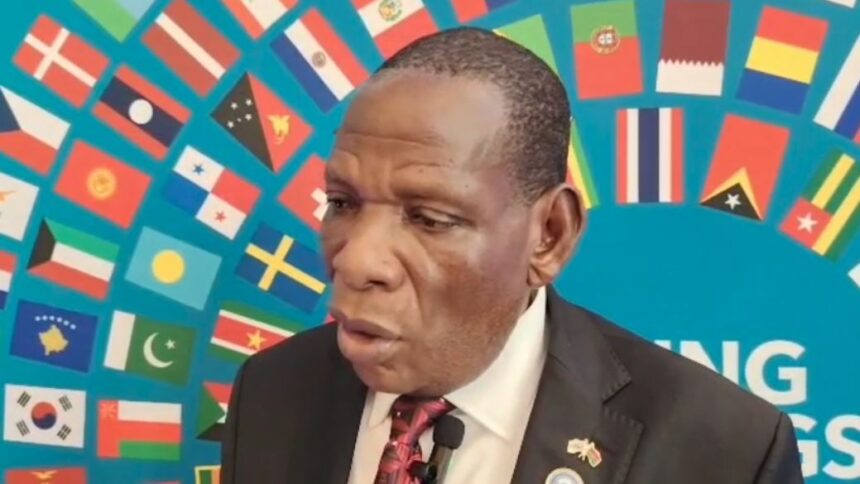
Finance Minister Joseph Mwanamvekha has appealed to the World Bank and the International Monetary Fund (IMF) for support to cushion the economy against shocks stemming from the United States (US)-Israel war with Iran.
Speaking to The Daily Times Thursday on the sidelines of the IMF/World Bank Spring Meetings in Washington, US, Mwanamvekha said discussions were progressing well, with both institutions expressing confidence in Malawi’s economic management.
He said the IMF had positively assessed the country’s macroeconomic fundamentals, including public debt, revenues, deficit, inflation and interest rates, under the administration of President Peter Mutharika.
“We also had several discussions with the World Bank. They are also happy with the performance of our economy and they are also ready to help us, in terms of giving us resources, so that we stabilise the economy but, at the same time, also address challenges that we are experiencing as a result of the war that is happening in Iran,” Mwanamvekha said.
- Advertisement -
On Tuesday, the IMF released its World Economic Outlook report.
IMF Research Department Director Pierre-Olivier Gourinchas said despite major trade disruptions and policy uncertainty, the previous year had ended on a strong note, supported by private sector resilience, lower-than-expected US tariffs, fiscal support in some countries, favourable financial conditions and a technology boom.
He said the momentum had been expected to continue into 2026, with an upward revision to global growth forecasts under consideration.
“The war in the Middle East has halted this momentum. The closing of the Strait of Hormuz and serious damage to critical energy facilities in the Middle East raised the prospect of a major energy crisis, should a durable solution not be found soon.
- Advertisement -
- Advertisement -
“Oil and gas prices have increased sharply and so have the prices of diesel and jet fuel, fertiliser, aluminium and helium,” Gourinchas said.
He said the overall impact would depend on three channels.
“First, higher commodity prices are a textbook negative supply shock: raising prices and costs, disrupting supply chains and eroding purchasing power.
“Second, these effects may be amplified as firms and workers try to recoup losses, risking wage-price spirals, especially where inflation expectations are poorly anchored.
“Third, financial conditions could tighten, with lower asset valuations, higher risk premia, capital flight, dollar appreciation, dampening demand,” he said.