By Pelumi Salako:
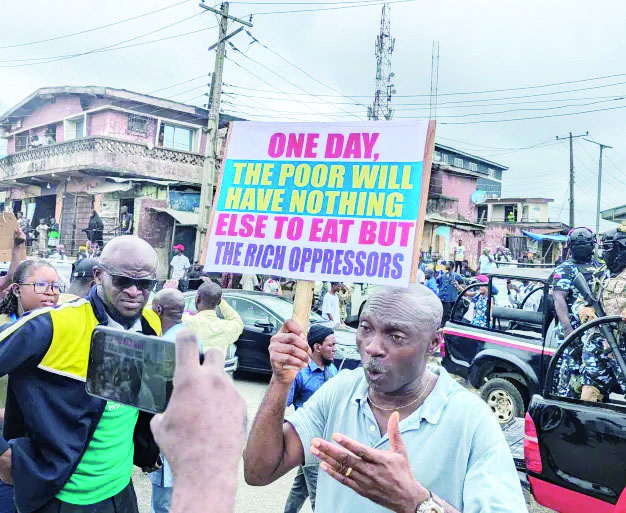
Armed with a protest sign, 20-year-old Samuel Adeleke joined a crowd of angry Nigerians gathered in Ikeja, the heart of Nigeria’s commercial capital Lagos, on Thursday morning.
Passing through nearby residential areas, the few hundred protesters raised placards decrying the high cost of food and rising cost of living, while pumping their fists in the air and chanting songs to urge more people to join them.
By the time they arrived in Ojota, the area 7.5 kilometres away where demonstrators were converging for the first of a planned 10-day-long protest, the number of demonstrators had swelled to a couple of thousand.
Tens of thousands of people across Africa’s most populous country were participating in the protests under the banner of #EndBadGovernanceInNigeria. Organisers have called for days of street demonstrations beginning on August 1 to protest against bad governance, corruption and the increasing cost of living that has left millions of Nigerians reeling. In total, protesters have 19 demands.
- Advertisement -
In parts of the country, such as the northern Kano and Yobe states, authorities imposed a curfew as some protesters attacked vehicles, burning them.
In the capital Abuja, the police fired back tear gas shells to disperse protesters, and gunshots were heard.
By Friday morning, rights group Amnesty International’s Nigeria head said at least 13 protesters had been killed, and more than 300 arrested.
Adeleke, a law student at the University of Lagos (Unilag), went out to register his displeasure with the government, which he said has put his education under threat because of its policies.
- Advertisement -
- Advertisement -
“People [in government] that got free education came into power and withdrew free education,” he told Al Jazeera, urging the government to “reverse school fees and make the nation habitable for students”.
Unilag increased university tuition fees while simultaneously instituting a rule that forbids students from doing business from their hostels, he said, which has left already vulnerable young people without sources of the much-needed income.
“Do they want them to drop out?” asked Adeleke, whose school recently raised fees by several thousand naira following the removal of a government subsidy.
In May 2023, Bola Tinubu became president of Nigeria. In the year since, Nigerians have grappled with unprecedented economic hardships owing to his decision to remove a fuel subsidy, which was introduced in the 1970s to keep petrol affordable and help the naira increase in value.
Although experts say Tinubu’s move will help rejuvenate Nigeria’s economy, it has had a biting effect on ordinary citizens whose disposable income has eroded as a result.
Food inflation in Nigeria also stands at 40 percent, the highest in nearly three decades, while unemployment maintains an upward posture, according to the Nigerian Bureau of Statistics. But economic insecurity is not the only challenge as kidnappings, terrorism and banditry pervades the country, including the capital city, Abuja.
Rising insecurity has affected protesters like Jibril Suleiman, a native of the Gwoza area in Maiduguri in Borno State – a stronghold of the armed group Boko Haram. Suleiman said he could not go home and was concerned about the suffering of his kinsmen.
“I want Nigeria to live in peace. Because of insecurity, people are dying every day in my village. People are dying because of hunger, our sisters have turned to Ashewo [Yoruba for sex worker] because of hunger. That is why we have come out here to fight for our rights,” the logistics worker told Al Jazeera.
Basic commodities have become a luxury that is out of the grasp of many Nigerians; and unexplained fuel scarcities happen every other week even as Nigeria is one of the biggest oil exporting countries. Petrol sold at 1,300 naira ($0.78) per litre this week, up from 580 naira ($0.35) earlier this month. The naira has also maintained a downward slope despite government attempts to prop it up through policies and by forceful means.
It is particularly challenging for students, many of whom struggle to pay their school fees or buy textbooks. The removal of an electricity subsidy for the highest power users in February also made matters worse. Because universities are typically large power consumers, some institutions have been unable to afford their high electricity bills, and have been disconnected from the national grid – leaving students having to find ways to work in the dark.
Last month, students at the University of Ibadan in Oyo State took to the streets to vent their frustrations, while those at the University of Ilorin in Kwara State, where student dissent is outlawed, had to write their exams without any electricity to study.
The government’s tertiary education loan scheme has meanwhile been of little help to many at the brink of dropping out due to the complex requirements needed to access it.
Basket of grievances
Away from the protest grounds on Thursday, the characteristic buzz of Lagos traffic waned – the streets were scant as many shops and businesses shut in anticipation of violence. Yet the protests were not as big as anticipated as millions of Lagosians stayed home, many to avoid getting hurt in the event of violence.
Still, armed police were visible across the city – even in places like Yaba, kilometres away from the protest zones where no demonstrations were held. Passersby chanted “no violence” at military or police convoys they passed so they’d not be triggered to shoot.