








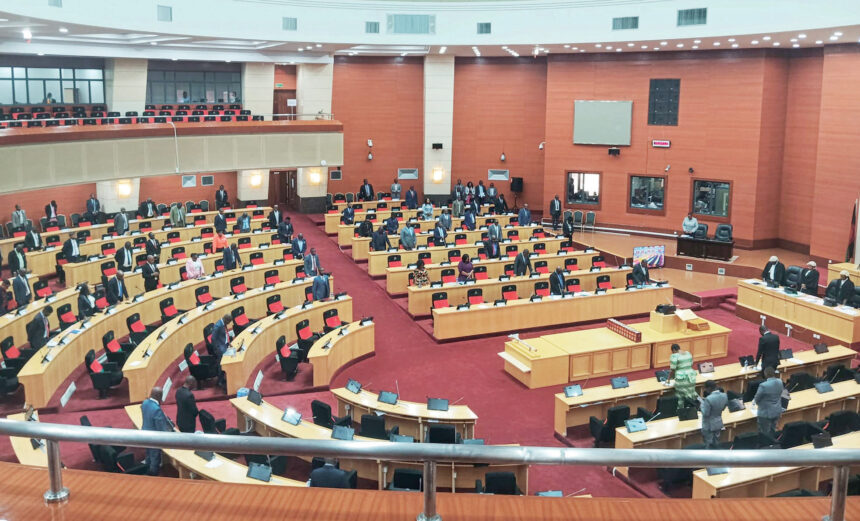
As Parliament rose indefinitely Friday at the conclusion of the two-month 2026-2027 budget meeting, the proceedings revealed a mix of progress and notable democratic gaps to fix.
Among analysts, one concern is the apparent departure from established constitutional standard regarding presidential accountability. For the first time in recent years, President Arthur Peter Mutharika did not return to Parliament to respond to questions from members, as required under Section 89 (3)(c) of the Constitution.
Traditionally, the President appears before Parliament within days after debate on the State of the Nation Address during the budget meeting.
This did not happen during this session and no Member of Parliament raised the issue, nor did the Speaker’s office provide any explanation.
Another issue that dominated early proceedings was the Public Accounts Committee (Pac) inquiry into the procurement of the Amaryllis Hotel.
- Advertisement -
The committee conducted hearings involving several stakeholders to establish the circumstances surrounding the purchase, reportedly at K128 billion.
Initially, the Pac indicated it was ready to present its findings, and the report was even listed on the Order Paper. However, in a surprising turn of events, the report was later withdrawn.
While different reasons were given, the development exposed clear divisions within the House. The opposition pushed for the report to be tabled but the government side resisted, raising concerns about concern of potential political influence in accountability processes.
These two issues—the President’s absence from parliamentary questioning and the withdrawal of the PAC report—stand out as defining features of the session’s opening phase.
- Advertisement -
- Advertisement -
On the inquiry itself, the public awaits to see what else happens. This is on account of the experience where Parliamentary inquiries have been no more than talk shows that have attracted public attention but failed on the ultimate public desire: to see those found to have been conducted themselves questionably held to account.
At the same time, the session also marked structural headache within Parliament itself. This is the first meeting with more than 220 members of Parliament, up from 193 in the previous term. While this reflects an expanded representation, it has also created operational challenges.
One such challenge has been the limited time allocated for questions to ministers. With 229 Members now in the House, it has become increasingly difficult to ensure that all MPs have a fair opportunity to ask questions, suggesting the need for reforms in parliamentary procedures.
In essence, while the House has carried out its formal duties, the first phase of the budget meeting points to deeper institutional issues. These include gaps in enforcing constitutional accountability, tensions in handling sensitive investigations, and operational strains within an expanded Parliament.
Governance expert Michael Kaiyatsa has described the last two months of the 2026-2027 budget session as a generally more structured approach to budget scrutiny, with committees playing a stronger role in interrogating sectoral allocations and fiscal priorities.


