






By Temwani Mgunda:
Global demand for Southern Africa’s unique succulent plants is fuelling an illegal trade that threatens them with extinction.
Between 2019 and May 2024, more than 1.6 million illegally harvested succulents, representing around 650 species, were seized by law enforcement in South Africa while being trafficked to overseas markets.
The figures are revealed in a recent study by Traffic, a non-governmental organisation working on the trade of wild animals and plants. Succulent exploitation raises serious environmental and conservation concerns.
- Advertisement -

Dominique Prinsloo, a lead researcher for Traffic, says “the allure of rare and exotic succulents” has exerted huge pressure, especially on wild populations from South Africa, leading to unsustainable harvesting and even extinction.
- Advertisement -
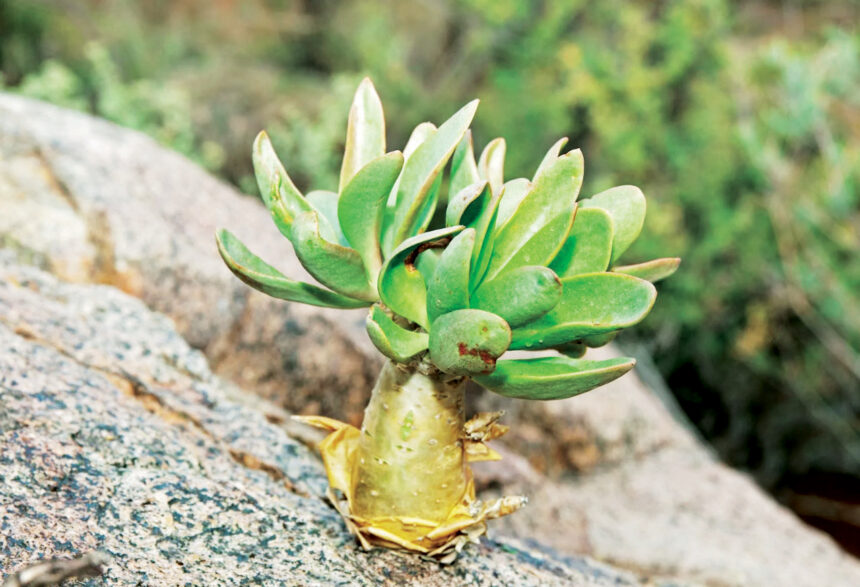
Succulent plants usually grow in arid regions and store water in their roots, leaves or stems, which makes them look fleshy and swollen.
Prinsloo says the succulents most commonly traded illegally are from the genus Conophytum, followed by the Eriospermum and Tylecodon genera.
Succulents have ecological value as habitat and economic value as food and medicine, says Carina Bruwer, a senior researcher at the Institute for Security Studies who published a study on the issue in 2023.
Bruwer observes that plants like succulents, orchids and cycads, are in high demand for their aesthetic appeal.
- Advertisement -
“In addition to being rare, many succulent species have unique characteristics such as thick stems, miniature shapes and beautiful flowers,” she tells Dialogue Earth. “These features – and their evolutionary survival skills – make them highly sought after by plant collectors and gardeners globally, resulting in the species being traded worldwide.”
Disasters also drive demand
Traffic’s report states that demand for succulents has existed since the 1990s, but that two key events may have influenced the recent surge: a drought induced by El Niño in 2015-16 and the Covid-19 pandemic.
The El Niño weather patterns triggered low and erratic rainfall throughout the Southern Africa region, which, Prinsloo says, led to higher-than-normal temperatures and a longer drought season. This sparked unexpected demand for domestic plants that do not require much water.
As for Covid, Prinsloo heard the lockdown of 2020 led to a notable shift in the players involved in the succulent trade.
Traffic’s report states that before the pandemic, foreign nationals – often from East Asia or Europe – would visit South Africa to remove plants and smuggle them back home. Since they could not travel to the region during the lockdown, they recruited local people to harvest succulents on their behalf.
“The foreign nationals might also have been afraid of the apparent high risk of getting caught as a result of the high presence of law enforcers imposing the pandemic’s restrictions,” she says.
Prinsloo adds that poaching of succulents increased during lockdown because of the economic hardship people experienced at that time. Before the pandemic, the succulents trade was rather informal, but by the time the restrictions were lifted, “it had evolved into an organised crime”.
As a result, the number of succulent plants seized drastically increased in the years following the pandemic, from 58,779 in 2019 to 329,434 in 2021.
Impacts of the trade
Numerous succulent populations in Southern Africa have declined in large numbers and many face near extinction as a result of illegal harvesting, according to Bruwer’s 2023 study.
These rapid declines triggered conservation status assessments, the study highlights. The International Union for Conservation of Nature (IUCN) then classified several species in the Succulent Karoo biome as critically endangered.
The study adds that illegal succulent harvesting also harms habitats conducive to other plants, reptiles and insects, and that such degraded landscapes become less resilient to climate change shocks.
According to Bruwer, in most communities she spoke with in South Africa, the illegal trade makes people lose “something precious, something rare”.
“Some of the people we interviewed expressed concern over losing part of their heritage and opportunities to gain a livelihood from the succulents,” she tells Dialogue Earth.
Her study mentioned two owners of plant nurseries who feel they can longer compete with the illegal trade. One has ceased trading while the other now only exports seeds.
The illegal succulents market is causing tensions to rise in communities where young people are being turned onto criminal activities, Bruwer says. While conducting her research, she heard that “farmers are becoming frustrated, and poachers are becoming more aggressive”.

There is also an impact on the broader economy. For example, an area such as South Africa’s Northern Cape province mostly depends on tourism income and is popular for its succulents and wildflowers, especially during spring.
“If these plants disappear, so will their contribution to tourism,” Bruwer says.
Actors in the trade
According to Bruwer, there are parallel legal and illegal markets for succulents that at times overlap. The legal market, she says, supplies artificially propagated plants and derivatives, while the illegal one supplies wild harvested plants and derivatives. The same nurseries are sometimes used for both.
“While legal traders observe laws and regulations controlling the succulents trade, the illegal traders manipulate or circumvent them,” Bruwer says.
The Traffic study established that some of the illegal harvesters of succulents have a criminal background linked to diamond and drug smuggling. They transitioned to succulent plants “potentially due to the perception that it is easier work”.
“There is convergence between the illegal trade in succulents and other commodities, including abalone, rhino horn, ivory, and reptiles,” the study notes.
Men do most of the poaching but women have also joined the trade in recent years, according to the study. There is also recruitment of children by their parents, reportedly because “children are less likely to receive severe punishment”.
After harvesting, the plants are passed on to middlemen and then exported. Prinsloo says based on her research, exporters are largely of Asian descent – especially Chinese nationals living in South Africa – and that most of the illegal harvesting is planned by those who are “wealthy and own property that is used for collating illegally harvested succulents”.
The researchers heard anecdotal evidence that plants are smuggled to China before being re-exported to the United States.
“Consumers range from unsuspecting online buyers who don’t know the consequences of their purchasing behaviours, to specialist collectors who knowingly look for rare or authentic wild species,” she explains, adding that most of the demand comes from the US, Europe and East Asia.
Researchers heard the “plant parenting” trend had seen demand spike, and that succulents are also popular among people living in small apartments without gardens.
Succulents are also placed in rooftop gardens of skyscrapers in China to increase the value of the building, the report states.
One interviewee said demand had drastically increased after a book dedicated to a particular genus was translated into Chinese.
According to Bruwer, much of the illegal trade currently takes place online, with most of the illegally harvested succulents in Southern Africa sourced from South Africa, Namibia and Madagascar.
Mozambique, Tanzania, Zimbabwe, Zambia, Botswana and Malawi have been implicated as transit countries in the trade.
Andrew Kachere, head of the criminal analytical unit at Interpol in Malawi, says the trade in succulents and other wildlife products is rampant in Southern Africa mainly because the region has extensive borders that are difficult to police effectively.
Corruption within law enforcement and customs agencies is part of the problem.
“As such, these spaces have become safe havens and corridors for traffickers to smuggle succulents and other wildlife products … undetected,” Kachere tells Dialogue Earth.
He adds that most countries in the region lack access to modern surveillance technologies, such as drones, satellite imagery and advanced forensic tools, to combat illegal cross-border wildlife trade.— Dialogue Earth