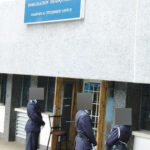




Police in Zomba Thursday used teargas to disperse protesters who turned violent and stoned law enforcers as one way of forcing them to release one of the demonstrators.
One of the protesters was arrested after he allegedly defied orders of police officers.
The arrest sparked tension, such that some of the protesters resorted to stone-throwing— leaving police with no option but to calm the situation with the tear-inducing gas.
Later, activist Bon Kalindo, who organised the demonstrations, was taken into a room at Eastern Region Police headquarters, where discussions were held.
After about three hours, Kalindo came out and claimed that the protest organisers were threatened with arrests.
- Advertisement -
“They took us into a room and, then, released us without attaching any conditions.
“We will proceed with our programme of having demonstrations in Karonga District in the Northern Region on November 28. We are also going [to hold demonstrations] in Lilongwe,” he said.
Eastern Region Police spokesperson Patrick Mussa said their role was to assess the situation and ensure that sanity prevailed in Zomba.
“We are [actually] still assessing the situation,” Mussa said.
- Advertisement -
- Advertisement -
The demonstrations were organised to remonstrate about the recent 44 percent devaluation of the Kwacha.
The demonstration started from Zomba Stadium, from where protesters started marching at 9:42am.
From there, they passed through Namiwawa and Kalimbuka roads, on their way to the M3 road, with the intention of presenting a petition to the Zomba District Commissioner’s office but were stopped at University of Malawi’s Turn off (Zomba Zero Point) when things went haywire.
This week, Democratic Progressive Party parliamentary spokesperson on finance Ralph Jooma said the recent 44 percent devaluation of the Kwacha has hit people hard, calling for cushioning measures.
The development, according to Jooma, means Malawi’s recovery hopes next year have already started diminishing.
He was quick to note that before the devaluation, authorities should have injected seed forex into the formal market to ensure that commercial banks are well stocked with forex.
“You do not do it after; you do it before,” Jooma said.