



By Barbara Plett Usher, Nomsa Maseko & Basillioh Rukanga:
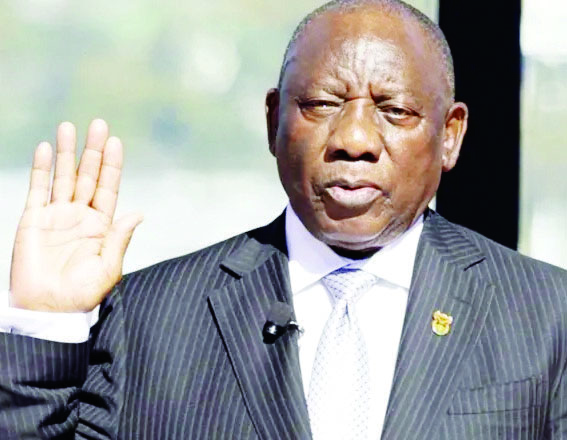
South Africa has begun a “new era”, President Cyril Ramaphosa announced as he was sworn in for a second full term in office.
He remains in office even though his party, the African National Congress (ANC), failed to secure a majority in parliament during last month’s election.
The ANC subsequently made a deal with its long-time rival Democratic Alliance (DA) and other parties to form a coalition government.
Ramaphosa hailed this government during his inauguration speech, but also warned that unless it addressed deep inequalities, the country could become unstable.
- Advertisement -
“Through the ballots that they have cast, the people of South Africa have made plain their expectation that the leaders of our country should work together,” Ramaphosa, 71, said.
“They have directed their representatives to put aside animosity and dissent, to abandon narrow interests, and to pursue together only that which benefits the nation,” he said.
A huge crowd gathered outside the official seat of government in Pretoria, waving national flags.
Under a sharp blue winter sky, the Chief Justice Raymond Zondo administered the oath of office.
- Advertisement -
- Advertisement -
“I swear I will be faithful to the Republic of South Africa… I will obey, observe and uphold the constitution and all other laws of the republic,” Ramaphosa said.
A band then played the national anthem. The rendition was followed by a 21-gun salute and a fly-past by army helicopters.
The ANC, which has governed since the end of the racist system of apartheid in 1994, lost its majority for the first time after the May 29 election produced no outright winner.
The party got 40 percent of the vote, a drop of 17 percentage points, and it lost 70 seats in parliament.
However, lawmakers re-elected Ramaphosa after the ANC made a power-sharing arrangement with the pro-business DA— which came second in the poll with 22 percent— and three smaller parties.
The ANC’s main new governing partner, the free-market DA, is ideologically at odds with the party’s social welfare traditions, and seen by many as catering to the interests of the white minority, which it denies.
But the two political opponents are focused on a common agenda of fixing the country’s infrastructure, providing basic services such as water and power and creating jobs.
The coalition is a move to the political centre because the ANC’s left-wing and populist breakaway parties rejected the invitation to join a national unity government.
Ramaphosa told South Africans the coalition was committed to reversing inequalities and growing the economy. He also warned that the country was riven with deep divisions between the haves and have-nots.