By Lola García-Ajofrín
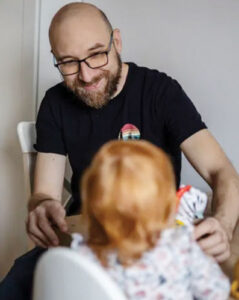
In an eastern Bucharest neighbourhood filled with apartment blocks, Oana wakes up and makes breakfast as her husband, Vlad, tends to their baby, a little girl named Mara.
After a nappy change and with full bellies, father and daughter head to the park.
Oana switches on her laptop and in a flash, the living room is transformed into an office as she hosts Zoom meetings for the public relations agency she operates.
In 2022, 36,507 fathers and 223,100 mothers took parental leave in Romania, according to data provided by Romania’s Ministry of Labor and Social Solidarity. The trend continued into 2023, with 33,689 men and 201,108 women taking parental leave between January and October.
- Advertisement -
Maternity leave is 126 days, with 85 percent of a salary paid. Paternity leave is a far shorter 15 days. But beyond these periods, either mothers or fathers can opt to take childcare leave until their infant blossoms into a two-year-old toddler.
Typically, mothers take childcare leave.
“[But] I am 40 and I feel that I have accomplished enough things, so I would not be frustrated for being home for a while with my daughter,” said Vlad, explaining why Oana’s career was prioritised.
At 33, she has just started her own communications company.
- Advertisement -
- Advertisement -
“I run a small business, and I could not put it on pause for two years,” Oana said.
Most of her income comes from the company’s earnings. Parental and childcare allowance only applies to salaries.
Romania’s parental leave is among Europe’s longest. By comparison, women in Austria receive 16 weeks of paid maternity leave, after which either parent can take unpaid parental leave until the child is two. In Bulgaria, paid maternity leave is 58 weeks. When it comes to fathers, Spain is home to the longest paternity leave in Europe, which at 16 weeks is the same for maternity.
Sergiu, a 24-year-old father in Brasov, is also on parental leave, looking after his one-year-old.
“The first six months we managed things together. Since then, I am in charge,” Sergiu said proudly.
His partner is 20 and studying medicine.
“We agreed she could follow further more classes if stay home with the toddler,” he said.
For Gabriela, 34, an actress who gave birth in October, and her partner, Silviu, 34, a pharmacist manager, there was only one option.
“I am a freelancer, and in Romania if you don’t work under a permanent contract, you are inexistent for fiscal administration,” said Gabriela.
“The most challenging part will be not to go to work”, said Silviu, who started his leave allowance in January. “And for the rest, we will wait and see what happens.”
“We go with the flow but I don’t think we found a rhythm yet,” Gabriela said, adding that while grandparents visit, the bulk of the childcare is down to them.
Sweden’s parental package is considered pioneering: paid leave for 480 days. Fathers who enjoy the time to look after their children, often with a coffee in hand, have been nicknamed “latte dads”.
Romania’s latte dads can usually be seen in parks.
While playing with Mara on a seesaw, Vlad said their decision will be useful in the long term, “for the relationship I am building with my daughter”.
Near them, another two fathers play with their respective children.
“I did not have something like this with my father,” he said.
Diana, meanwhile, opted to take the extended leave because in her family, she’s the higher earner.
“This two-year parental leave is a blessing”, said Diana. “I have a permanent job and a better salary.”
But in a quip that could be heard among mothers the world over, she added: “Among all my female friends there is a lot of frustration because we are doing everything … It is so easy having children when playing is the only thing you do with them.”
Raluca Popescu, a sociology professor at the University of Bucharest, said it is “remarkable” that men often choose to take parental leave, “especially in rural areas”.
While she would like to think that this trend could represent a better work-life balance, “considering the whole picture of gender equality in Romania, this explanation becomes hard to believe”.
Popescu, who was pregnant when she was researching parental leave, said men are more involved now rather as a “strategy of adaptation to the lack of resources”.
In many cases, men are more likely to be the only employed partner in the household, meaning they can benefit from paid allowance. In other cases, they probably earn less than the mother and so a decision is made to sacrifice some of his salary instead, she said.
Romania’s parental leave is the expression of reforms throughout history, from socialism until the country’s entry into the European Union.
Professor Anca Dohotariu, who has studied maternity leave, said that during the socialist era, Nicolae Ceausescu, the former authoritarian president, aimed to boost the Romanian population by implementing a strict pro-natalist policy and limiting abortion, while also exerting pressure on women’s participation in the workforce.
“We got this very long maternity leave, but they were more interested in children than in women’s position in the labour market,” Dohotariu said. “They were obsessed with the needs of children.”
She lauded the current parental leave as providing an incentive to fathers, but warned “it is not enough to make sure that fathers get more involved in parental obligations”.— Al Jazeera