Lack of access to cheap and patient capital finance has been a challenge facing the small and medium enterprise (SME) sector since time immemorial in Malawi.
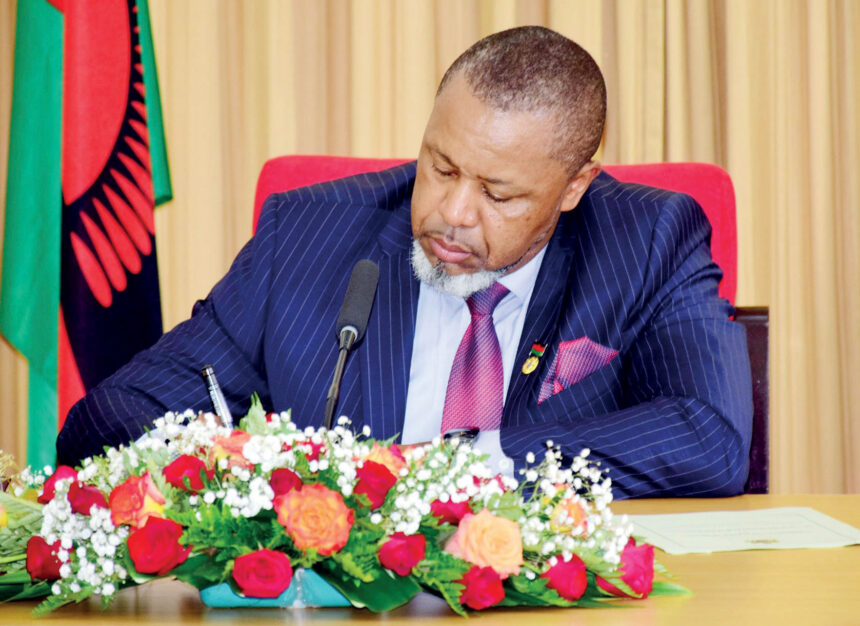
Departed Vice President Saulos Chilima was one of the people who vehemently spoke against the current interest rate regime for impinging growth of SMEs and economic growth in general.
As his remains will be laid to rest Monday at Nsipe in Ntcheu, the conditions have not changed a bit and proponents of the idea will never have a strong voice that brings the hope for a fairer interest rate regime.
Currently, lending interest rates hover around 31 percent while saving interest rates are averaging 4.3 percent, giving a spread of over 26 percent.
Irked by such trends, Chilima said at the Economics Association of Malawi (Ecama) annual conference on November 11 2021 that interest rates must come down and that this must be non-negotiable for the banks.
- Advertisement -
He took to his social media pages after delivering a strong speech against the trend at the conference stressing that the Reserve Bank of Malawi must engage banks on the issue as a matter of urgency.
“If moral Suasion will not work, the Governor must issue a directive. Otherwise, our efforts to develop Malawi will be derailed. SMEs and businesses are not thriving. I have also proposed to the Reserve Bank to consider capping the interest spread, stressing that if banks raise the lending rates, they must also pass-through the same to depositors.
“I recalled at the conference that in the 1980s, Malawi had only two banks and then lending rates averaged 19.1 percent while deposit rates averaged 11.5 percent, thus providing a spread of 7.6 percent. As the financial sector opened up, one would have expected competition to force the narrowing of the spread. Yet this is not the case. Hence my call for a directive if negotiation will not replace confrontation with the banks. We have people to serve and a country to run,” Chilima said.
Surprisingly, nothing changed despite Chilima’s call.
- Advertisement -
- Advertisement -
The current interest rate regime has shown its ugly face on well-meaning Malawians who in extreme cases have seen their business empires shrinking to the ground.

One such entrepreneur is Mike Chilewe of Mike’s Trading. Narrating his story in Times Exclusive TV show on TTV earlier, Chilewe explained how he got a K100 million loan to finish an ambitious hotel project which was at 60 percent completion.
Things did not go exactly according to his plan and with the passage of time, he found himself owing the bank K1 billion. The principal of K100 million attracted an interest and penalties of K900 million.
He narrated that when he failed to service the loan, the bank valued the hotel at K405 million and sold it at around K450 but it was not enough, Mike’s Trading was eventually sold to pay the remaining balance.
The ripple effect is increased unemployment, rising poverty levels and a dwarfed economy among other things.
General Secretary for the Financial Market Dealers Association (Fimda) James Mbingwa believes the wide interest rate spread may be mainly attributed to the prevailing macro-fiscal conditions which determine direction of the Policy rate.
He said this informs the reference rate (the Lombard rate), which is benchmarked on the policy rate and has the highest weight in the calculation of the reference rate which is now used as a benchmark interest rate for lending.
“The Lombard rate contributes the highest weight of 64.80% in the determination of the market reference rate, which in turn determines overall lending rates). As the Policy rate is increased therefore, so do lending rates,” Mbingwa said.
He added that the higher operational costs that banks incur to provide financial services are worth considering in the prevailing wide spread.
Mbingwa said once these inefficiencies are reduced, we should anticipate the margin to improve as is the case in Western economies.
When all is said and done there is need to soberly rethink the interest rate regime in the country and reflect on Chilima’s suggestions to build a better and prosperous Malawi.
Aspirations in the Malawi 2063 will require heavy investments in various fields which require cheap loans. Those that are into saving need encouraging through rewarding interest rates from commercial banks.