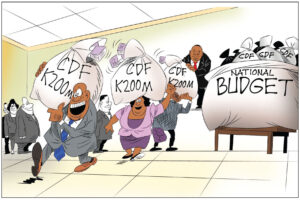
 One of the biggest winners—like they have always turned out to be—in the 2024-25 national budget whose statement Finance Minister Simplex Chithyola Banda presented in Parliament Friday last week are members of Parliament (MPs).
The Constituency Development Fund (CDF), which is heavily controlled by the lawmakers, has been hiked by 100 percent, from K100 million to K200 million.
The vote under which the allocation falls will pass at the speed of light as long as the MPs are content with the other titbits.
In fact, there have been provisions in the budget that have not been subjected to the strenuous scrutiny required for a national financial blueprint if they are to the MPs’ advantages.
Information just comes out in spurts about the agreement that have been surreptitiously reached by both sides, especially those to do with personal benefits.
- Advertisement -
That is why it was not strange to see and hear members across both sides of the aisle giving Chithyola Banda a standing ovation after he had announced the doubling of CDF.
In fact, while CDF has proved effective in countries such as Kenya, according to various studies, its introduction in Malawi in 2006 might not have been out of necessity but as a bargaining tool for the late Bingu wa Mutharika’s administration to coerce opposition MPs to pass the budget.
They were in large numbers and were giving Mutharika a tough time.
Observers state that CDF tremendously pacifies the legislators across the political divide because it practically serves their interests which are central to building their political careers without having to dig deeper into their own pockets.
- Advertisement -
- Advertisement -
We have seen how the MPs have turned CDF-funded projects into their own success stories and resist the fact of acknowledging the money used never came from their private vaults.
In fact, studies have also shown that CDF is one of the most abused funds.
The parliamentarians themselves do not deny this but feel the over-generalisation is unfortunate.
They sometimes claim that even if funds are mismanaged by council secretariats (the District Commissioner remains the controlling officer of CDF), the MPs are hauled over the hot coals due to their positions of influence.
Well, truth remains that some of the MPs have been forced to redo or trigger the redoing of some CDF-funded projects after accountability projects have exposed shortcomings in the work.
That is why a lot of attention is being paid to CDF these days.
It is even disastrous to see that a fund that rarely produces the desired change in communities is being prioritised when several government agencies are complaining that their proposed allocations have been severely reduced.
Crucial projects such as road rehabilitation have had their ceilings reduced.
Yet, there even is no guarantee that the reduced ceilings themselves will be reached, for we have seen several projects not being funded even if their names appear in the national budget.
On the other hand, there has never been an instance where funds have not been provided for CDF. It would not just work with the MPs.
It is always about them, them, them them…
And as we march closer to the September 2025 general elections, the CDF appeasement policy is going to gain more traction.
Our MPs will be pushing for more and more money into the fund so that they can implement more projects in their constituencies using taxes and later claim they brought development to their areas.
CDF will once again oil their campaign wheels and they will continue using it to woo voters until the day of the election.
But there has been some change in recent years and voters are not as gullible as they used to be.
Accountability and transparency projects are opening the electorate’s eyes. People are able to see that the money someone claims to have used to bring development to their areas is actually their taxes.
Of course, we all know nothing will stop our selfish MPs from pushing for anything that sustains their positions and work.
But we will continue reminding Malawians that not all of them care about them.
Some have not even allowed the utilisation of CDF to pay school fees for needy students in their constituencies—under the bursary component—and cannot point at anything worthwhile which CDF has funded.
Others have even influenced the award of contracts to their relations or cronies without declaring business interest as required by law.
There still are those who have used CDF to take development projects to sides of their constituencies which they feel give them more votes than any other section.