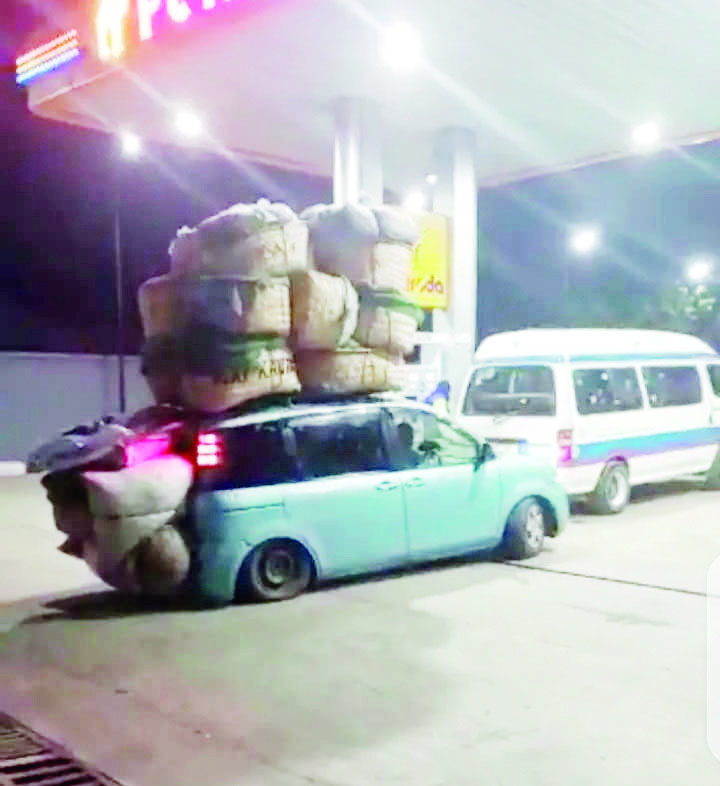
Police will say they enforce traffic laws but everyone who sees how some Sienta drivers break those laws on the watch of traffic police officers will ask what laws the traffic police are enforcing.
For a start, travel along the Bakili Muluzi Highway from Liwonde through Nsanama and Ntaja to Chiponde; or the M5 Road which connects Salima and Balaka districts; or the Peter Mutharika Highway which stretches between Liwonde and Mangochi.
Along these routes, one is likely to find fixed road blocks or impromptu ones mounted by traffic police roadblocks. On the same roads ply Sientas packed to a breaking point.
You find more than half a dozen of people inside, an overload of bags of maize at the back and another on the roof that is not designed to carry goods at all.
Over the past few weeks, we have been to these roads observing Sientas huffing and puffing with loads that weigh beyond the vehicles capacity, with people and babies squashed inside like fish.
- Advertisement -
At traffic police roadblocks, officers wave them on to pass – without question.
Chisomo Kunje, 32, uses this mode of transport to reach his home village in Bilila from Golomoti where he conducts fish business. He expressed concern about the risks regarding this kind of travel.
But he said there is nothing people could do about it because the taxi drivers do not allow to be lectured about traffic rules.
“We are frustrated when they pack us in this way. However, there is nothing we can do because I think these taxi drivers have made it as their rule not to be broken,” he said.
- Advertisement -
- Advertisement -
He suspected there is a “strong connection between taxi drivers and traffic officers” along the route.
“I feel so because these drivers are not given punishment at all for exceeding capacity,” he said.
Along all the routes, commuters sounded as helpless. We contacted the Directorate of Road Traffic and Safety Services (DRTSS) on why it has let Sientas on the loose.
Spokesperson for the department, Angellina Makwecha, admitted the problem, saying it is common for saloons generally to carry more passengers than their allocated capacity. According to her, officers do crack down on these traffic violations.
“Certainly, during our routine enforcement exercises, in these situations, relevant fines are imposed (and the fine is K10, 000 per extra passenger), and also drivers are forced to have the extra passengers disembark, ensuring their compliance with the approved seating capacity regulations,” she said.
Makwecha further said the department would continue its efforts to ensure motorists adhere to all road traffic rules and regulations.
“We will consistently impose penalties on drivers who violate seating capacity regulations and mandate the removal of excess passengers before permitting the driver to proceed,” Makwecha said.
But she also charged the passengers with the responsibility of ensuring their safety when using these taxis.
“This shall include choosing a registered taxi, avoiding being overloaded and ensuring that they are being driven by someone who is adhering to road traffic rules and regulations,” she said.
Executive Director for Consumers Association of Malawi (Cama), John Kapito, also laid the blame on commuters themselves.
“The traffic police do provide information on traffic laws and it is common sense for each and every commuter that you cannot sit four passengers in front of a Sienta,” he said. According to Kapito, taxi service users should not be forced into travelling in such unacceptable conditions.
He said it is the responsibility of travellers to choose the taxi to travel in at the place of boarding where traffic police officers are not available to enforce traffic regulations.
“Consumers have the responsibility over their own safety,” he said. But he also called on the traffic police to enforce the regulations on the reckless drivers of these vehicles along the way.
According to the World Health Organization, road traffic crashes result in the deaths of an estimated 1.3 million people around the world each year. These accidents leave between 20 and 50 million people with non-fatal injuries. It says developing economies record higher rates of road traffic injuries, with 93 percent of fatalities coming from low- and middle-income countries.
“In addition to the human suffering caused by road traffic injuries, they also incur a heavy economic burden on victims and their families, both through treatment costs for the injured and through loss of productivity of those killed or disabled.
“More broadly, road traffic injuries have a serious impact on national economies, costing countries 3 percent of their annual gross domestic product,” says the WHO.