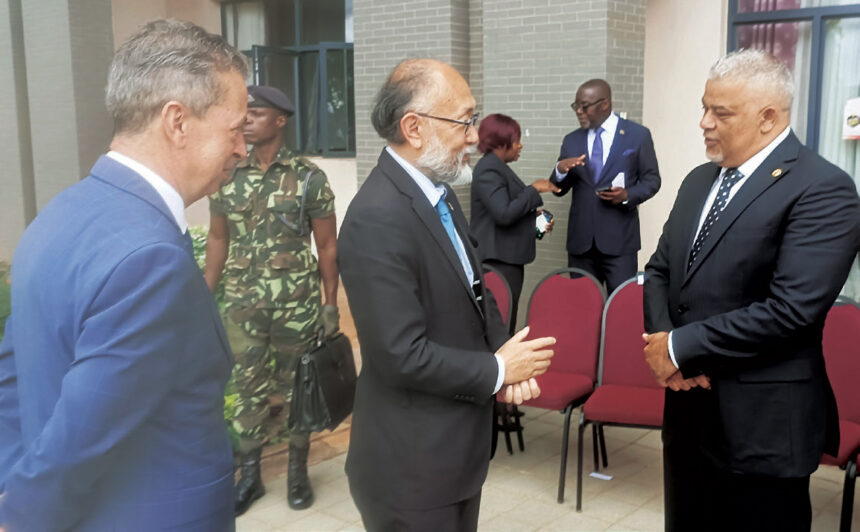
Speaker of Parliament Sameer Suleman has said the legislature will intensify its oversight role by initiating and completing a series of inquiries aimed at strengthening government accountability.
Speaking in Lilongwe Wednesday during a breakfast meeting with various development partners in Malawi, Suleman said faster national development could be achieved if efforts to tackle corruption were stepped up.
He called on development partners to support Parliament in ways that would protect its independence and enhance its ability to carry out scrutiny effectively.
“As you are aware, parliamentary committees have undertaken public inquiries, and key reforms such as upgrading chamber systems have begun to modernise our practice. Yet progress has been uneven,” he said.
“Too often, such inquiries have raised public expectations without the necessary follow-through. These gaps weaken confidence in our institution and reduce the impact of our oversight work.”
- Advertisement -
The Speaker pointed to recent findings, including the 2024 Afrobarometer survey, which he said painted a gloomy picture of public trust in Parliament.
More than 40 percent of Malawians, he noted, expressed little or no trust in the legislature, while over 54 percent disapproved of the performance of their Members of Parliament.
“Nearly half of our citizens believe MPs never listen to their concerns, and an overwhelming 88 percent have never contacted their MP,” he said.
“These figures are not mere statistics. They signal a widening gap between Parliament and the people we are elected to serve. We must not ignore this message.”
- Advertisement -
- Advertisement -
Suleman added that the disconnect reflected deeper structural challenges within the broader political system, particularly the limited institutionalisation of political parties.
“When political parties are not sufficiently programmatic, internally democratic, or policy-driven, the consequences are evident in parliamentary functions.
“Weakly institutionalised parties tend to prioritise short-term mobilisation over long-term policy coherence and provide limited support to their members in research, policy development and constituency engagement,” he said.
Charles Anikwe, Officer-in- Charge at the United Nations Development Programme, said the discussions were taking place at a time of mounting pressure on public finances and growing public frustration.
He said fiscal strain, rising debt and increasing citizen expectations had heightened the need for strong parliamentary oversight.
“Too often, when citizens hear of mismanaged funds or delayed services, they ask not only ‘what happened?’ but ‘who is watching?’” he said.
“That question lies at the heart of this engagement. A robust and effective parliament, capable of asking difficult questions and following through with evidence-based recommendations, is one of the strongest safeguards against waste, corruption and declining public trust.”