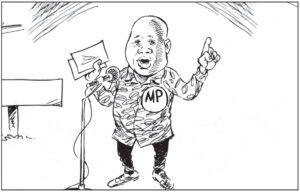
 As Malawi prepares for the 2025 elections, the political landscape is witnessing an alarming trend: a growing tendency among politicians to create ‘no-go zones’ for political campaigns.
This development poses a big challenge to the democratic process, as it undermines the fundamental rights of citizens to freely engage in political discourse, participate in rallies and make informed choices.
While such behaviour may seem like a strategy to consolidate power in certain areas, it creates a dangerous precedent, fuelling political intolerance and heightening tensions across the nation.
Historically, the creation of no-go zones has had dire consequences.
In the past, this approach has sparked bloody skirmishes between rival political factions, resulting in the injury and sometimes death of innocent citizens.
- Advertisement -
The use of intimidation, violence and force to control campaign spaces is not only unconstitutional but also a violation of the rights of Malawians to engage in peaceful political activities.
These actions, which occur in the heat of political competition, have far-reaching consequences for social cohesion, peace and the integrity of the electoral process.
It is crucial for politicians and political parties to change their approach and focus on preaching unity and coexistence.
In a democratic society, politicians are entrusted with the responsibility to lead by example.
- Advertisement -
- Advertisement -
They must rise above narrow partisan interests and promote messages that foster unity, inclusivity and dialogue.
Divisive tactics that undermine the trust and unity of the electorate should be rejected in favour of a more collaborative and forward-thinking approach.
Politicians must be reminded that their primary role is to serve the people, not to incite divisions among them for selfish gain.
Every Malawian has the right to campaign in any part of the country, regardless of the region’s perceived political leanings.
Whether a region is considered a stronghold of one party or another, no group has the right to monopolise political spaces.
A vibrant democracy requires the free exchange of ideas, where people from diverse political backgrounds can engage in healthy debates and make choices based on their beliefs and preferences.
The idea that some regions are off-limits to political campaigning is an affront to the very principles of democracy and fairness.
All Malawians, no matter where they live, deserve to participate fully in the electoral process, free from the fear of violence or intimidation.
Equally important is the need to move beyond the politics of intimidation, which has plagued the country for too long.
Historically, politicians have resorted to threats, violence and coercion to manipulate electoral outcomes.
Such tactics are not only morally indefensible but also destructive to the fabric of society.
Politics should be about ideas, policies and the betterment of the people, not about creating an atmosphere of fear or tension.
It is time for politicians to let go of divisive and dangerous practices that sow discord and instead work towards fostering an environment where all citizens feel empowered to engage in the political process without fear of retribution.
Sentiments that propagate violence may seem insignificant at first, but they have the potential to escalate into much larger conflicts, particularly when people begin to act upon the encouragement of their political leaders.
Political leaders who use inflammatory language or implicitly endorse violence risk stoking animosities that could have a lasting impact on social harmony.
What begins as a few scattered incidents can snowball into widespread violence.
Therefore, it is critical for political leaders to understand the consequences of their words and actions as they have the power to either de-escalate or intensify tensions.
The role of young people in the political process is also of paramount importance.
Too often, politicians exploit the vulnerabilities of young people, using them as tools for violence and intimidation.
These youths are sometimes manipulated into becoming instruments of terror and participate in violent acts that they may not fully understand or agree with.
It is essential for young people to resist such inducements and recognise the long-term damage that can be caused by participating in politically motivated violence.
Instead of being used as pawns in the pursuit of political power, young people should embrace their roles as agents of change and advocate for peaceful solutions, dialogue and unity.
Additionally, the police have a critical responsibility to ensure that those who engage in acts of violence or incite conflict are held accountable.
This requires a commitment to impartiality, professionalism and fairness in enforcing the law.
In previous elections, there have been instances where political violence went unpunished, sending a dangerous message to perpetrators that their actions would be tolerated.
In the lead-up to the 2025 elections, it is imperative that the police take swift and decisive action against those who seek to disrupt the peace and stability of the nation.
Peace is a precious commodity and every Malawian has a stake in ensuring that it is preserved.
Politicians, citizens and law enforcement must work together to create an environment where peace is the cornerstone of the electoral process.
A peaceful election season is not only necessary for the integrity of the election but also for the well-being of the country as a whole.
Ultimately, elections should not divide us; rather, they should be an opportunity for us to come together and choose leaders who will work for the betterment of all Malawians.