By Isaac Salima:
Some political parties and civil society organisations (CSOs) Tuesday once again expressed unease over the use of the Elections Management Device (EMD) for transmitting results in this year’s general elections.
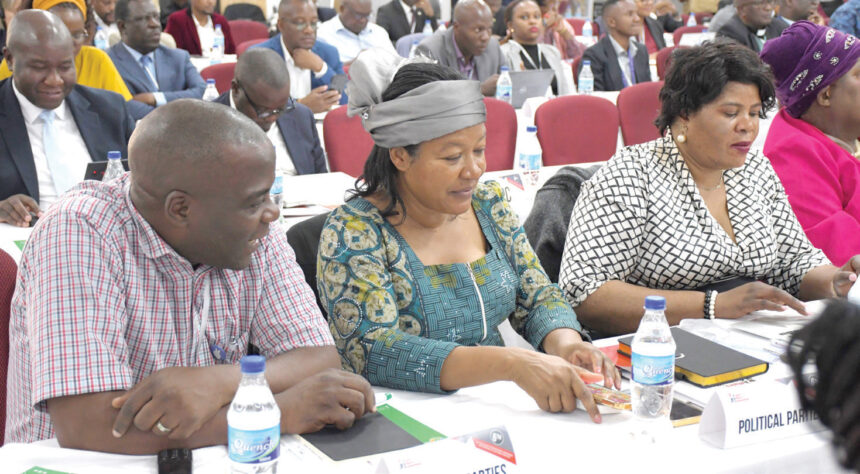
This issue has been the subject of considerable controversy in previous election-related discussions and was once again the main point of contention at the All-Inclusive Stakeholders Conference, convened by the Public Affairs Committee (Pac) in Blantyre from Tuesday to Wednesday.
For approximately six hours, stakeholders took turns expressing concerns about the system, while the Malawi Electoral Commission (Mec) stood firm in its support for the EMD.
The debate began with a presentation by Mec Chief Elections Officer Andrew Mpesi, who, outlining the commission’s state of preparedness, told attendees that vote counting would be conducted manually.
- Advertisement -
“Voting will be conducted using ballot papers and counting will begin immediately after polling stations close on September 16. Once the votes are counted, the results will be displayed publicly before being transmitted,” Mpesi said.
Responding to calls for an audit of Mec’s systems, Mpesi said five political parties had submitted their proposed scope of work and that Mec would consider the request.
Democratic Progressive Party (DPP) Director of Elections Jean Mathanga reiterated her party’s demand for a manual results transmission process.
Her stance was supported by Aisha Mambo Adams of the United Democratic Front.
- Advertisement -
- Advertisement -
In response, Mec Chairperson Annabel Mtalimanja said that the commission would engage political parties and other stakeholders to understand their concerns.
“We will consult the political parties to hear why they prefer a manual system. The laws governing election management require us to engage stakeholders when they raise concerns. However, this does not mean they will dictate our actions,” she said.
Nevertheless, Mtalimanja reiterated that Mec would retain a hybrid system for transmitting results.
She explained that this approach is guided by policy documents which stipulate the use of a hybrid model.
The Mec chairperson also condemned what she described as the spread of misinformation on social media and by political parties, warning that such behaviour could discourage voter participation.
Both CSOs and some political parties have voiced concern over the use of the EMD, which was supplied by the Dutch firm Smartmatic, claiming it is prone to manipulation.
The meeting, initially scheduled to end at 17:30, continued until around 20:00 due to the volume of questions concerning the EMD.
Malawi Congress Party deputy spokesperson Ken Msonda, however, said that his party was comfortable with the system.
In contrast, DPP Director of Women Mary Navicha threatened to mobilise women to march naked in protest.
In her opening remarks, acting United Nations Malawi Resident Coordinator Nelida Rodrigues said the conference provided a platform to address concerns ahead of the elections.
“Free, fair and peaceful elections are the bedrock of democracy, yet electoral disputes, often resulting from mistrust, unfair processes or contested outcomes, can undermine stability.
“The United Nations stands with Malawi in supporting dialogue to prevent grievances and identify potential flashpoints before they escalate. This inclusive platform, bringing together government, political parties and civil society, is a testament to Malawi’s commitment to maintaining peace through collaboration,” Rodrigues said.
Pac Chairperson Patrick Thawale also underscored the importance of the conference.
“This meeting will help clarify misunderstandings and address allegations, such as concerns over the elections management system. The Reserve Bank of Malawi will also confirm whether funds for the elections are available,” he said.
In a separate interview with The Daily Times, Centre for Multiparty Democracy (CMD) Executive Director Boniface Chibwana expressed hope that the conference would address several key issues.
Chibwana—whose organisation brings together political parties to discuss matters of mutual interest— acknowledged that CMD had previously engaged the parties, but noted that divergent views were inevitable.
“However, when it comes to the management of elections in this country, the role of Mec is central. So yes, we engage with them.
“But it is also important to understand that we deal with the leadership of political parties, those within the CMD platform. And when you look across the broader political landscape, there are many different levels and structures,” Chibwana said.
He also highlighted the possibility that messages discussed at the leadership level may not always filter down effectively, potentially leading to misinterpretation or misrepresentation of facts.
The conference continues today, with the Malawi Police Service, through the Inspector General, expected to outline its role during the electoral process and how it cooperates with the Malawi Defence Force.