










By Percy Zvomuya:
Of all my records by Zimbabwean musicians, the one I treasure the most is Thomas Mapfumo’s crackly 7-inch single with “Kuyaura” on side A and “Zvanyadza” on the flip side.
Released in 1979, towards the denouement of the war for African freedom in white-ruled Rhodesia, the song is a template for Mapfumo’s later achievements until his retirement gig in Leicester, England, in June 2023.
Over his chief collaborator Jonah Sithole’s mbira-guitar strumming, he vocalises the troubles of the land, nhamodzenyika, borrowing his yodelling vocal techniques from the Shona repertoire.
On the single, Mapfumo is direct and confrontational – as if seized by the spirit of chimurenga (the Shona word for revolutionary struggle) – eschewing coded political lyrics that, if called in by the Special Branch of the Rhodesian police, he could plausibly deny.
- Advertisement -
He invoking the dead nationalists Samuel Parirenyatwa, the first African doctor in then Southern Rhodesia and deputy president of the Zimbabwe African People’s Union at the time of his death in 1962; and Herbert Chitepo, the University of Fort Hare-trained lawyer and nationalist, and Zanu’s chairman at the time of his assassination in March 1975.
In one verse he calls on the country’s witches and wizards to bewitch the enemy which, in those charged times, was unambiguously the white settler government.
It’s not a surprise that he was indeed called in by the police and imprisoned for several months.
Mapfumo was only released after he agreed to play at a rally for Bishop Abel Muzorewa, co-leader (with Ian Smith) of a sham compromise state called Zimbabwe-Rhodesia.
- Advertisement -
- Advertisement -
Mapfumo had abandoned doing covers of Western music only at the turn of the 1970s: this journey, from Elvis Presley impersonator to prisoner of conscience in Smith’s jail in just under a decade, is a phenomenal trajectory.
In 1975, on winning a talent contest for his song “Torayi Mapadza”, an exhortation to go farm, Mapfumo told African Parade: “Before, we were carried away by pop, soul and Motown … now we want something different, something that identifies the African with his kind of music. It’s just a beginning, mind you, but the future for this kind of music is great!” So it was that chimurenga music was born.
After 1980, Mapfumo and Sithole, his musical soulmate and long-time collaborator, perfected the mbira-to-guitar sound, a transposition African musicians in Rhodesia had been attempting ever since western instruments started making their way into Rhodesia in the 1930s. It was realised only in the 1970s.
Although it was with Sithole that the sound was achieved, the experiments had begun with the guitarist Joshua Hlomayi Dube in the Hallelujah Chicken Run Band.
A string of albums followed, including the 1985 Chimurenga for Justice, an album notable for Mapfumo’s experimentations with reggae on the song “Mugarandega” – the first Zimbabwean musician to include Jamaican dancehall-style chanting.
Other notable albums include the 1987 Zimbabwe-Mozambique, a dirge for the recently slain Mozambican president, Samora Machel.
The title track Zimbabwe-Mozambique is a sonic triptych that begins with martial cacophony of the cymbal hit, before it slows down to the slow riddims of rock-steady tune, then gathers speed, fired up by ska-like horn sounds, before concluding with a drum-based jit sound.
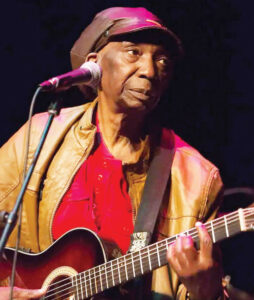
Besides his musical innovations, Mapfumo was a leading voice against graft as heard on his 1988 reggae song “Corruption” (with side B a dub version). That was one of the few songs he sang in English, whose hegemony he would rail against on the tune, “Vanhu Vekwedu” on Hondo, his 1991 album.
The chimurenga man was decrying the hegemony of American pop on national radio and the secondary place local languages occupied in the hierarchy of lingos, deftly condensing the polemics of Ngugi’s Decolonising the Mind: The Politics of Language in African Literature into just over seven minutes.
Mapfumo is the great modernizer. Not only did he reinterpret old Shona mbira standards in Western band formats, but he made it possible for the mbira instrument to stake a claim on the band stage.
He felt the mbira’s sound was muted and overwhelmed by the sounds of other instruments. The mbira wasn’t going to be just a stylised prop on the band stage.
Working with the late mbira maker Chris Mhlanga, they found a way to configure a built-in audio pick and phono jack to amplify the sound and make it an equal to the other instruments in the band, literally running electricity through the instrument. Through this innovation the mbira, the sacred instrument of music of the ancestor-dead, was transformed for secular purposes.
In the early 2000s, he relocated to Oregon, USA. He chose Oregon, where the herb marijuana was already free, so he could continue to inhale and commune with those in the netherworld without bother from American authorities.
Mapfumo returned to perform in Zimbabwe after more than a decade in 2018, following Mugabe’s removal from power by his own soldiers.
That homecoming concert was memorable. Staged in Harare before thousands of Zimbabweans who had not seen him play live since the early 2000s, it ended as the sun was coming up.
But when his brother Lancelot, a long-serving percussionist in his band, died last year, Mapfumo said he couldn’t come back to bury him as he feared for his life. The truce he had made with Mugabe’s successors was short-lived.
Thus, we have the anomaly of Mapfumo playing his final gig in Leicester, England, not in his homeland of Zimbabwe, closing a career marked by innovation, the fight for justice, and the championing of African culture.
As a heroic pioneer of what came to be called World (now Global) Music, perhaps it’s not odd at all that Zimbabwe’s Mapfumo closed his career in metropolitan Britain.—AFRICAN ARGUMENTS

