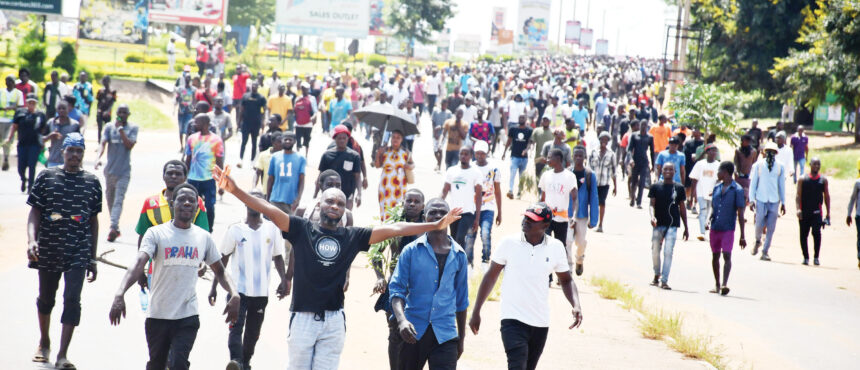

Hundreds of vendors Wednesday poured onto Kamuzu Procession in Lilongwe on their way to Malawi Revenue Authority (MRA) offices in a march aimed at forcing the tax collector to reverse its decision to hike duty on second-hand clothes to $2.5 per kilogramme (kg).
For days, the vendors had been pushing for the reversal of the hike, which became effective on March 15 following Minister of Finance Simplex Chithyola Banda’s announcement of new tax measures for customs and excise.
In the wake of the protests, MRA has reverted to the earlier position where the used clothes duty stood at $1.9 per kg.
Deputy Commissioner for the tax body’s Lilongwe Port, Khumbo Gondwe, said the reversal had already been implemented on Tuesday following discussions between government and other stakeholders.
By the time Gondwe made the announcement, the vendors had already invaded the streets on their way to MRA officers where they were told their grievances had been heard.
- Advertisement -
“The new [duty] values have been withdrawn with immediate effect. The vendors will be using the same values that were in place before the circular of the new ones was issued,” he said.

In a circular announcing the reversal, MRA Commissioner General John Biziwick advised station managers and staff that the previous circular had been withdrawn.
“The value for duty purposes for used clothes remains at [cost, insurance and freight] $1.9 per kg,” the statement dated March 20 2024 says.
One of the vendors who ply their trade at Tsoka Market in Lilongwe, David Kathumba, said the hike in the duty had affected their businesses.
- Advertisement -
- Advertisement -
“We have already been affected by the 44 percent devaluation of the Kwacha and now the government is also increasing the duty purpose; how are we going to survive?” Kathumba said before the reversal was announced.
Chairperson for Tsoka Market Vendors Lyson Chinunga said the traders were looking forward to the implementation of the reversal.
In the budget statement, which he presented in Parliament on February 23, Chithyola Banda announced several other tax measures including removal of 30 percent import duty and 25 percent import excise on electric motorcycles.
There is also an introduction of 10 percent import excise duty for petroleum products including automotive lubricants and petroleum jelly.
Import duty on finished iron sheets was also hiked from 15 percent to 25 percent.
The custom and excise amendments further show duty-free importation of passenger-carrying motor vehicle with a seating capacity of more than five people for returning residents.
“[There is also] restricting the duty-free importation of building materials… for the tourism sector to three years, subject to an extension of two years at a 50 percent rate of the normally applied import duty,” the amended measures read.
Meanwhile, Used Car Dealers Association (UCDA) petitioned Parliament expressing displeasure over what they described as government’s change of tune on the implementation of the new duty calculation system of clearing used motor vehicles which was agreed last year.
Government introduced the fixed rates targeting second-hand motor vehicles manufactured between 2001 and 2020.
For motor vehicles that are zero to three years old and those older than 23 years, an ad valorem (tax derived from an assessed value) was introduced to be used where duty would be charged according to value.
This was not received well by many Malawians including the car dealers who complained that the introduced duty calculation system would cripple the car market as duty for the vehicle prices “went too high due to the system”.
The car dealers pushed government to go back to specific taxes system which helps the importers to know in advance the amount of duty to pay for the particular motor vehicle and government bowed down to the pressure.
Despite gazetting what the two parties had agreed, MRA announced the revocation of the specific taxes and reverted to the ad valorem tax method which some quarters and the car dealers protested before reaching an agreement on specific taxes.
UCDA president Themba Mkandawire said they feel betrayed by the government.
“We are greatly affected by the revocation of the specific taxes that were gazetted last year. We are failing to pay duty for the imported motor vehicles due to the effects of the revocation of specific taxes.
“As such, MRA has announced that it will auction our vehicles that are at the border posts. This is a huge setback to us because that is our capital,” Mkandawire said.
Speaking after receiving the petition, Vice Chairperson for the Budget and Finance Committee of Parliament Ismail Mkumba said it would be treated as a matter of urgency.