Ordinarily, Group Village Headman Joroti should have been spending much of his time leading his people in projects meant to develop their area in Traditional Authority Bogyoyo in Nkhata Bay District.
Instead, Joroti spends that time resolving conflicts amongst women and girls in his area. On daily basis, he deals with an average three of such cases. The fights get nasty that some even lead to injuries.
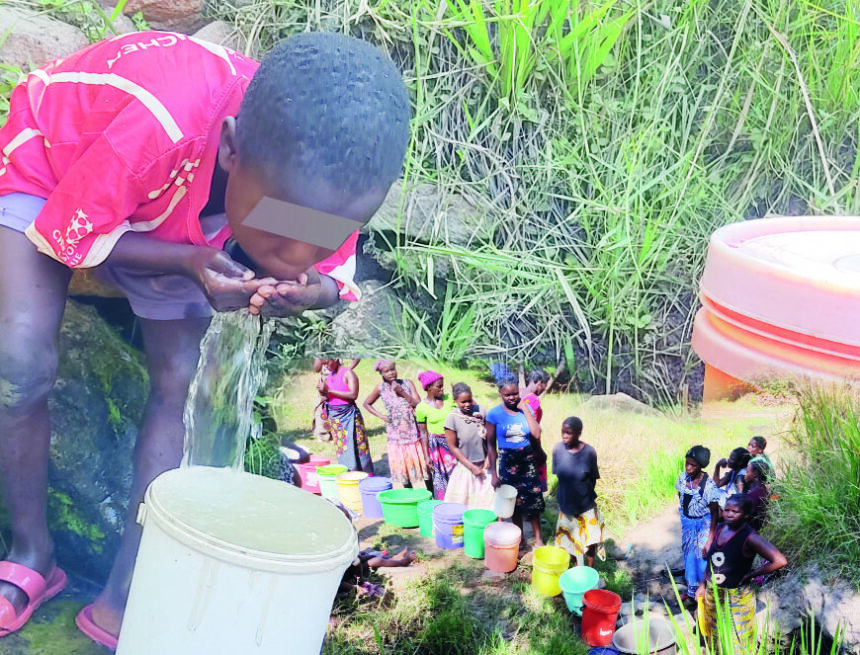
The reasons for the conflicts are not about gossiping as one would think. Their concern is scrambling for water—unprotected water —at the only well which caters for more than 150 households in the village.
“The water challenge is a nightmare here. Women are the worst affected as they wake up early in the morning to fetch water down the stream,” Joroti said.
Trials of reaching Joroti
- Advertisement -
Joroti area is one of the remotest places in Nkhata Bay District.
It is located in a hard-to-access area in Usisya. It has a population of about 2000. To reach it, our reporter drove 52.4 kilometre down the treacherously windy, giddying and sloppy Mzuzu-Usisya road.
The road is essentially a passage to tragedy, as it were. It is bumpy and rocky, has sharp —sometimes hairpin—bends in places.
It takes about three hours for one to negotiate all these features in the hills before you reach Usisya Trading Centre. And the passage is only possible in dry season.
- Advertisement -
- Advertisement -
Once rains starts, the road is almost impassable.
Reaching the Bande area, our reporter had to use water transport which take about two hours using a speed boat, consuming about 30 litres of fuel.
Then scale up the hills for another two hours on foot because bicycles and motorcycles cannot pass through the terrain.
After you have sweated well enough from the exertions of the climb, you arrive in Joroti village.
There is nothing spectacular here that would define a proper human living condition.
No source of potable water so livestock and people drink in once place where frogs and worms also habit.
Health pays price of poor water
People in the area gave up that they are a part of Malawi because, they say, no authority has ever had much interest to address at least the water challenge, according to Shida Nyirenda from the village.
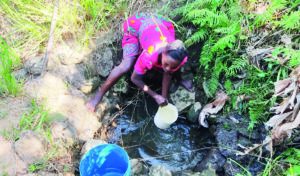
from the only well in Joroti village
“We normally come here at 4 am to fetch water which we also wait for. Livestock also want the same water. The problem is too much here,” Nyirenda said.
Dorocy Msuku said cases of water borne diseases are rampant in the area and people know why.
“We know this is bad water but we cannot do otherwise. We cannot survive without water. So, we still drink the same water,” Msuku said.
Impact on education
The water challenge has also affected education in the area. Deputy head teacher at Khwenthu Primary School, Blessings Nyasulu, said on a daily basis, at least four learners are sent back from the school after suffering from waterborne diseases.
Nyasulu said sometime back, the council drilled a shallow well. But it dried up.
“Hygiene and sanitation is a problem at our school. Learners walk long distances to fetch water from a well, for both drinking and cleaning at the school. Teachers are also affected because they use the same water,” Nyasulu said.
100 waterborne disease cases per year
Community health workers in the area said waterborne diseases have increasingly ravaged the area over the past 10 years. Senior Health Surveillance Assistant Makoka Mkandawire said the area registers over 100 waterborne disease cases per year. They include dysentery, typhoid, diarrhoea and cholera.
“If there is no serious intervention, these cases will continue and we will lose more people,” Mkandawire said.
Failed gravity projects
Area Development Committee chairperson Alfred Kondowe said people in the area were supposed to benefit from a K3.1 million mini[1]gravity water supply project.
He said government had channeled the funds to the council as a Covid-19 impact mitigation initiative. According to him, the council paid the contractor who only bought 81 small pipes and three bags of cement.
These materials are currently gathering dust at Khwenthu Primary School.
“If our school was connected with gravity water from Manda tank, it would be easy for locals to get the same water to their respective homes. People are suffering,” Kondowe said.
He added that as a commitment to the project, the community contributed K114, 000 to help connect water from the school and supply the area once the project was done.
Mazomera Primary School which is within the area also faced a similar challenge as the contractor for a mini-gravity water supply project which was supposed to service the school abandoned the project after reportedly pocketing the money.
Nkhata Bay District Water Officer Chunga said he is not aware of the projects because he is new in the office.
How about CDF?
But councillor for Usisya ward Brown Chizeze said Nkhata Bay North Constituency, just like any other constituency, receives about K12 million for water development annually under Constituency Development Fund (CDF).
He said the money should have been utilized to complete the projects. However, Chizuze said the problem is that the funding is controlled by Member of Parliament, Chrissy Kanyasko, who he said has her own priorities.
“I have been reporting this problem but nothing is taken on board,” Chizuze said.
However, Kanyasko said resources have always been limited to work on all the challenges people are facing in her constituency.
She admitted that she has not visited the area but she will take an initiative of meeting the people and see how best they can be assisted.
“I try my best only that the resources are limited. So, I will send my constituency assistant to visit the people,” Kanyasko said.
Centre for Social Accountability and Transparency (Csat) Executive Director Willy Kambwandira said people from the area are being deprived of their right to access clean water.
“The funds which were meant to support people with good water should not be pocketed by a few individuals who lack humanity,” Kambwandira said.
According to WaterAid Malawi Country Programmes Strategy 2023-2028, Malawi has been working towards the goal of access to water, sanitation and hygiene (Wash) for several years.
However, progress towards the goal has been slow.
It further says Malawi needs an annual capital investment of $238 million for each year up to 2030 if these targets are to be met but currently, less than $100 million is available annually.