




By Emmanuel Chilemba:
It is daybreak along the Blantyre-Chikwawa M1 Road, with vehicle and motorcycle engines roaring as they criss-cross the steep and meandering route.
Despite the chilly weather and fog on the horizon, 48-year-old Bertha Damalikeni, a resident of Dulansanje in Chikwawa, is already up, selling bags of charcoal by the roadside in a bid to make ends meet.
“This is our livelihood. We make ends meet through this business to take care of our families. Most of us produce this charcoal ourselves in our fields and in some hilly areas,” Damalikeni says.
While reloading fallen charcoal into a bag, Damalikeni, a widow and mother of four, says she makes between K15,000 and K25,000 per bag.
- Advertisement -
Her story is common along the road, where other traders display bundles of firewood and furniture, including beds, beehives, chairs and door and window frames.
Authorities say there is high demand for these products for cooking and construction in urban areas, particularly neighbouring Blantyre, about 35 kilometres away.
Covering 4,878 square kilometres and home to more than 500,000 people, most of whom are farmers, Chikwawa has seen its once-thick vegetation cover reduced to shrubs, leaving bare ground vulnerable to soil erosion and destroying wildlife habitats.
“As we speak, deforestation is at two percent, leaving bare ground vulnerable to soil erosion and destroying wildlife habitats,” Chikwawa District Director of Forestry Hector Mkawihe says.
- Advertisement -
- Advertisement -
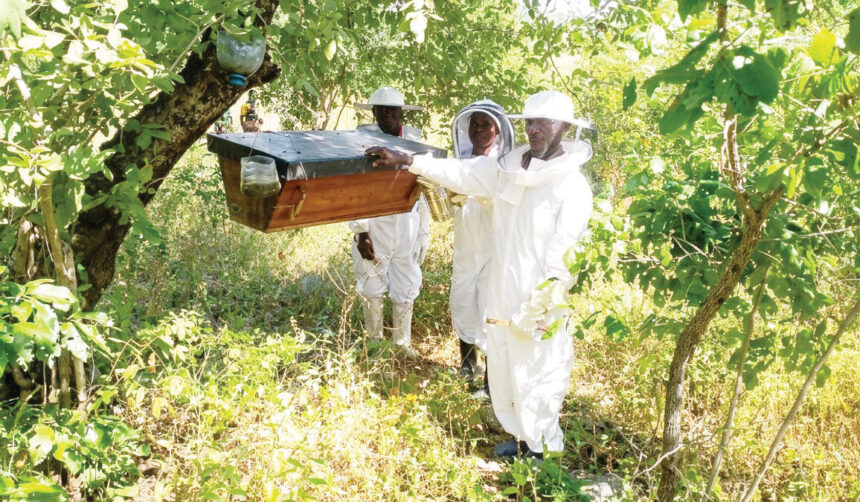
Mkawihe, who is also a member of the district’s Food Systems Steering Committee, says they are promoting beekeeping as an alternative livelihood to reduce communities’ reliance on forest resources.
The committee is being established through GIZ’s Step Up project, with support from German Cooperation.
“We are still engaging authorities at African Parks (Majete Wildlife Reserve) as an off-taker over the market linkage that the Food Systems Steering Committee facilitated for Chikwawa-based beekeepers.
“Hopefully, the deal will be more beneficial to farmers. Besides this, we are planning to capacitate our farmers with value addition to make their honey more competitive on the market,” Mkawihe says.
He says the committee is also seeking additional off-takers for local beekeepers.
African Parks, through its Honey with Heart Project, works with communities around Majete, Liwonde and Nkhotakota protected areas, buying honey and supporting farmers with inputs, market linkages, honey aggregation and bottling services.
Namisempha Beekeeping Cooperative secretary Christopher Chisesa, whose Chikwawa-based organisation has supplied honey to Majete Wildlife Reserve since 2003 under the Honey with Heart Project, says the business has transformed members’ livelihoods.
“Since then, they have offered us unwavering support, including beehives, beeswax, smokers and a fully furnished honey processing building. We are now able to fend for our families,” Chisesa says.
He adds that the cooperative earned K30 million in profit after selling 6,260 kilogrammes (kg) of honey harvested in 2025, up from K17 million from 4,860 kg in 2024.
Beekeeper Michael Lapken from Traditional Authority Kasisi says access to reliable markets can help other farmers expand their businesses.
“Sometimes we harvested large quantities but finding buyers was difficult. Those who came wanted small quantities and offered very low prices. Value addition will make our products more competitive,” Lapken says.
Promoting market linkages for beekeepers is one of the initiatives being implemented by the Food Systems Steering Committee to strengthen food system governance.
The initiative also seeks to assess food production, distribution and consumption patterns in the district.
Studies have shown that beehive fences can also deter elephants from entering crop fields. Elephants are sensitive to the sound, scent and sting of bees and tend to avoid areas where they are present.
A 2011 study conducted in Kenya and published in the African Journal of Ecology found that beehive fences placed between farms and protected areas helped prevent elephants from invading crop fields.
By 2023, Malawi had lost more than 23,000 hectares of natural forest, according to Global Forest Watch data reviewed by The Daily Times.
The loss has implications for the forestry sector’s contribution to the economy. In the 2024-25 financial year, the sector generated K4.8 billion.
However, the government has identified forestry as a potential contributor to the Malawi 2063 agenda under Pillar 1, which focuses on agricultural productivity and commercialisation.
In the short term, the country aims to restore 4.5 million hectares of degraded land by 2030.
The approach is also supported by a Department of Forestry report titled ‘Assessment of Forest-based Enterprises in Malawi’, which identifies forest-based enterprises as important for wealth and job creation.
The report recommends stronger private-sector involvement, genuine community participation and ownership, transparent financial management, market research, quality assurance and effective monitoring and evaluation.
It identifies forest-based enterprises as businesses that use forest resources, including mat-making, pottery, bamboo selling, wine-making, beekeeping, juice-making and curios.
However, the report notes that many such enterprises face challenges, including limited value addition and marketing, inadequate policy support, unsustainable forest management, short shelf-life of some products and limited access to markets.