By Amararam Gujar, High Commissioner of India to the Republic of Malawi:
In global diplomacy, the most meaningful partnerships are often measured not only by trade or strategic interests but by their impact on people’s lives.
The evolving health partnership between India and Malawi offers a compelling example. Over the past decade, India’s support—from life-saving medicines and vaccines to advanced cancer treatment technology and artificial limb programmes—has strengthened Malawi’s healthcare system while restoring dignity and hope to thousands of citizens.
What distinguishes this partnership is its focus on long-term capacity building rather than short-term assistance. In a world where health security has become a central pillar of development and stability, India– Malawi cooperation demonstrates how diplomacy can translate into tangible improvements in public health and human development.
A friendship rooted in history
- Advertisement -
India and Malawi share historical ties that predate Malawi’s (then Nyasaland) independence. These connections date back to the colonial period when Malawi, then known as Nyasaland, developed early links with Indian traders and professionals. The relationship strengthened further during Malawi’s struggle for independence.
When Malawi became a sovereign nation in 1964, India was among the first countries to recognise it and establish diplomatic relations. Over the decades, the two countries have cultivated a partnership built on mutual respect, solidarity and South–South cooperation.
Central to this relationship is the shared belief that investments in people—through health, education and skills—are fundamental to sustainable development.
The rise of health diplomacy
- Advertisement -
- Advertisement -
Health has always been essential to human well-being, but in recent decades it has also become a strategic dimension of international relations.
From the cholera epidemics of the 19th century to the Spanish Flu pandemic and the recent Covid-19 crisis, global health emergencies have demonstrated how quickly diseases can disrupt economies and societies. These experiences have elevated health diplomacy as a key pillar of global cooperation.
India has emerged as a major contributor in this field. Often described as the “Pharmacy of the World,” India supplies affordable generic medicines to many developing countries, particularly across Africa. Its pharmaceutical industry has played a crucial role in expanding access to life-saving drugs worldwide.
During the Covid-19 pandemic, India’s global supply of medicines and vaccines reinforced its reputation as a reliable partner for countries across the Global South.
Building health systems in Malawi
India’s cooperation with Malawi’s health sector has focused on strengthening institutions and local capacity.
A major milestone came in January 2010, when India extended a $5 million development grant to Malawi during the visit of India’s then Vice-President. A significant portion of the grant supported the health sector, including the supply of mammography and ultrasound machines that improved diagnostic services in public hospitals. These early investments laid the foundation for a deeper partnership in healthcare.
Responding to national emergencies
India has consistently supported Malawi during periods of crisis. In 2015, when devastating floods affected more than one million Malawians, India provided $1 million worth of medicines and medical supplies to help stabilise the healthcare system.
The following year, Malawi faced a severe drought triggered by the El Niño weather phenomenon. India responded with a $1 million humanitarian grant to support the country’s efforts to address food insecurity and its health implications.
India also contributed to strengthening emergency healthcare services. In February 2020, ten India-made ambulances were donated to improve emergency response capacity, particularly in rural areas. In addition, essential life-saving medicines worth $2 million were supplied to support hospitals and clinics.
Restoring mobility and dignity
Among the most transformative initiatives in India–Malawi cooperation has been support for persons with disabilities.
Under the India for Humanity initiative, inspired by Mahatma Gandhi’s philosophy of compassion, India organised artificial limb fitment camps in collaboration with the Bhagwan Mahaveer Viklang Sahayata Samiti, creators of the globally renowned Jaipur Foot.
One such camp held at Kamuzu Central Hospital between July and September 2024 enabled 599 Malawians to walk again after receiving prosthetic limbs. For many beneficiaries, this meant returning to work, going back to school and participating fully in society.
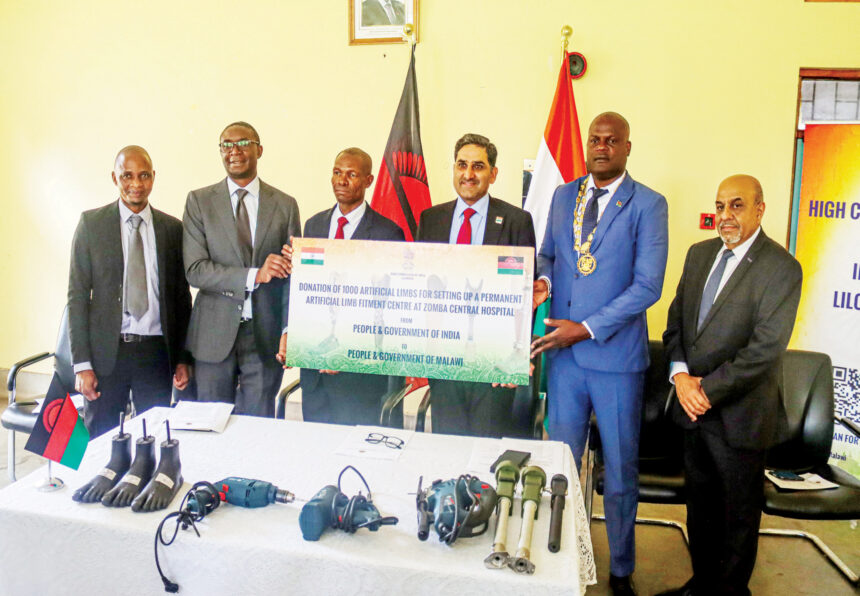
To ensure sustainability, more than 1,000 Malawians have been trained in the fabrication and maintenance of artificial limbs. A major step forward came during the State Visit of the President of India to Malawi in October 2024, when India announced the establishment of a Permanent Artificial Limb Fitment Centre at Zomba Central Hospital.
India subsequently donated 1,000 artificial limbs in February 2026, enabling the centre to begin operations and provide continuous services across the country.
Pandemic solidarity
India’s partnership with Malawi was particularly visible during the Covid-19 pandemic. Through the Vaccine Maitri initiative, India became the first country to donate Covid-19 vaccines to Malawi, providing 50,000 doses of Covishield. These were prioritised for front-line workers including healthcare professionals, teachers and security personnel.
In September 2021, India delivered additional support in the form of Covid-related medicines and personal protective equipment worth $1.4 million. Despite global supply chain challenges, India continued to support its partners, reinforcing the importance of international solidarity during global crises.
Standing together in times of disaster
India has also stood with Malawi during natural disasters. Following the devastation caused by Cyclone Freddy in March 2023, India dispatched more than 11 tonnes of emergency relief supplies, including shelter materials, food supplements, hygiene kits and essential medicines.
Later that year, India delivered the largest medical consignment ever provided to Malawi – over 165 tonnes of essential and anti-cancer medicines supplied in multiple tranches. The assistance helped the country respond to overlapping challenges including disaster-related displacement, cholera outbreaks and economic pressures.
Strengthening cancer treatment
Health cooperation reached another milestone during the 2024 State Visit of the President of India to Malawi, which strengthened collaboration in specialised healthcare.
A key outcome of the visit was India’s support for cancer treatment services through the installation of the Bhabhatron radiotherapy machine at Kamuzu Central Hospital.
Developed in India, the Bhabhatron is an advanced yet cost-effective cancer treatment system designed for resource-constrained environments.
Along with the equipment, India also supplied anti-cancer medicines. For many patients, this initiative means access to life-saving treatment without having to travel abroad.
Health, food security and development
India has also supported Malawi during periods of severe food insecurity. In October 2020, India donated 1,000 metric tonnes of rice to help address shortages caused by crop failures and the economic impact of the pandemic.
Again, in October 2024, following a declaration of national disaster due to drought, India provided another 1,000 metric tonnes of rice to support vulnerable communities.
In October 2025, President Peter Mutharika declared a state of disaster in 11 districts and appealed for local and international assistance, India responded positively to this appeal and decided to dispatch another 1000 MT rice as food assistance to the friendly people and Government of Malawi. The consignment was already dispatched from India and is expected to reach Malawi in April 2026.
These contributions reflect the broader understanding that health security depends not only on medical infrastructure but also on nutrition and resilience.
As Malawi pursues its long-term development strategy Malawi 2063, strengthening healthcare systems will remain central to achieving its goal of becoming an inclusive and self-reliant upper-middle-income country.
Across the continent, initiatives such as the African Union’s Agenda 2063 and programmes to expand vaccine manufacturing highlight Africa’s ambition to build stronger health systems and pharmaceutical capabilities.
India’s robust pharmaceutical sector offers ample opportunities for deeper collaboration in areas such as local manufacturing of generic medicines, vaccines, diagnostics and medical equipment.
A partnership built on humanity
Over the past decade, India has emerged as a trusted partner in Malawi’s health journey. From emergency medicines and vaccines to cancer treatment technology and prosthetic support, the cooperation between the two countries has delivered tangible benefits.
But the real measure of this partnership lies in human stories: the patient receiving cancer treatment closer to home, the healthcare worker protected during a pandemic, and the hundreds who regained mobility through the Jaipur Foot.
In a world increasingly defined by shared challenges, the India– Malawi partnership reflects a broader philosophy captured in India’s vision of “One Earth, One Health.” and “The world is one family”.
Because when nations work together to protect health and human dignity, they strengthen not only their bilateral ties but the well-being of the global community.