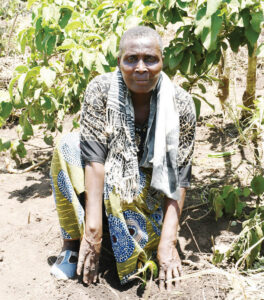
Every time thunder rumbles through dense rainclouds that have been frequently veiling the naked rocky top of Soche Hill in Blantyre, Margret Kamanga tenses up.
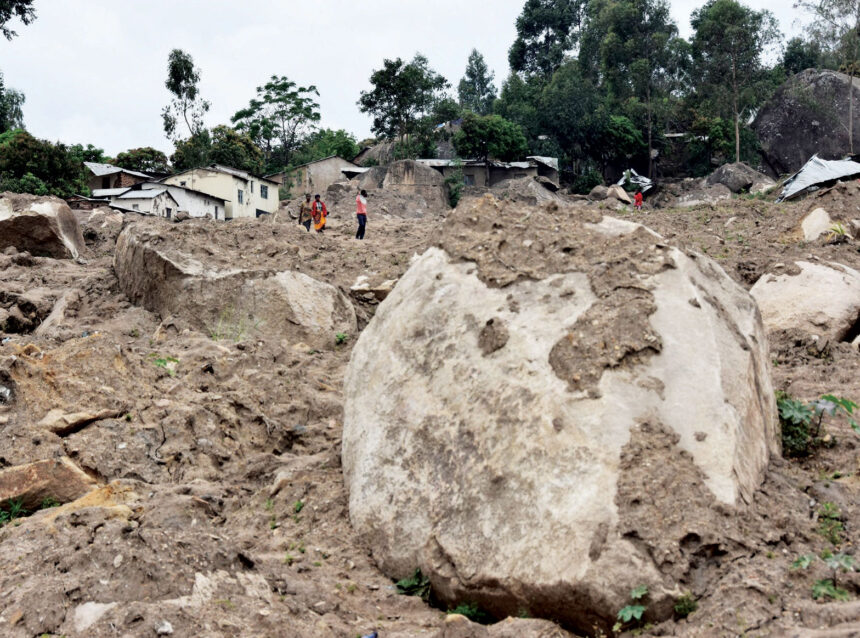
The scenario reminds her of the mass wasting that killed at least 150 people in her location and missed her by a hair.
Throughout the Southern Region, floods, storms and mudflows triggered by Tropical Cyclone Freddy left over 1,200 people dead and at least 650,000 others internally displaced.
The cyclone made a third landfall in its lifetime in Malawi in March last year to complete a month-long cycle—the longest lasting on record.
“It is not a good memory. I wish I could just scrub everything out of my head,” Kamanga says before firmly wiping her face with crumpled palms.
- Advertisement -
Since the current rainy season set off in November last year, she has been having constant night terrors, which she believes are linked to the mudslide event.
Familiar faces are no longer part of her regular treks to a nearby trading centre to buy foodstuffs.
“They are all gone. My neighbours are gone,” Kamanga says, her rusty voice tapering off into a shaky whisper.
At one edge of her small, open compound, cold wind blows through lightly limbed trees and rattles reed mats and clothes bundled up at the veranda of her red-brick house.
- Advertisement -
- Advertisement -
Some of the trees’ roots are naked after the soil that covered them got washed away together with the rocks that slipped down the hill, killing two of her cows in the process.
Kamanga’s house overlooks the source of the mudslide. She admits she should have constructed it elsewhere.
“The trees saved my life and lives of my children. They resisted the raging debris running down the hill and even saved my house from being swept away,” she says.
The rapid surge of water-saturated rock, earth and debris could not be evaded in time by dozens of people she knew.
While some got buried in the wreckage, and might still be there, others had their bodies found trapped beneath heavy rocks or collapsed houses.
Of the over 1,200 believed to have died in the wake of Cyclone Freddy, about 500 are still missing nearly a year after the storm, which also hit Mozambique and Madagascar.
“I lost hope of finding them alive. So, I accepted it, that I lost my husband and three children in the accident,” Harriet Koloko, a resident of a slum planted at the eastern foot of Soche Hill, said a week after Freddy’s retreat.
Many more survivors who could not trace their loved ones gave up on any hope of finding them alive.
When announcing the suspension of search and rescue activities, head of the Department of Disaster Management Affairs, Charles Kalemba, called attention to the fact that even excavators and sniffer dogs had failed to trace the missing persons.
“Based on the advice from experts, probably the people were buried in the landslides,” Kalemba said.
That is the notion Kamanga has firmly held for close to a year now.
“Otherwise, where are they? Obviously, they are not alive wherever they are,” she says, adding that is why several families had opted for early closures by conducting funeral rites for their loved ones.
Whenever she sums up images of the catastrophe, she tells herself that trees can save lives.
Kamanga recalls standing at a corner of her house watching the rockslides sweep everything in their path while sparing her house.
She has now vowed to continue planting trees wherever she can and regularly joins any group that is climbing the once-dense Soche Hill to dress it in green again in the current forestry season.
“There are trees at my home, but I will continue taking part in replenishing those that have been cut down on the hill. Trees save lives,” the single mother of four says.
Group Village Head Misesa, whose area spans the eastern part of the hill and its base, admits that his people contributed to the intensity of Cyclone Freddy’s impact.
He says the “irresponsibility” that had come with democracy after the end of the one-party era in 1994 saw Soche growing bare bit by bit.
Before then, the hill had been supporting some 150 hectares of mid-altitude rainforest.
Then everything on Soche, which is one of several isolated peaks that form part of the Shire Highlands, went haywire.
Misesa recalls that in those days, the reserve, confirmed as a key biodiversity area of international significance in 2011, had wild animals such as deer and hyenas.
“Today, you can’t even find a hare here. But, at least, the replenishing of chopped trees has been growing in recent years,” he says, a hue of positivity lighting up his face.
The fresh conservation efforts mean Soche Hill woodlands, which rises to a height of 1,533 metres, could return to holding a good population of indigenous plant species.
Misesa still knows the hill may not retain its dense forest, whose lush trees on the lower slopes provided a buffer zone against human pressure, in his lifetime.
“Still, we must do what we can. Eventually, the forest will entirely return. We may not see the fruits of our labour now; but surely, our children will,” he says.
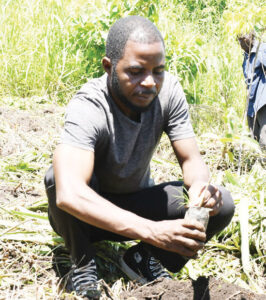
The chief then gently packs humus-rich soil around a tree seedling that he has planted few metres from the broad path created by the mudslide.