





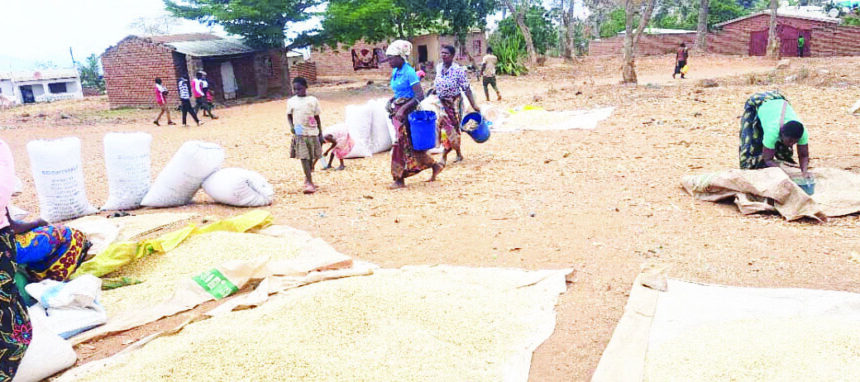
By Donasius Pathera:
In the bustling open-air markets in most African cities, the morning ritual has transformed from a simple exercise in commerce into a high-stakes calculation of survival.
Stall owners rapidly re-tag bags of rice and gallons of cooking oil while consumers visually shrink their shopping lists in real time.
Across sub-Saharan Africa (SSA), the relentless surge of inflation is not merely an abstract statistic printed in central bank bulletins; it is an omnipresent economic shadow that erodes wages, destabilises businesses and tests the limits of social cohesion.
As advanced economies grapple with their own cyclical price stabilisation post-pandemic, sub- Saharan Africa presents a far more complex, structural, and deeply entrenched inflationary puzzle.
- Advertisement -
According to statistics from the International Monetary Fund (IMF), average inflation in the region has frequently tricked into double digits over the past decade, with several prominent economies experiencing chronic hyperinflation or severe stagflation.
While standard economic textbooks prescribe a predictable remedy— raising benchmark interest rates to dampen demand— this conventional toolkit repeatedly hits a wall in the African context.
To understand why inflation management remains such a profound challenge across the subcontinent, one must look beyond basic monetary theory and dissect the deep structural vulnerabilities, political realities and institutional constraints that define the region’s economic landscape.
The structural trap: Supply-side shocks and the weight of the basket
- Advertisement -
The foundational reason why orthodox monetary policy often fails in sub- Saharan Africa lies in the very composition of what citizens consume.
In high-income countries, the Consumer Price Index (CPI) basket is highly diversified; spending on core items like food and basic energy typically constitutes less than 15 percent of total household expenditure.
In stark contrast, food alone commands between 40 and 50 percent of the CPI basket in most SSA nations.
In lower-income households, this figure can exceed 60 percent.
This extreme concentration means that the aggregate price index is heavily hostage to supply-side shocks rather than shifts in domestic aggregate demand. If a prolonged drought decimates maize harvests in East Africa, or if geopolitical tensions interrupt global fertiliser distribution, food prices spike instantly.
A central bank raising interest rates cannot summon rain, nor can it lower the international price of imported grain.
Instead, aggressive rate hikes risk penalising domestic businesses by making credit expensive, without successfully suppressing the supply-driven inflation of essential commodities.
The fiscal-monetary discord: Dominance over autonomy
In textbook economics, central banks operate as fiercely independent technocracies, insulated from the short-term political pressures of government spending.
In reality, across much of sub-Saharan Africa, fiscal dominance heavily subverts monetary autonomy.
Facing narrow tax bases, inefficient revenue collection systems and limited access to international capital markets, many regional governments find themselves chronically cash-strapped.
When tax revenues fall short and debt obligations mount, governments frequently turn to their own central banks to plug the deficit—a process colloquially known as monetary finances or money printing.
In countries where debt-to-gross domestic product (GDP) ratios are precarious and interest payments already consume a massive share of State revenues, aggressive monetary tightening can push the government toward technical default.
This fiscal trap leaves central banks politically paralysed, forced to maintain loose monetary environments that feed the very inflationary fires they are mandated to extinguish.
The informal blind spot and weak transmission mechanisms
For monetary policy to be effective, there must be a robust, interconnected financial system through which changes in a central bank’s policy rate flow to commercial banks, corporate borrowers and everyday savers.
This is known as the monetary policy transmission mechanism. In sub-Saharan Africa, this mechanism is profoundly fractured.
The defining feature of many SSA economies is their vast informal sector, which the International Labour Organisation (ILO) estimates accounts for up to 80 percent of total employment in the region.
The vast majority of informal traders, smallholder farmers and micro-enterprises operate entirely outside the formal banking architecture. They do not rely on bank loans for capital, nor do they hold their savings in formal interest-bearing accounts.
Instead, they rely on informal credit networks, cash savings or mobile money ecosystems that are largely insulated from central bank interest rate adjustments.
Consequently, when a central bank raises its policy rate by 200 or 300 basis points, the impact is confined to a tiny island of formal corporate borrowers and urban elites. The broader, informal economy continues to move to its own rhythm.
This structural disconnect explains why monetary tightening in countries such as Ghana or Angola often takes an exceptionally long time to show any discernible cooling effect on aggregate price levels.
The way forward
Lessons from both the failures and successes across sub-Saharan Africa make one reality abundantly clear: managing inflation in developing economies requires a radically different approach than the templates used in Washington or Frankfurt.
If regional central banks are to achieve durable price stability, a holistic approach that bridges structural, fiscal and monetary policy is non-negotiable.
First, institutional walls must be reinforced. Governments must legally and practically respect the independence of central banks, placing strict statutory ceilings on direct monetary financing. Without closing the valve of central bank money printing, all other inflation-fighting measures are merely cosmetic.
Second, because inflation in SSA is primarily a supply-side and exchange-rate phenomenon, monetary policy cannot operate in a vacuum. It must be paired with aggressive structural reforms to boost domestic productivity.