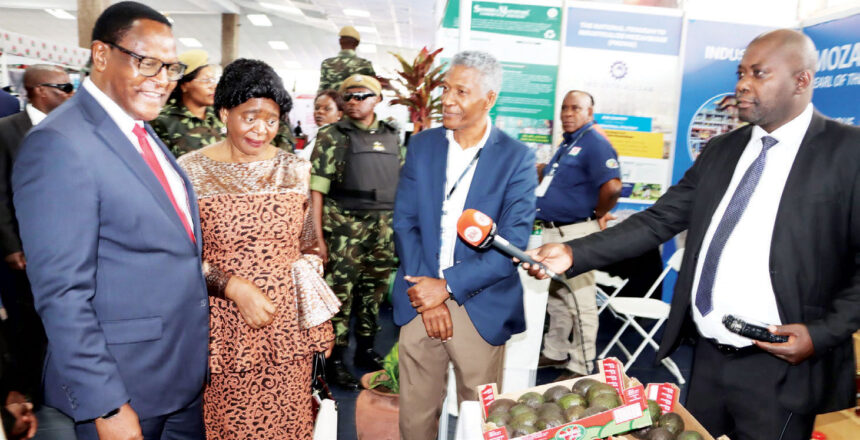
President Lazarus Chakwera has expressed dismay over the country’s widening trade deficit—a situation where the country’s import dues exceed receipts from exports—faulting the situation for derailing economic growth efforts.
Chakwera said this in Blantyre Thursday when he opened the 34th Malawi International Trade Fair (MITF) which the Malawi Confederation of Chambers of Commerce and Industry (MCCCI) has organised.
He noted that the country’s trade deficit rose to $194.4 million in March 2024, from $177.7 million recorded during the same month last year.
This represents a 9 percent increase in trade deficit between the two periods.
“For a long time, we have been importing heavily without selling enough of our products abroad. Every business knows that the more you import goods more than you export, that business is going down. So, let us change and export as much as we can to grow this economy.
- Advertisement -
“So, this tendency of only taking forex to buy foreign goods but not returning forex by selling goods in foreign countries is not developing the country. This is what we, in government, have been working hard to change,” Chakwera said.
Malawi Investment and Trade Centre Chief Executive Officer Paul Kwengwere said the major challenge has been productivity.
“We get markets for different products but we can’t supply them and, then, in most cases, most of those products come into the country as well. So, when you look at it, you find that there are more products coming into the country than the products we can export. Even though we have high demand for the products that we can export, we are not able to satisfy that demand.
“What can be done is for Malawians to improve their productivity and, then, utilise the markets that require our products in different countries. There is high demand for our products outside there. We know about the demand for Kilombero rice in Zimbabwe and the Gambia. We’ve talked about different times where we’ve had contracts, but we can’t satisfy those contracts because it boils down to productivity,” Kwengwere said.
- Advertisement -
- Advertisement -

MCCCI President Wisely Phiri said the availability of patient capital has been a major challenge for the private sector for it to increase quantities of exports.
“Exports will continue to be a challenge if we do not attract domestic and foreign investment. However, such investments require long-term capital. Access to finance, particularly medium to long-term capital, is a common and major challenge affecting key productive sectors in the country.
“The magnitude of finance and investment required to boost production and meet our development goals is significant. Mobilising the much-needed long-term resources for sustainable development will require deliberate policies that steer and allocate patient capital to productive sectors,” Phiri said.
He added that, currently, available finance in Malawi remains insufficient in scale, too expensive and heavily pitched towards the short end of the market to the extent that it becomes inadequate to support economic growth.
Figures by the Reserve Bank of Malawi reveal that the country’s trade deficit reached $2.18 billion in 2023, representing an $800 million increase from the $2.10 billion recorded in 2022.