





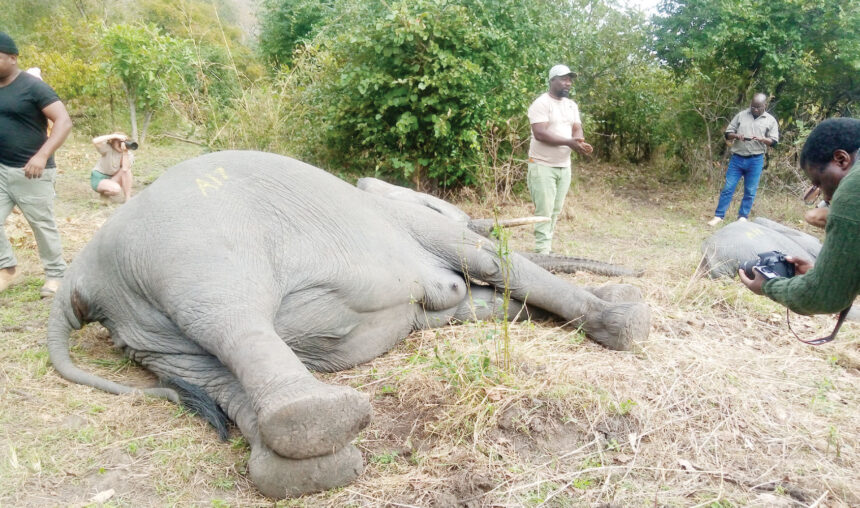

As COP28 officially opens today, conservationists are calling on delegates to put at the heart of the discussion the contribution wild animals make in tackling global climate crisis. Charles Mpaka writes
Elephants are not called “ecosystem engineers” or “keystone species” for nothing.
They balance up the natural ecosystem and make it habitable for other wildlife species.
Here is one way how: Every single day, an elephant in the wild eats copious amounts of carbon-rich vegetation – estimated at more than 130kgs.
- Advertisement -

As it clears its habitat during its foraging for food, it is creating room for other trees and plants to grow.
- Advertisement -
And as it poops, it is delivering a three-fold service to the ecosystem – planting seeds of trees and other vegetation, fertilising other plants and returning to the soil the carbon captured in the vegetation it has ingested.
A scientific study published in March this year finds that restoring African forest elephants to their historical population levels within national parks and protected areas in the Congo Basin, for instance, could result in an additional annual storage of 13 million tons of carbon.
That is – elephants, alongside other wild animals, make a vital contribution in halting emissions of greenhouse gases that cause global warming and climate change.
And as the COP28, dubbed Global Stocktake climate conference, officially opens in Dubai today, the tracking and evaluation which delegates will make of the Paris Agreement should take into account the critical role wildlife conservation plays in tackling climate crisis.
- Advertisement -
This is the call of the International Fund for Animal Welfare (Ifaw), a non-profit which works across seas and oceans and in more than 40 countries around the world.
At the COP21 in Paris in December 2015, the world resolved to work towards limiting the temperature increase to 1.5°C above pre-industrial levels to stem the tide of climate crisis.
According to the United Nations Framework Convention for Climate Change (UNFCCC), crossing the 1.5°C threshold poses the danger of “unleashing far more severe climate change impacts, including more frequent and severe droughts, heatwaves and rainfall.”
Amongst the practices the world has turned to in order to decelerate climate change is what is known as nature-based solutions.
These are ecosystem management and protection activities aimed at ensuring disaster risk reduction, addressing food and water insecurity, preventing biodiversity loss, tackling climate change and ensuring good health for humans.
In a statement which Ifaw released on Tuesday about COP28, the organisation says nature-based solutions can help keep global warming within the 1.5°C limit.
It further says with the world currently “woefully off target” and heading close to 3°C of warming, there is a growing understanding of the importance of nature in combating climate change.
However, Ifaw indicates there is a deficiency in the approach – the exclusion of the role of wildlife conservation in previous climate crisis summits.
“…Discussion of nature-based solutions to date has tended to focus on critical ecosystems for addressing climate change— forests, wetlands, mangroves, or seagrasses—as if these are static spaces that exist in isolation from their parts—including animals— that enable them to function and absorb and store carbon from the atmosphere,” Ifaw says.
Simon Addison, Ifaw’s climate change adviser, says his organisation believes that the world can still attain the Paris Agreement goals if it halts and reverses nature loss.
“Wild animals are some of our most powerful allies, driving ecosystem processes that capture carbon from the atmosphere – we need to harness this role as a nature-based solution to the climate crisis,” he says.
Wild animals are known to protect the carbon already stored in nature, prevent it from being released into the atmosphere, and help nature store even more carbon.
“Restoring wild animal populations offers an inspirational vision and practical action we can take to combat climate change today,” Addison says.
Scientific studies have actually made a strong case for wildlife conservation among the approaches the world needs in combating climate crisis.
In one such study published in scientific journal Nature Climate Change in March 2023, researchers note the global push of natural climate solutions as a way of halting climate warming through enhancing carbon capture and storage.
According to the researchers, these solutions are viewed by some quarters as having the additional benefit of protecting habitats and landscapes to conserve animal species diversity. The 15 scientists fault this reasoning, however, arguing that it underestimates the role animals themselves play in controlling the carbon cycle.
They say protecting and restoring wild animals – such as African forest elephants – and their functional roles can enhance natural carbon capture and storage.
In one illustration, when a rinderpest disease outbreak decimated a large proportion of the wildebeest population in the Serengeti landscape in Kenya between the 1930s and 1960s, the grass that the animals would usually graze on built up as fuel. This resulted in more frequent and intense wildfires plaguing the Serengeti ecosystem and releasing carbon into the atmosphere.
Since the restoration of the wildebeest population, the Serengeti is now absorbing an estimated 4.4 million more tons of carbon annually.
“We call for new thinking that includes the restoration and conservation of wild animals and their ecosystem roles as a key component of natural climate solutions that can enhance the ability to prevent climate warming beyond 1.5 °C,” the researchers say.
Lead author of the study, Oswald Schmitz, professor at the Yale School of Environment in the United States, says throughout their interaction with the environment, wildlife are the “missing link” between biodiversity and climate.
“Allowing key animal species to reach ecologically meaningful densities as part of dynamic landscapes and seascapes would probably shorten the time taken to reach the 500 GtCO2 target,” he is quoted as saying about the findings of the study.
The Intergovernmental Panel on Climate Change (IPCC) estimates 500 gigatons as the budget of carbon dioxide the world can emit from the year 2020 onwards if it has to have a 50 percent chance of not exceeding the 1.5°C threshold.
The scientists demonstrate that if the world were to protect and restore populations of just nine species—marine fish, whales, sea otter, sharks, grey wolf, wildebeest, musk ox, American bison and African forest elephants — it could facilitate the capture of more than 95 percent of the amount of carbon needed every year to help keep global warming below the 1.5°C limit.
This potential has remained largely unrecognised in climate discussions at previous COPs thus far, Ifaw says, and now calls on delegates that have gathered for COP28 to recognise the place of wildlife conservation in urgent efforts to tackle the climate crisis.