
By Patrick Kasauka:
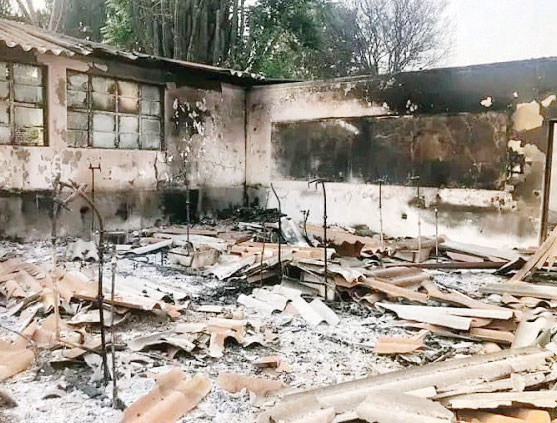
In the past year and years before it, it was not uncommon to hear news about students vandalising school property.
It can safely be concluded that in most, if not all, cases, students resort to destroying school property when they perceive that some of their rights are being limited unfairly, or when they are disoriented because their entitlements are not being honoured as expected or, in other words, when they are in disagreement with school management policies and decisions.
When such students are overcome by anger and anxiety, they wage a fierce war on property, destroying everything in their vicinity.
In so doing, they wrongly think that their demands will be adhered to instantly.
- Advertisement -
As opposed to contact and dialogue as an ideal way of resolving matters, they think that ‘common nuisance’ is the most appropriate way of forcing things to go their way.
In reaction to such madness, and in a more predictable way, school management is always left with no option other than closing the school indefinitely in a bid to cool down the volatile situation.
Notwithstanding efforts by government and other stakeholders to sensitise members of the young generation to issues such as ills of vandalism, the vice is refusing to die.
What could possibly be wrong with students, for them to be failing to control their anger in moments like these? Why do they resort to destroying property whenever they are angered? Is it not a manifestation of some unmannered behaviour encultured at their homes? Are parents or guardians not guilty of this moral decadence among students?
- Advertisement -
- Advertisement -
Toning it like William Shakespeare, if I should do someone wrong, I should do the parents or guardians wrong. I rather choose to wrong the society than wrong students.
In behavioral therapy theory, proponents say that every behaviour is learned; thus, whatever attribute a person may exhibit as a response to a particular stimulus is learned.
However, it is important to note that the learning process could either be passive or active.
Just to take some self-introspection; how do parents or other adults solve misunderstandings at home or in our society? As individuals, how do we manage anger when someone steps on us? How we conduct ourselves in situations like these is very crucial in the sight of children.
Parents or elders in the family are seen as role models by children. If you fight or protest by destroying family property when there are misunderstandings, children will take it as a golden way of dealing with misunderstandings.

Do you scorn or use abusive language or beat up a spouse when displeased with their actions? Most likely, your children will regard that as the best way of dealing with such situations.
The saddest part is that most parents are irresponsible and lack maturity in that they argue and fight in front of children.
Some parents have destroyed television sets, cooking utensils, damaging cars and all sorts of family property as a way of protesting. That is a recipe for the immoral society we are witnessing presently.
Much as we understand that we are in the information age, whereby there are various platforms from which children learn many things— notably social media, online sites, television, among others— it is the primary responsibility of every parent or guardian to make sure that their children are growing in the right manner.
It is worrisome that most parents run away from the responsibility of teaching their children good morals; instead, they leave it all to school teachers or religious leaders. This is a grave mistake.
If parents who are responsible for one or two kids fail to impart standard morals in their children, how practical is it for one teacher, who is responsible for over a hundred students, to manage them?
Some people may argue that it is, therefore, the duty of initiation ceremonies to fill the gap. However, not to undermine the power of initiation ceremonies in our society, the truth is that such ceremonies could be less useful if parents were to take the responsibility of parenting seriously. Biological parents or immediate guardians should be primary initiators.
Only when children prove troublesome at home can secondary initiators such as schools and traditionalists fill the gap.