
When parliamentarians started meeting on August 26 this year, there was hope that, perhaps, with the September 16 2025 Local Government, Parliamentary and Presidential Elections around the corner, lawmakers would treat Malawians with the honour they deserve.
Alas! The citizenry got a raw deal right on the first day of deliberations.
This is because 83 members of Parliament (MPs) were in no-show.
Not that the august House was not without drama on that day; there was drama aplenty.
- Advertisement -

For instance, some UTM Party lawmakers moved out of the government benches to start a new lease of life on the opposition benches.
- Advertisement -
Other MPs also awakened when a contentious motion to co-opt opposition Democratic Progressive Party (DPP) legislator Lonnie Chijere Phiri into the Parliamentary Service Commission was introduced to the House.
Leader of the House Richard Chimwendo Banda presented the motion.

It read: “Pursuant to Section 194D(1)(b) of the Constitution and Section 5(2) of the Parliamentary Service Act, this House resolves that Zomba Chingale MP Honourable Lonnie Chijere Phiri be appointed to the Parliamentary Service Commission, filling the vacancy left by Mulanje South West MP Honourable Dr. George Chaponda’s election as Leader of Opposition.”
However, government lawmakers rejected the motion, with 75 voting against it and 32 in favour.
- Advertisement -
With that outcome, Chijere Phiri knew that, if ever she wants to become commissioner, she has to wait for another turn.
Just that no one knows when that turn may come.
Leader of the Opposition in Parliament Chaponda was, definitely, taken by surprise by the turn of events in Parliament.
“I’m surprised that she was rejected because the Business Committee agreed to accept her,” Chaponda said.
What is in colours?
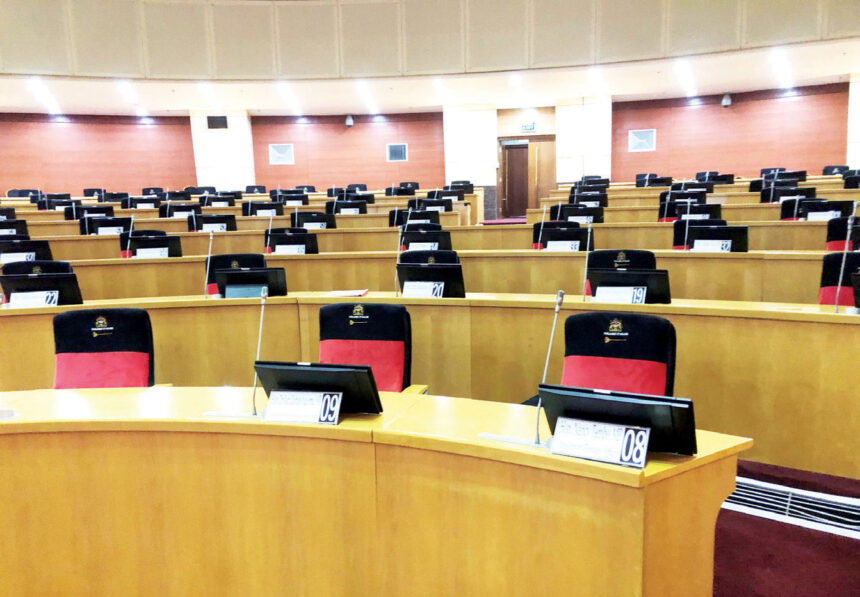
On the day when 83 MPs forsook the august House, the chamber underwent transformation.
In this case, the blue seats that had become synonymous with the house of honour were removed.
In their place, Malawi flag colours shone brightly.
The Malawi flag features a black stripe that represents the people of Africa.
There is also red, which stands for the blood spilt in Malawi’s struggle for independence.
The other colour is green, which symbolises vegetative, features that are complemented by a rising sun, which represents the dawn of freedom and hope on the African continent.

On that day, Speaker of Parliament Catherine Gotani Hara also announced that Parliament would be going digital.
True to her words, the chamber had state-of-the-art tablets installed on tables.
Parliament officials said once they were fully rolled out, they would enable MPs to access the Order Paper and other documents and engage in e-voting.
Of course, Chaponda welcomed the move.
“Yes, the blue colours favoured us [Democratic Progressive Party] but this is also okay. What matters is what we discuss and not necessarily what we sit on,” Chaponda said.
On her part, Gotani Hara said, just in the nick of time, the House was wearing a new ‘face’.
“The cloth covering the seats was old, having been done 10 years ago. It was time for a change,” she said.
Meanwhile, some UTM MPs were getting used to being on the opposition benches.
Led by Chrissie Kanyasho, they said they moved to the opposition benches following the party’s decision to dump the Tonse Alliance.
“We are no longer working with government and, so, why should we sit on the government bench?” Kanyasho said.
“Our party left the Alliance, automatically leaving the government side. This is what has necessitated our move,” she said.
Estate agents in focus as land, property issues get boost
Of course, there are a number of highlights from the just-ended parliamentary meeting.
On September 16, lawmakers unanimously passed Sectional Titles Bill of 2024, allowing individuals or firms to have legal ownership of part of an existing building.
The bill, once assented to by President Lazarus Chakwera, would see individuals owning a minimum of one room in an existing building.
Housing Minister Deus Gumba told the House that the bill had three main objectives, namely to provide for the ownership of real rights in, or over parts of, buildings and the registration of title to ownership or other real rights in, or over such parts of buildings; to provide for the application of the Registered Land Act for reproduction of documents and units deemed to be land, and to provide for the management of common property.
Gumba said the bill specifically provided for the division of buildings into sections and common property areas, and for the acquisition of separate ownership in sections coupled with joint ownership in common property.
“The bill also proposes the control of certain incidents attaching to separate ownership in sections and joint ownership in common property. It also proposes the transfer of ownership of sections, and the registration of sectional security (or charge) over, and real rights in, sections.
“The bill further proposes the conferring and registration of rights in, and the disposal of, common property; and the establishment of bodies corporate to control common property, and for that purpose to apply rules,” Gumba said.
According to Gumba the new legislation is expected to facilitate the growth and improvement in the real estate market.
“It is expected that more investors will be willing to invest in real property because they will be assured of a market for real estate. People will be able to buy affordable portions of buildings for housing or offices, instead of the whole building, and this will provide an opportunity for more Malawians to own real property.
“This development is also expected to have an effect of reduced floor rentals to the general public and that will further encourage business growth in our cities and enhance the economic development of the country,” he indicated.
According to Gumba, a high-rise townscape and attractive built environment would signify the socio-economic status of the country and the well-being of the people, and is expected to attract investors and visitors.
During deliberations, DPP spokesperson on the matter Yusuf Nthenda seconded the bill, describing it as progressive.
UDF president Lilian Patel also seconded the bill and hailed the Ministry of Lands for consultations conducted in the run-up to days of tabling the bill.
Patel said the bill would allow many people to own property.
The House also unanimously passed Bill Number 19 of 2024, Property Valuation Bill.
The bill proposes new legislation for the regulation and practice of property valuation.
Among other things, it establishes the office of Commissioner for Valuation, who shall be a public officer and shall be responsible for advising the minister on all matters in relation to valuation practice and activities, including valuation rates in the purchase and disposal of government properties.
And, then, on September 17, the House passed the Real Estate Management Bill.
It seeks to establish new legislation for the regulation of real estate management, real estate agents, real estate developers and real estate transactions.

According to Gumba, the bill, once assented to by Chakwera, would bring professionalism and order to the real estate sector.
“If the President signs this bill, [officials from] the ministry will travel across the country to educate the public about its provisions, ensuring that even rural communities understand what the bill entails,” Gumba said.
He added that, currently, some individuals are masquerading as agents, leading to malpractices in the industry.
Gumba said the real estate sector should be managed by well-trained professionals.
Among other things, the bill establishes the office of the Commissioner for Estate Management, a public officer responsible for advising the line minister on all matters related to real estate management and activities.
This includes overseeing the development of public land, plot allocation and plans for essential infrastructure such as access roads, electricity, water, street lighting and fiber-optic cables.
Business as usual
However, there are some things that did not impress Transparency Initiative’s Nicholas Mwisama.
He singled out events of the first day of deliberations.
“It’s disheartening to see such a lack of seriousness on the very first day of deliberations. What does this portend for the coming days? It’s high time our members of Parliament demonstrated some level of maturity and commitment to the tasks at hand.
“The nation is watching and it’s imperative that they take their responsibilities seriously,” Mwisama said.
Maybe, as legislators reflect on what was done during recent deliberations in Parliament, they may go back to Parliament for the next meeting a changed lot.