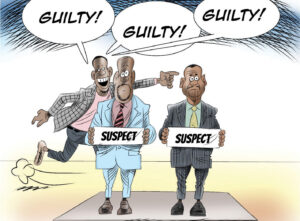
 Kenyan lawyer and anti-corruption crusader Patrick Loch Otieno Lumumba is famous for his numerous scathingly deep speeches in which he talks about why Africa remains poor despite being endowed with lucrative resources.
His powerful rhetoric often questions the political, cultural and systemic failures that continue to hinder the continent’s progress.
Of course, he also has his own downsides but his talks have been crucial in highlighting the African psyche which has largely plagued the continent.
Despite criticism from some quarters, his insights have played a role in igniting dialogue on governance and accountability across Africa.
One issue he has previously talked about is the view by some people of their countrymen and women hooked up in corruption.
- Advertisement -
He notes how many individuals tend to adopt a selective approach when condemning corruption depending on who is involved.
He talks about some people deliberately turning their eyes and mouths away when the one being accused or arraigned before the courts of law are their kinsmen or favourite politicians.
This kind of bias, he argues, undermines the very principles of justice and fairness that the fight against corruption demands.
In many spaces where they gather or talk, such people will try as much as possible to demonise others implicated in corruption while turning a blind eye from the sins of their favourites.
- Advertisement -
- Advertisement -
That happens a lot in Malawi and it is one of the reasons the fight against corruption will be hard to win.
The partiality shown by segments of the public makes it nearly impossible to hold everyone equally accountable.
We have seen how people arrested on corruption charges end up not facing the same hauling over the hot coals because their noisy backers are doing their work of avoiding demonising them.
This creates an atmosphere where justice becomes negotiable and dependent on public sentiment.
Right now, the social media and the general-public discourse is revolving around some people who are appearing on a charge sheet on crimes related to British businessman Zuneth Sattar on bribery, where he is accused of having attempted to bribe or bribing several senior officials in the current administration.
The online conversations have been polarised, with supporters and critics exchanging accusations based on loyalty rather than facts.
It is clear that there is a lot of cherry-picking on who should be the focus of the censure. The inconsistency reveals how personal interests often override the commitment to integrity in such matters.
Everyone is choosing who to demonise as long as it is someone they are not related to or interested in in any way. This behaviour exposes the deeply entrenched culture of favouritism and selective morality.
There are two sides with each trying their best to pile the criticism on one person or some people while ignoring others implicated in the case.
The result is a fractured narrative that undermines the collective effort needed to combat corruption effectively.
While the issue is now largely public, I am gagged to disclose the names of the implicated individuals because the case is not being heard in our courts and might have its own implications in the United Kingdom, where Sattar was charged and is answering the charges.
However, it is clear that there are many elements which are coming out as long as this issue is concerned.
The revelations so far suggest a broad and deep network of complicity that may take time to fully unravel.
By choosing who we should criticise when corruption is being seen and done, we essentially conclude that as long as corruption is being done by our favourite politicians or other public officials then it is fine.
Such thinking is dangerous as it legitimises wrongdoing based on personal allegiance rather than principle.
When we segregate which corruption should be persistently highlighted in our discussions including on social media, we can never claim to be staunch and sincere in our condemnation of corruption.
Selective outrage only serves to protect wrongdoers while weakening public resolve to demand accountability.
Corruption in any form, by anyone, including our favourite politicians, is evil and must be unapologetically condemned.
Our standards must remain consistent if we are to root out this cancer from our society.
Only then will the crusade against this vice which has terribly eaten into our moral and economic fabric be successful. A truly impartial approach is essential if justice and transparency are to prevail.
The good thing with our colleagues in the UK is that they will handle everything with due diligence without being swayed by our inclinations.
Their institutions are built on principles that prioritise impartiality and uphold the rule of law.
That is why they have released every name, including those we would have rather had hidden, because their fight against corruption is not like ours where we choose who should be prosecuted.
Their exposure of all involved parties stands in stark contrast to our own selective and politicised approach.