


By Alick Ponje in Belém, Brazil:
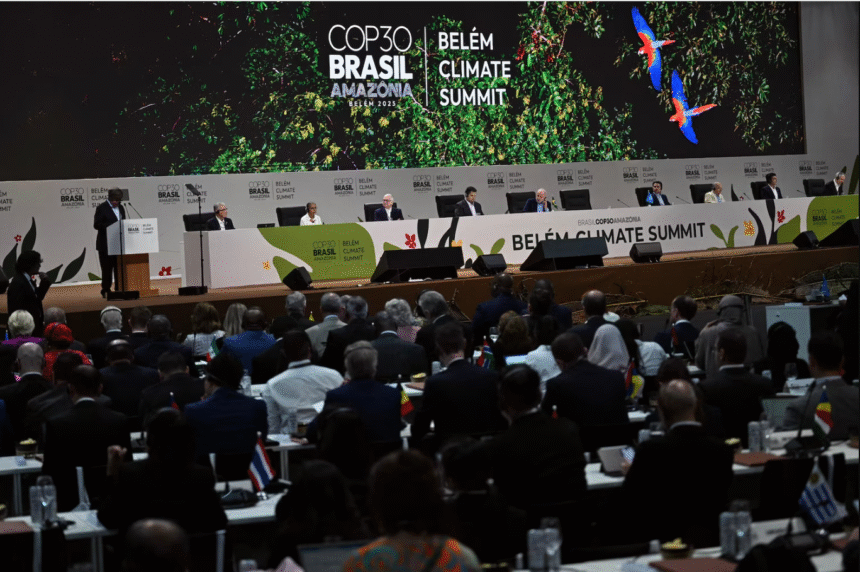
At the 30th United Nations Climate Change Conference (COP30) underway in Belém, Brazil, senior European Union (EU) negotiators have warned that the talks could produce an imbalanced outcome.
They say finance and mitigation may be prioritised while adaptation, loss and damage and capacity-building are left on the margins.
Their concerns focus on four issue areas the Brazilian presidency deemed politically essential for discussion at the meeting, which has drawn more than 55,000 onsite participants.
These are Nationally Determined Contributions (NDC) Synthesis Reports, Biennial Transparency Reports (BTRs), Article 9.1 of the Paris Agreement and trade and climate measures.
- Advertisement -
NDC Synthesis Reports review mitigation targets and assess the ambition gap, while BTRs monitor implementation progress before 2030.
Article 9.1 covers climate finance commitments from developed to developing countries, while trade and climate measures address how trade policies affect climate action, particularly for clean technology and just transition issues.
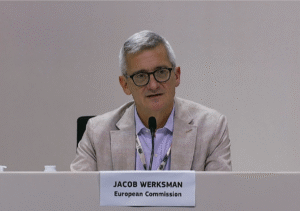
“Those four areas are very important for progress, but they do not include anything on adaptation, loss and damage or capacity building, which are key to a balanced COP package,” EU Principal Adviser on Climate Policy Jacob Werksman said.
“The Brazilian presidency decided to focus on what they saw as the four most politically essential discussions, but that inevitably meant some areas, like adaptation, didn’t make the cut,” he added.
- Advertisement -
- Advertisement -
Werksman said the NDC Synthesis Report and other measures must respect the Paris Agreement’s five-year ambition cycle, designed to gradually increase countries’ climate action commitments.
“We have to be very careful… this response can’t suggest any change to the Paris Agreement architecture, which operates on a five-year ambition cycle.
“We see no reason to press against those boundaries. What we can do instead is send a political signal that while progress has been made, there is still a significant ambition gap that needs to be addressed,” he said.
Werksman indicated that the EU is ready to discuss climate finance under Article 9.1, but only within the broader Paris Agreement framework.
“The article was negotiated alongside other provisions, which make clear that the amount of money provided by developed countries is insufficient to implement the Paris Agreement,” he said.
On trade, the EU negotiator said discussions must be non-prejudicial.
He said trade is an essential enabler of the transition away from fossil fuels but that in order to decarbonise, open markets must not drive deindustrialisation.
“We are happy to have conversations around these frictions, but we aren’t prepared to create a proxy dispute settlement system in our process,” he said.
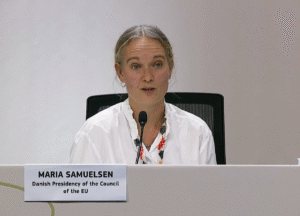
Maria Samuelsen, an EU negotiator from the Danish Government, said NDCs and reporting systems have evolved substantially since the first round submitted in 2015–2016.
Samuelsen still flagged gaps and insisted there are areas where parties can enhance implementation of the commitments.
“We really think there is some information here worth reflecting on in this moment in time and that is really worth emphasising in a response plan and in an outcome from this COP,” she said.
Samuelsen also said the EU is focused on measurable adaptation outcomes and finance, adding there is a need to finalise work on adaptation indicators.
“We want to make sure that we do our part to mobilise at least $300 billion a year by 2035 and scale up finance from all sources to $1.3 trillion,” she said.
At last year’s climate conference in Baku, Azerbaijan, countries agreed that developed nations would mobilise at least $300 billion a year by 2035 to support developing countries in tackling climate change.
The agreement also set an aspirational goal to scale up total climate finance from all public and private sources to $1.3 trillion annually by the same year.
Meanwhile, Malawi, which chairs the Least Developed Countries (LDC) bloc, has vowed that together with other nations it will push for concrete action on adaptation and loss and damage.
A member of the delegation, Taonga Mbale Luka, told Times that “substantial financial commitments” to climate-vulnerable nations are essential.
“The Loss and Damage Fund must be adequately capitalised with additional finance that meets the needs of vulnerable developing countries such as Malawi,” Mbale Luka said.
She added that Malawi and all LDCs are also seeking practical tools to measure progress on adaptation.
Several other entities have called for adaptation and loss and damage issues to take centre stage in the COP30 discussions.
For instance, the World Wide Fund for Nature (WWF), a global organisation that protects nature and endangered species, has warned that vulnerable communities need urgent and direct financial support to cope with worsening climate impacts.
Fernanda Carvalho, WWF Global Climate and Energy Policy Lead, said adaptation must receive the same attention as mitigation.
“As we can see, climate change is a reality. You just go outside, wherever you live in the world, it is hotter or it is colder.
“Or the disasters that some people are already used to as typhoons and floods, they are becoming more and more frequent,” Carvalho said.
Lavinia Naivalu, a district representative from Natula in Fiji, described how repeated disasters are overwhelming her community’s ability to recover.
Naivalu also called for decisions that allow local and indigenous communities to access climate finance directly.
This story was produced as part of the 2025 Climate Change Media Partnership, a journalism fellowship organised by Internews’ Earth Journalism Network and the Stanley Center for Peace and Security.