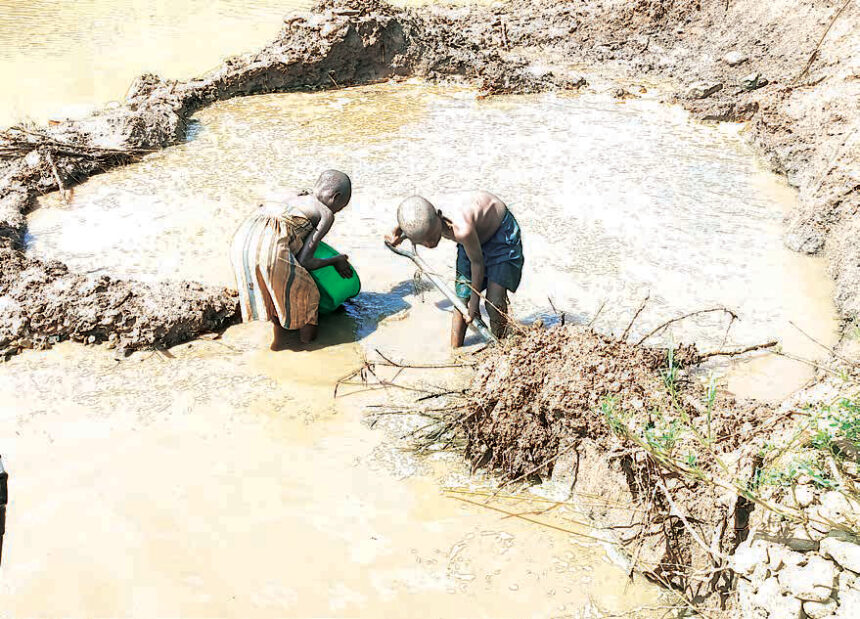
It is nine o’clock on a sunlit morning in Chingira Village, Traditional Authority Tsabango in Lilongwe, and 13-year-old Grace is already deep in the slow choreography of survival.
Standing knee-deep in the muddy waters of Nanjiri River, she sinks a shovel to the bottom, scooping sand and mud before emptying the mixture into a plastic basin.
Then comes the waiting. With quiet concentration, Grace begins sieving, her eyes fixed on the muddy swirl as she patiently lets the water drain away.
From morning into the long afternoon, Grace repeats the same ritual: shovel, scoop, sieve, wait. It is a routine she has known since childhood.
Occasionally the river rewards her. She remembers one day when she captured gold that fetched K60,000.
- Advertisement -
The memory lingers like a promise.
Beside her, another young prospector tries his luck for the first time. Kelvin Mwase, a boy not much older, is new to the river’s gamble.
“I need some money,” he says simply. A few kilometres away at Banje near Chiuzira in the capital, the same scene unfolds.
Scores of men, women and children dot the riverbanks, sifting mud and sand in search of the same elusive reward. For many families, gold has become both an opportunity and a dilemma.
- Advertisement -
- Advertisement -
Kondwani Phiri, a local parent, acknowledges the uncomfortable reality. The rush for gold is pulling children away from school.
Poverty is forcing many parents to send their children to gold digging sites so they can raise some money for their families.
To seasoned miners like Clement Mangani, the attraction is clear. There is money in gold digging, sometimes a lot of it.
On a good day, a miner can make even K500,000 if they are lucky enough to find a sizeable granule. On a bad day, they go home empty handed.
Still, Mangani insists the children should be elsewhere. “When children come here, we chase them and push them to go to school.
We encourage them to hunt for gold in the afternoon after school,” he says. The practice exists largely in a legal grey area. Member of Parliament Jimion Nyanda says most mining in the area is illegal and stresses the need for government guidance on how gold mining should be conducted, including the issue of child involvement.
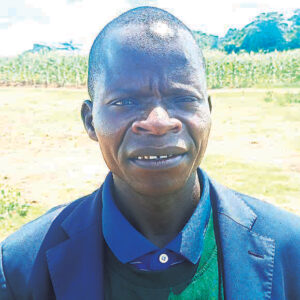
Traditional leaders are aware of the tensions. Senior Group Village Head Mdondwe says gold mining helps communities support their families but maintains that children should not participate.
Leaders urge children to remain in school, though some still sneak to the river.
Research suggests what is happening in Chingira reflects a wider pattern.
In his paper ‘Places and Practices of Child Labour in Malawi’, Centre for Youth and Children’s Affairs Executive Director Desmond Nyuma Mhango observes that children are often employed in informal mining, sometimes assigned by parents or guardians or by what he describes as invisible masters and mistresses.
According to the 2026 Malawi Government Annual Economic Report, alluvial gold deposits occur in several districts, including Balaka, Neno, Machinga, Mangochi, Kasungu, Nkhata Bay, Nkhotakota and parts of the Shire Valley.
Yet Malawi has made no significant medium- to large-scale discoveries. Gold production remains almost entirely artisanal and smallscale. “Given gold’s high international value, recent years have seen recurring gold rushes, drawing increasing numbers of
Malawians into informal mining and trading. Gold miners have become a key focus of the Government’s formalisation agenda,” the report says.
The 2015 National Child Labour Survey found that 38 percent of children aged five to 17, about 2.1 million, were engaged in child labour.
The Malawi National Action Plan on Child Labour 2020–2025 describes the problem as complex, driven by weak enforcement of laws and poverty.
The government says it is taking action. During the 2025-26 financial year, a total of 246 children were withdrawn from child labour, mainly from the agriculture sector.
Of these, 121 were returned to school, 13 were sent to vocational institutions and 75 were repatriated to their homes of origin.
The report further notes that from April to November 2025, 139 children had been withdrawn from child labour, with 45 placed back in school, 12 sent to vocational schools and 43 repatriated to their homes.
“In 2026-27, the [Ministry of Labour] plans to finalise the child labour monitoring system for easier tracking of child labour cases and faster interventions,” it says.
Back in Nanjiri, Grace lifts another shovel of sand and mud, pours it into her basin and waits once more for the water to clear, watching carefully for the faint shimmering possibility that somewhere in the sediment lies the small piece of gold that might change her day.