


By Daniel Aristi Gaztelumendi:
According to the Collins Dictionary, the 50th anniversary of an important, or special, event is called a ‘Golden Jubilee’.
Gold—being a rare, incorruptible precious metal—was chosen to symbolise the longevity and worth of such a bond, a tradition that goes back to medieval Germany, where a gold wreath—the goldener Kranz—would mark a couple’s 50th marriage anniversary.
Fifty years is quite a milestone in any partnership or common endeavour. It requires a joint vision and the continuous work and care it takes to make it happen.
In 2026, the partnership between Malawi and the European Union (EU) reaches this very special landmark. Fifty years ago, in 1976, both partners started their journey together through the signing of the Lomé Convention.
- Advertisement -
Today, it is under the Samoa Agreement that this partnership is enshrined. Fifty years of working together every day to support Malawi’s development and to defend together in the international arena the values and causes that both Malawi and the EU share.
To be sure, things back in the mid-1970s were quite different.
In Malawi, the second population census of 1977 found that there were some 5.5 million people in the country, whereas the European Union did not even exist yet as such! Denmark, Ireland and the United Kingdom had joined what back then were the European Communities on 1 January 1973, raising the number of member countries to nine, as it stood in 1976.
As you can imagine, quite very many events and markers dot the landscape of five decades of common labour.
- Advertisement -
- Advertisement -
What began in the 70s as support to rural infrastructure and agriculture has grown into a development partnership spanning very many different areas: agriculture and food systems; social protection; skills and jobs; connectivity and trade; transport infrastructure; renewable energy; good governance, and private sector investments.
Over fifty years, cooperation has shifted from isolated projects to broader sector and systems-based approaches, aligned always with Malawi’s national priorities.
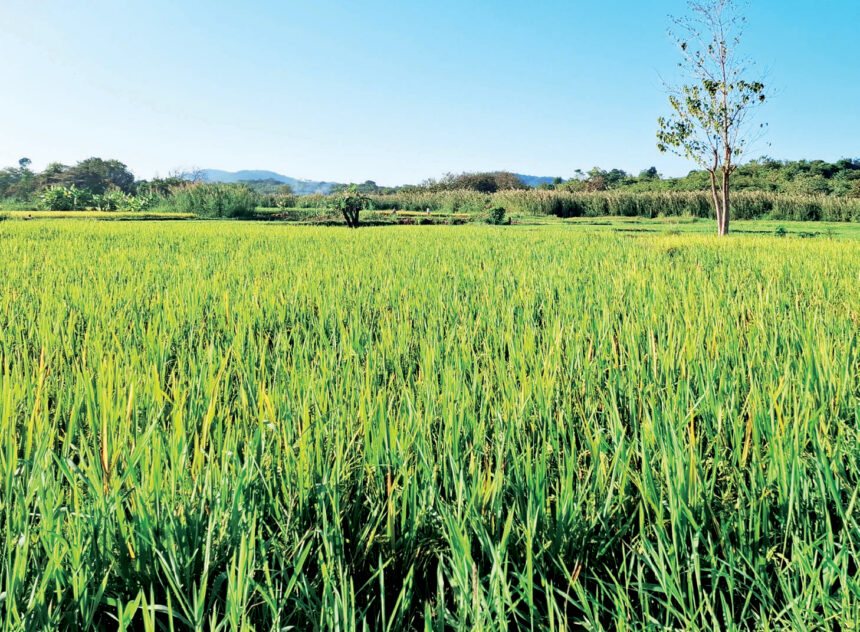
Concrete examples are quite telling. Take agriculture, for example: since the 1970s, the EU/ Malawi partnership has supported smallholder sugar schemes (Dwangwa and Phata–Kasinthula) and aromatic Karonga rice varieties (Faya, Kilombero, Pusa), revitalised banana production, promoted disease resistant and high quality tea and coffee, strengthened cassava production and backed paprika farmers with quality and safety testing through Malawi’s first high-performance laboratory (now run by the Malawi Bureau of Standards).
If we look at education and skills, since 2014, the EU’s Improving Secondary Education (ISEM) programme has reached roughly one-third of Malawi’s public secondary schools (409 across 12 districts), delivering capacity building to 18,000 teachers and 3,500 school managers.
Moreover, the EU has enabled an additional 3,000 students per year to access technical and vocational education and training (TVET) institutions. School meal initiatives are another key dimension: the Afikepo School Meals Programme of 2017 reached 160,357 pupils and 7,916 preschoolers; the much bigger Tsolata Phase II programme, currently in operation, reaches over 444,000 primary learners and 17,800 preschool learners across seven districts.
Infrastructure is another focal area where the Government of Malawi and the EU have joined forces since back in the 1980s. Key examples of transformative EU-funded projects to date include the Bwanje Valley Dam, critical for water security and irrigation to boost agricultural productivity, and the Rural Roads Improvement Programme, vital for improved access to markets, agricultural inputs and social services.
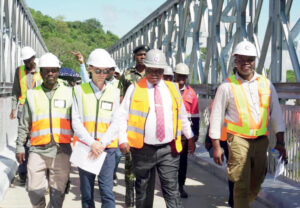
President and Cabinet Justin Saidi (second right)
Nowadays, it is mostly through the EU’s worldwide flagship initiative, known as Global Gateway, that such cooperation takes place, with ongoing or upcoming projects such as the rehabilitation of 300 kilometres (km) of the M1 Road, the main national transport artery, as well as the Mpatamanga Hydropower Station, the biggest engineering project ever undertaken in Malawi, slated to generate 356 megawatts of electricity both for internal consumption but also for export to the Southern African Development Community (Sadc) region.
As time passed, the relationship between Malawi and the EU grew into other domains.
Trade is a very important example of these new realms: in 2001, exactly 25 years ago, the Everything But Arms (EBA) initiative was launched, which removes tariffs and quotas for all imports of goods (except arms and ammunition) coming into the EU Single Market from a set of countries, including Malawi—eventually making the EU the biggest importer of Malawian exports (35 percent in 2024).
The bilateral exchanges were complemented by regional interconnections through the EU/Sadc cooperation as well as the ever-growing ties at continental level between the two sister unions, the African Union-European Union Partnership.
Malawi and the EU work together politically and diplomatically, too, very often upholding common positions in different international fora to advance the rules-based global order and address climate-related challenges. A concrete example of such cooperation was evident on 16 April, when the first EU/Malawi Partnership Dialogue session of 2026 took place at Bingu wa Mutharika International Convention Centre in Lilongwe, bringing together representatives of the Government of Malawi and from EU member states, many of whom travelled to Malawi for the occasion to debate extensively about a broad array of matters.
Thus, we can say that these have been 50 very eventful years for Malawi and the European Union. Fifty years of an ever-growing partnership that encompasses a plethora of subjects, deepening the quality and significance of a cooperation that brings mutual benefit. We will strive now to elevate the partnership to an even higher plane.
The Collins Dictionary defines ‘Centennial’ or ‘Centenary’ as someone’s or something’s 100th anniversary. For the EU and Malawi, this means another 50 years of fruitful partnership. So, I say let us continue our journey together, and let us celebrate again in 2076!
*The author is the EU Ambassador to Malawi