Professor Robin Broadhead passed away in Blantyre on Sunday at the age of 83. Typical of great leaders, his death has opened tonnes of sweet memories of his work and life in Malawi.

By Mzati Nkolokosa:
Some professors came to Kamuzu University of Health Sciences (Kuhes), taught, retired and left.
By contrast, Professor Robin Broadhead came, taught, led the College of Medicine (CoM) as Kuhes was known then, taught again, retired but never left, in two ways.
First, in Chimutu, a building named after his nickname. Second, he remained in the hearts of colleagues, students and parents of the children he treated at Queen Elizabeth Central Hospital (QECH).
- Advertisement -
The nickname Chimutu has an interesting story. It might have been his students, perhaps, who nicknamed him Chimutu, after his “very broad head”, according to Professor Adamson Muula, a student of Broadhead in the early 1990s and later colleague.
But it was not just the size of the head. Among students in Malawi, mutu (head) is a metaphor for brilliance. In this sense, chimutu (big head) signified exceptional brilliance. Typical of doctors’ jokes, the nickname Chimutu was a reference to Broadhead’s lobes, seated at the front of the brain, behind the broad forehead. Lobes are responsible for learning, personality and behaviour, among other functions.
For Broadhead, the nickname Chimutu was formalised because he embodied all its qualities.
He was exceptionally brilliant, genuinely interested in others and characterised by kindness and empathy.
- Advertisement -
- Advertisement -
Perhaps not surprising. He was a paediatrician, and learned to listen more than he spoke, even to nonverbal cues of newly born babies whose only verbal language is a cry.
That was Broadhead, the children’s doctor who passed away on Sunday, “never again to behold the children he so dearly healed”, as the poet Benedicto Wokomaatani Malunga put it in a poem published in the Malawi Medical Journal on Sunday.
Malunga was registrar at CoM when Broadhead was principal.
The two were buddies beyond the academia. They were united by art. Broadhead was a painter, Malunga is a poet and short story writer. The artists in the two educators contributed to the growth of CoM in ways that are yet to be investigated.
A classic example is the growth of the School of Public Health from a small Department of Community Health in the 1990s.
At the University of Malawi’s 20th Professorial Lecture by Joseph Mfutso-Bengo and Adamson Muula in April, 2015, Broadhead recalled the resistance he faced from clinical academics who were against the recruitment of Mfutso-Bengo, a social scientist specialised in bioethics. The clinicians were also against the growth of the Department of Community Health.
“It was registrar Malunga who supported me in the recruitment of Joseph,” Broadhead said.
Over two decades later, Mfutso-Bengo is a professor known across the world for his work in research ethics.
The Department of Community Health is now a vibrant School of Public Health, place for learning, teaching and research, offering various programmes that are contributing to health in
Africa.
It takes a paediatrician to see the future of a baby. It took Broadhead to see a bright future of the Department of Community Health, in the distance. It takes an artist to see that health is not about natural sciences only. It took Broadhead to facilitate the growth of social sciences for health at CoM. He worked towards a medical school “grounded in community health—its lifeblood”, writes Malunga in his poem.
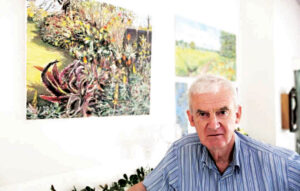
Broadhead was at CoM from its founding in 1991 and served as Head of Paediatrics and Child Health and “helped set high standards for teaching, clinical training, and patient care”, according to a statement from Kuhes.
He became principal of the college from 2001 to 2010, a period during which the institution grew in many ways, including infrastructure.
The paediatrician was “a selfless professor who chose Malawi not for comfort, but for purpose”, says Malunga in his poem titled ‘Ode for Robin Broadhead – a.k.a. Chimutu’.
It was for a purpose indeed, because Broadhead arrived at CoM when Aids was a death sentence in Malawi, when children died because there was no prevention of mother to child transmission (PMTCT). So, when a pilot PMTCT programme was launched in 2001, Broadhead was happy.
When a national PMTCT programme was launched in 2003, Broadhead was happy again, even excited.
He described Aids treatment, especially PMTCT, as “one of the greatest advancements in medical science”. It is not surprising that in the same year, he was awarded the OBE for his service in Malawi.
But there was a problem, typical with all progress. It was difficult to get mothers use PMTCT to protect their children from HIV.
So, children were still dying when help was available. Preventable death could be the most painful experience for physicians.
Why not force the treatment on the expectant mothers, I asked Broadhead at a media training on HIV and Aids at Alendo Hotel in August 2004. He looked at me, looked at his colleague, and said, “he will answer your question”. Broadhead was referring to Professor Mfutso-Bengo.
The combination of a paediatrician and bioethicist was evidence that natural sciences and social sciences are like two wings on which a bird flies. It takes natural scientists to develop drugs, and it takes social scientists to facilitate the research that led to the development of the drugs and their acceptance.
In 2011, Malawi became a global leader when it launched a strategy to provide lifelong antiretroviral therapy to all HIV positive expectant and breastfeeding mothers.
The combined efforts of clinicians and social scientists had finally paid off. We cannot attribute this successful story entirely to Broadhead.
But it would be unfair to deny him the critical role that he played in the fight against HIV in Malawi.
As Malunga says in the envoi of his poem, And so his life remains a light—To be admired, To be emulated, By all who dare to serve beyond themselves