By Madalitso Musa:
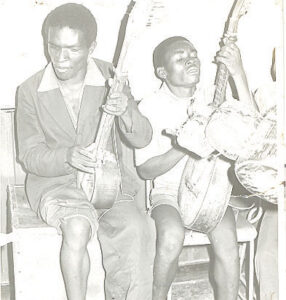
Allan Namoko died. And when he died, there wasn’t that pomp and funfair befitting the icon he had been in his living years. There is no grand marble mausoleum erected at his resting place. Of course there is a generous tombstone that was later erected: but not a splendid one. He was simple in death—perhaps a final act of confirmation about the seeming simplicity of his music.
All that serves as a reminder that there once lived a colossus of a musician is his music, music that leaves people with a wistful affection of the good old days when music was music. And in his music, Namoko was full of nostalgia. He strummed tiny pieces of his life on the strings of his sharp guitar. From yearning to visit a mother after so many years in ‘Amayi Anga’ to an ode to a friend who had sewn a bag for him in Chemponda, Namoko did not look too far for inspiration in his music.
The sophistication of Allan Namoko’s music was in the simplicity of characters, while the depth and length of his themes were in the superficiality and brevity of the verses.
In the song ‘Amayi Anga’, the personae longs to visit his mother whom he last saw a long time back. However, he cannot visit because he does not have money to pay his train fare. He sings:
- Advertisement -
Amayi anga ndilinawo chifundo
Ndimati ndikawaone amayi anga
koma transport ndilibe yokwelera sitima
“I have missed my mother
- Advertisement -
- Advertisement -
I wish to travel and visit her
But I do not have money to pay for
train fare”
Overtly, the song may be dismissed as a simple refrain that is all about mother and child attachment yet there is a subterranean social cry against poverty that is hitting the youth hard. The persona in the song has been rundown by privation and he cannot afford to manage to raise money enough for a train fare. The irony is that train is relatively a cheaper means of transport and yet for the persona it is still expensive.
In the two verses that are almost repetitions of each other, Namoko manages to cleverly protest the state of poverty by portraying that it is deep rooted enough to the extent of severing social and filial ties.
Namoko, in his music, demonstrates how he is so attached to the people that have been part of his life. In ‘AChimwene CheChitekwe’ Muli Bwanji? Which is in letterform, the personae simply writes to enquire how his relatives are doing:
Achimwene che chitekwe mulibwanji?
Ife kuno tilibwino.
Ngati muli bwino
ife kuno tikondwela
[“Brother Chitekwe
How are you.
Here we are all fine.
If you are fine we will rejoice from this end”]
One would be wondering why Namoko had to record a song that has two verses that are only about asking people how they are faring in life. But, Namoko, again, sings about the need to keep abreast with people who have been there particularly in times when there is so much strife.
Chief in the song is Namoko’s show that despite fame—that usually drifts people from their roots—it is important to keep ones feet on the ground. The persona in the song is a mystical branch that refuses to wilt even when it has been taken away from the tree which is held by his roots.
Namoko’s Chemponda is a celebration of friendship and generosity that is needed amongst humankind. In the song he sings:
Chemponda, chemponda
Munandikomera mtima Chemponda
Munapanga zabwino chemponda
munapanga kathumba
Mwati kwaya mwananga uziyikamo ndala
chemponda
Anthu asamakubere chemponda
Chemponda, Chemponda
“You were kind with me
You did me well Chemponda
You sew for me a bag
for me to keep my money
So that people should not steal from me”
There are records that Chemponda is a real character that once lived in Thyolo and was close to Namoko. It is said that since Namoko did not have a safe place to keep his money which he earned from his music, Chemponda offered to sew a bag for Namoko where he was to keep his money safe.
What might, to many, have seemed a simple act of benevolence from a kinsman not worthy blowing, to Namoko it was muse enough to inspired him to write a song. The song Chemponda is Namoko’s sermon about the need to appreciate the shimmer of love that is demonstrated through simple acts like Chemponda’s.
Namoko did not need lofty metaphors or long verses to put his themes across. In his simplicity, he could relay dense messages covertly. At first listening, one would only notice the nostalgia in the lyrics that is often emphasised by the husky and poignant voice coupled by the soul-relaxing acoustics. But, Namoko’s music tells stories beneath the surface.