Referees are subjected to a physical test to be declared fit and eligible to handle elite football in the country and all over the world.
Suddenly, local referees have become endangered species and must now find extra energy and skills to escape from the wrath of players, teams and fans baying for their blood over alleged biased and incompetent officiating allegations.
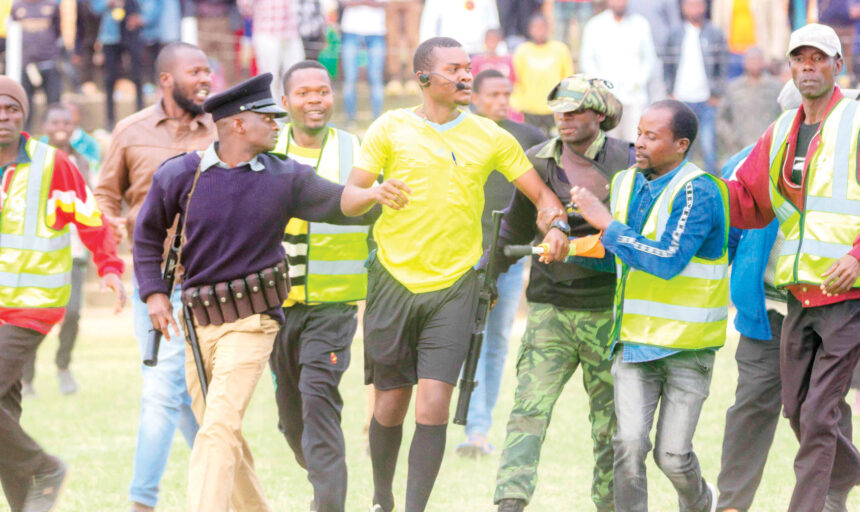
Last weekend, referee Rose Zimba and assistant referee Perie Kumwenda found themselves in a catch-22 situation as marauding Blue Eagles players bayed for their blood after the police side lost to Ekwendeni Hammers, in a TNM Super League match at Mzuzu Stadium.
The pair had to run away to duck Eagles players who were not amused with their decisions.
In another incident, Silver Strikers Pieter de Jongh, charged toward referee Davie Chombo after the teams’ goalless draw against Chitipa United at Civo Stadium.
- Advertisement -
Although his intention was not known, de Jongh told reporters after the match that the referee did not give a red card to a Chitipa United player nor added extra minutes.
This season, most teams have complained of alleged biased and incompetent officiation.
Ironically, last month, Football Association of Malawi (Fam) president Walter Nyamilandu, speaking during the association’s annual general meeting, felt that referees were under attack from some quarters.
“Despite making such good progress, the standard of match officiation in some cases remains a concern. In addition, we have all heard allegations of bribery and corruption against some of our whistle blowers. Fam hopes that law-enforcement agencies will investigate such claims and those involved brought to account.
- Advertisement -
- Advertisement -
“I need to say that we know that there are cartels in football that thrive on fixing matches. Some of those that drive these cartels are among us here, serving the game of football with no intentions of advancing the game. This immoral conduct must stop. It is detrimental to football because it discourages investors and frustrates players and officials alike,” he said.
Bullets Chief Administration Officer Albert Chigoga said officiating standards are below the expectations but teams must know the rules.
“And this has opened a plethora of complaints from teams. Bias is perceptual assessment. I would say incompetence. At the same time, teams must also study laws of the game to avoid inciting baseless fights with match officials. The teams’ complaints are justified because you watch certain decisions with shock. In most cases repeated as a sign of incompetence.
“The solution is for the football authorities in liaison with the referees association to conduct regular refresher training so as to keep the match officials up to speed with the laws of the game. People have become knowledgeable on laws of the game these days, and it is not hard to know that a referee is at fault,” Chigoga said.
Silver Company Secretary Peter Masiye echoed the sentiments.
“Not all referees are biased but there are some who lack better judgement at a time they are needed to make a decision. Teams are justified [to complain] but violence is not a way to voice out the concerns. Any form of violence must be condemned in their entirety,” he said.
Masiye suggested the need to train referees constantly, introduction of a better remuneration package and rotation of the match officials to different regions.
“We must not hide. We have a problem and we must collectively address it,” he said.
However, Wanderers Board Secretary Chancy Gondwe felt that some referees are biased towards a particular team.
“This story of poor officiation has always been a thorn in the flesh for some time. We have always been complaining about poor officiation. The teams are justified to complain about poor officiation. Most of our referees are competent but the challenge is that they are biased. They just want to see one team winning,” he said.
However, National Referees Football Association General Secretary Chris Kalichero said teams should concentrate on playing and not officiating games.
“Since when did teams and players become referees? Officer in charge of the game is the referee according to Fifa rules. Club officials should refrain from picking a refereeing job,” he said.
Veteran match assessor Bester Kalombo also backed the referees.
“If the referees are making errors they are humans. Ninety percent of referees are good while 10 percent can make human errors operating from blind side of the action. This is my personal view based on my Caf experience,” Kalombo said.
Sports analyst Peter Kanjere said referees are prone to errors by virtue of being human.
“Referees, like all human beings, will always make mistakes and that is an undeniable fact of football. Actually football is a game of mistakes. Minimising such mistakes and taking appropriate remedial action in a sober and professional manner is what matters. Unfortunately, some administrators and coaches, who themselves make atrocious mistakes in the course of their duties, are going overboard attacking referees verbally and physically thereby setting a bad precedent hence the growing cases of attacks on referees. Such people must be fined heavily and even banned.
“Referees must be protected at all times and if they get it wrong, they must be penalised, but there is a way you deal with incompetent referees and mob justice is certainly not one of the ways,” Kanjere said.