By Deogratias Mmana:
Minister of Finance Simplex Chithyola Banda Friday presented a budget that stands to be weighed down by failures of the past budgets, our analysis shows.
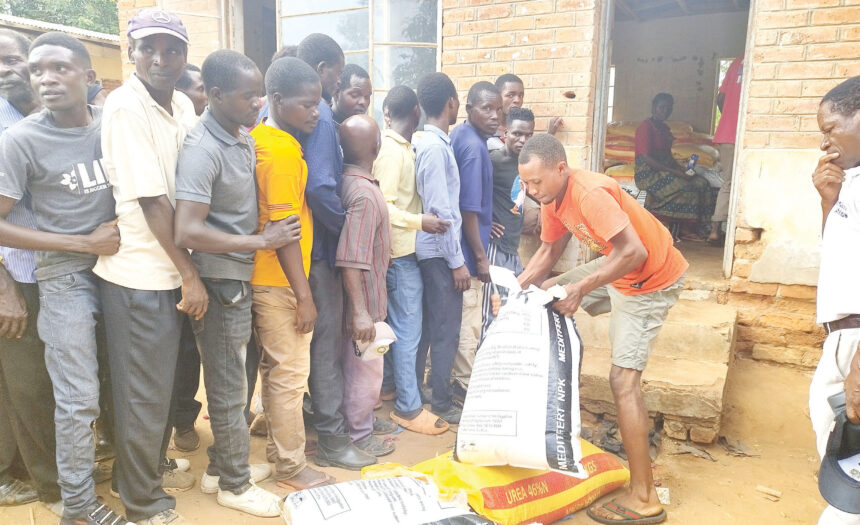
One of those is the Affordable Inputs Programme (AIP) which has for long been an area of concern, with stakeholders calling for its exiting due to its ineffectiveness and for being a hot bed of corruption.
Experts have said that AIP rips taxpayers twice – first through the budget allocation and secondly through purchase of food to support the same AIP beneficiaries when hunger strikes.
At the time one would have expected the government to show it shares those concerns by scaling down the allocation at least, Chithyola announced an increased allocation of K161.28 billion for the programme.
- Advertisement -
In the ending financial year, AIP was allocated K117 billion from K109 billion in 2022-2023.
According to a budget analysis of 2023-2024 fiscal year by Actionaid, AIP is one of the factors that cause budget overruns under the Ministry of Agriculture.
This week, the Ombudsman released a report that exposed the mess in AIP mess and called for its exit for it not being worth the money spent on it.
Again, this same week, Minister of Agriculture Sam Kawale said there was a reduction of beneficiaries as one way of showing that the government was on the path to exiting the programme.
- Advertisement -
- Advertisement -
But Chithyola said the increased allocation was aimed at complementing the other existing initiatives that strive for the attainment of national food self-sufficiency.
That said, Chithyola’s allocation of K497.75 billion for the Ministry of Agriculture which represents 8.3 percent of the total budget is not consistent with the Maputo Declaration on Agriculture and Food Security mainly on the target of allocating 10 percent of national budgets to the agriculture sector.
Yet the last budget of K455.10 billion, which was three percent of Gross Domestic Product and 11.8 percent of the total budget, achieved the target.
Over the past five years from 2019-20 to 2023-24, the combined allocation to social sectors of education, health and social protection has gradually declined from 35 percent of total government expenditure to 29.3, percent according to the analysis by ActionAid.
The current budget has allocated K729.47 billion to the Ministry of Health but the statement is silent on the allocation to water and sanitation sector and education sectors.
Malawi requires $238 million (K404 billion) every year up to 2030 to meet the Sustainable Development Goal 6 but less than $100 million (K170 billion) is available annually, according to WaterAid Malawi country programme strategy 2023-2028.
According to the United Nations, every country is required to provide clean water and sanitation for all by 2030.
Chithyola’s budget outlined some big projects under this sector which include construction of the Salima-Lilongwe water project. The project had featured in almost all the budget statements in the past nine years.
Minister of Water and Sanitation announced this week that the project finally rolls out in March.
While many schools in the country operate without resources, the budget statement has not come out clear on teaching and learning resources allocation. The budget talks about construction of some schools and upgrading and expansion of various infrastructure in public universities under the Skills for a Vibrant Economy project.
In his statement, Chithyola recited a list of road projects which the government will construct. It includes Nsanje-Marka road, Ntcheu-Tsangano-Neno-Mwanza road, Thabwa-Masenjere-Muona road, Nsipe-Chingeni-Liwonde road, Nsanama-Nayuchi road and Chikwawa-Chapananga-Mwanza road. These roads have regularly appeared in previous budget statements.
Chithyola also promised the construction of 30 houses for people with albinism. The programme too is suffering from carryover effects.
Government initiated the programme in 2021 to construct 965 houses to promote security of people with albinism.
By April last year, the project had only achieved 2 percent implementation progress.
The Association of Persons with Albinism has been complaining that there is little progress on this programme. Usually, the funds are not actually disbursed.