Economic experts have reiterated the need to enhance maize supply in areas where there is shortage to sustain a decline in inflation.
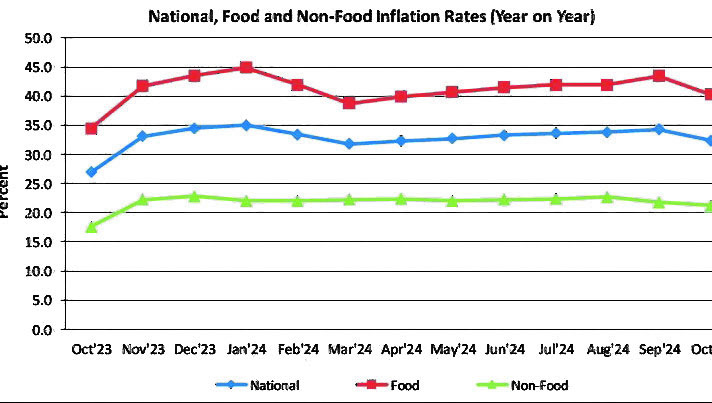
Figures from the National Statistical Office (NSO) show that the rate of increase in the prices of goods and services in the month eased to 32.4 percent, a decline from the 34.3 percent recorded in September 2024.
A stats flash published by the NSO, Friday, attributes the decline to a slower rate of increase in food prices compared to the same period last year.
“Food inflation now stands at 40.3 percent from 43.5 percent observed in September. Non-food prices, while still increasing, have registered a slight decline in the rate of increase from 21.8 percent to 21.2 percent over the same period. The national month to month inflation rate for October 2024 stands at 1.9 percent. Food inflation rate is at 2.2 percent while non-food inflation rate is at 1.3 percent.
“The urban month to month inflation rate is at 1.6 percent. Urban food and non-food inflation rates stand at 2.7 percent and 0.3 percent, respectively. The rural month to month inflation rate is at 2.0 percent. Rural food and non-food inflation rates stand at 2.0 percent and 1.9 percent, respectively,” reads the stats flash.
- Advertisement -
Economics Association of Malawi President Bertha Bangara-Chikadza said the trend should continue.
“As already anticipated in the reports by RBM, is should go down more around December if we continue intensifying making maize available in the Southern Region,” Chikadza said.
In a separate interview, economist Marvin Banda said the beginning of a decline in inflation would be seen in the December inflation report because the country would have closed the 12-month super-cycle.
“Inflation could still pick up if food availability were low post January. Inflation could still pick up if fuel prices increase, if we devalue the Kwacha etc. availability of food in the Southern Region was responsible for the slowdown of inflation.
- Advertisement -
- Advertisement -
“The general consensus is that once the 12-month inflation cycle that was perpetrated by last November’s 44 percent devaluation would have gone full-circle, inflation would start to slowly dissipate. This forms the base for the best-case scenario for the economy to experience. The best-case scenario inflation rate for 2025 will be 25.2; that is assuming inflation averages 2.1 percent on a monthly basis,” Banda said.
He added that the year 2024 could provide confidence in this projection. However, if the economy performs better than it did this year and has a monthly inflation rate of 1.9, it should be expected that inflation will go as low as 22.8 percent.
The hope is that the adherence to the IMF’s ECF will continue to be the saving grace that enforces donor confidence,” Banda said.