








By Charles Mpaka:
In Malawi, being a forest guard isn’t a glamourous, sought-after job.
And forest guards are often ignored, enjoying little mention in forestry discourse – until recently amid the worsening crashing down of the country’s forests, and how that is making the forestry security work become increasingly perilous.
In 2024 alone, a total of eight forest rangers were killed in separate incidents while in the line of duty, according to the Ministry of Natural Resources.
Malawi has not recorded such a high number of forest guard killings before, says the ministry, admitting that the hostility on its frontline staff by illegal charcoal producers and loggers is becoming alarming.
- Advertisement -
“People who are destroying our forests are on the loose. They are killing our forestry officials,” says Minister of Natural Resources, Owen Chomanika.
He said this at a meeting his ministry had convened in January 2025 to discuss with other forestry sector players strategies to stem the tide of forest destruction in Malawi.
What prompted the meeting was a brazen operation on the government plantation on Zomba Mountain.
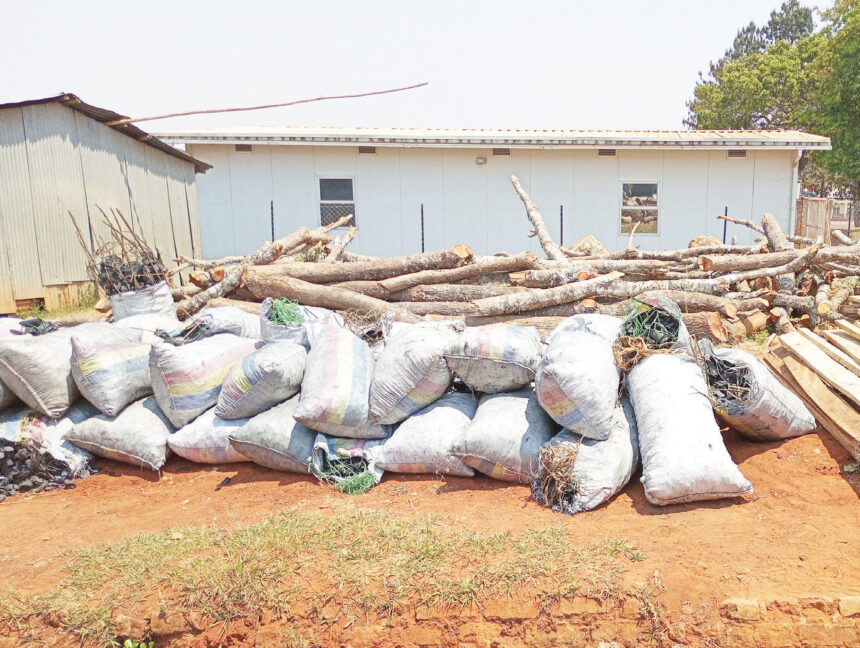
Over several weeks, young men armed with machetes, saws and axes, moving in groups numbering between 50 and 100 invaded the plantation every morning, cutting down pine trees and carrying away the contraband through the streets of the city below in full public spectacle.
- Advertisement -
- Advertisement -
With government forest guards overwhelmed, the ministry had to engage the Malawi Defence Force and Malawi Police Service to crack down on the terror.
Malawi’s forests are falling. Data from the Global Forest Watch show that between 2001 and 2023, Malawi lost almost quarter of a million hectares of its 1.5 million hectares of tree cover.
In 2023 alone, the country lost almost 23,000 hectares of tree cover, the highest forest loss Malawi has suffered in a single year since 2001.
This devastation is affecting even protected forests where government deploys forest guards. And as deforestation mounts – driven by worsening poverty, ever-rising demand for charcoal for cooking and farmland expansion – these forest security staff, badly ill-equipped and chronically inadequate in number, have the unenviable task of pushing back the avalanche.
In doing so, they are putting their lives on the line.

On February 14, 2025, three forest rangers sustained various degrees of injuries after being attacked by people from villages around Kaning’ina forest in Mzimba. The incident happened when the guards intercepted eight people who were illegally cutting down trees in the forest.
Three days later, five forestry officers were wounded when community members around Chikala forest in Machinga pelted stones at them, their crime being that they had arrested some men from the village who they had found producing charcoal illegally in the reserve.
From being stoned to death to being hacked in the face to being chased and beaten by irate mobs, forest guards in Malawi are increasingly coming into the firing line as they venture out to enforce the law.
Principal Secretary in the Ministry of Natural Resources, Yusuf Nkungula, attributes the trend partly to internal challenges.
“The challenges may be structural and operational. Structural challenges may be grouped as numbers of guards that are available at one particular time versus the number of offenders,” he says.
Operationally, he says, lack of proper equipment like guns means that the guards are unable to suppress the pressures they face from the offenders.
“Commonly, guards are attacked by offenders because they are not fully equipped to fight back. Because of this, in 2024 alone, eight forest guards were killed in the line of duty,” Nkungula tells IPS.
Sometimes, the ministry engages the Malawi Police Service, the Malawi Defence Force and national parks and wildlife rangers to help with patrols in deforestation hotspots; but these are short-term interventions.
“These engagements are always very expensive; as such they don’t happen continuously, hence still creating spaces for offenders to do illegal activities,” he says.
Currently, the forestry department has 806 guards deployed to forest reserves and plantations, way below the 4,772 forest guards which the department requires now, he says.
The department also struggles to equip even these few guards due to inadequate funding. Since 1998, not in a single year has the department received half of its budget requirement. According to Nkungula, the 2024-25 financial year was the worst as Treasury disbursed only 30 percent of the budget for the department.
“On average, 40 percent of the budget has been accessed annually in the previous 5 years. The shortfall adversely affects the operations of the department at all levels resulting into failure to achieve some important targets,” he says.

Environmental activist, Charles Mkoka, says the attacks on forest guards and the inadequate funding casts a gloomy picture of forest governance in Malawi as some groups of people exploit the institutional weaknesses to become law unto themselves.
“As a result, the future of the country’s forest resources is at a great risk—an issue that should concern all Malawians,” says Mkoka who is also Executive Director for Coordination Union for the Rehabilitation of the Environment.
Yet, these hostile groups can be instruments of forest restoration, Mkoka says, drawing lessons from other communities that have become agents of forest recovery and the experienced devastating impacts of forest destruction.
“We have forestry resources in some areas that have successfully recovered through natural regeneration and are now thriving. What this points to is the need for concerted efforts among communities and authorities in managing these resources.
“We also need to learn from the devastating effects of the recent cyclones that caused mayhem as a result of wide scale ecosystem degradation,” he says.
The rapid rate of deforestation undermines Malawi’s 2063 aspiration of becoming a developing country with more than 50 percent of forest cover and a deforestation rate below 0.22 percent year.
In the agenda, Malawi sees environmental sustainability as key to sustainable development and advances development programming that minimises depletion of natural resources.
“Our underlying concern as a people is that while we might enjoy the spoils of the environment today, we owe it to future generations of Malawians to do so responsibly and sustainably with an ethic of care,” reads the plan.
As both forests and forest guards fall, putting Malawi’s development goals in jeopardy, the Ministry of Natural Resources is rolling up its sleeves for a fight.
Hoping for improved funding, it plans to recruit 2,466 more forest guards in the 2025-26 financial year. The process will continue until the target of 6,000, the number the ministry believes will be adequate for effective policing of Malawi’s forests.
The ministry is also focusing on deepening community participation to plug the shortages in forest security staff and enhance local stewardship in forest management.
In addition, since forest invaders are becoming more militant, unleashing armed terror on forest rangers, the department is bolstering the military capacity of its frontline staff.
“The winning formula in terms of tackling the offenders is to make sure that the department becomes paramilitary as in parks and wildlife.
“To this effect, 205 forest guards have completed training in weapon handling. These trainings will continue until all officers are trained,” Nkungula says.


