






By Clifton Kawanga:
The laboratory doors were closed. Across Malawi, classrooms were empty as Covid-19 restrictions took effect. For many people, the pandemic meant interrupted learning, uncertain futures and dreams put on hold.
But in a modest room at Mzuzu University (Mzuni), two final-year Information and Communication Technology (ICT) students were asking a different question: What if students could carry a laboratory wherever they were?
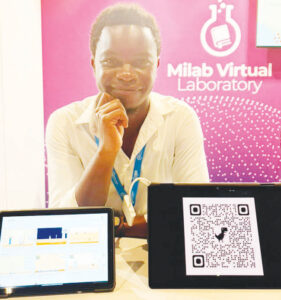
That question would grow into MiLab Virtual Laboratory, a home-grown innovation that is redefining practical science education in Malawi and demonstrating how a global crisis can become a catalyst for local solutions.
- Advertisement -

In 2019, Vision Thondoya and Lloyd Chunga were searching for a meaningful final-year project. Many students chose projects designed primarily to secure good grades before graduation.
- Advertisement -
Thondoya and Chunga wanted something different. They wanted to solve a real problem.
“We had seen how disruptive Covid-19 was during our final year at the university,” recalls Thondoya. “We started exploring the use of simulation technologies to support practical learning in universities.”
Could technology replicate the learning experience? Working closely with their supervisors, Rueben Moyo and Dr. Chimango Nyasulu, they began developing virtual science simulations that would allow students to conduct experiments digitally.
The work was far from straightforward. Developing scientifically accurate simulations required countless hours of coding, testing and refining. Every experiment had to mirror what students would encounter in an actual laboratory while remaining accessible to schools with limited resources.
- Advertisement -
As the project developed, an even bigger opportunity emerged.
“We realised that the same technology could have an even greater impact in secondary schools, where access to laboratory equipment has long been a major challenge. We were inspired to develop a prototype,” says Chunga, who is now studying an MSc in Business Analytics and Information Management at the University of Delaware, United States of America.
It was a turning point. As the idea matured, it became more than an academic project. It became intellectual property — a creation of the mind with the potential to improve lives, generate income and inspire new businesses.
Just as an author owns a book or a musician owns a song, innovators can own the technologies they create. Protecting those ideas ensures that those who invest their time, knowledge and creativity can benefit from their work while sharing it responsibly with society.
In 2020, the prototype was presented at the Malawi Institute of Education National Education Technology Exposition. Educators immediately recognised its potential to bridge the gap between theory and practice, particularly for rural schools where fully equipped science laboratories remain beyond reach.
Recognising the innovation’s promise, Dr. Moyo facilitated its transition to the ICT Incubation Centre at Mzuni in March 2021, transforming it into a nationally supported initiative.
Through the incubation programme, the team secured funding from the United Nations Development Programme (UNDP) and the National Commission for Science and Technology (NCST), enabling full-scale development of MiLab Virtual Laboratory.
“The development process was carried out in close collaboration with science teachers and education experts through the Directorate of Science and Technology and Innovation,” explains Moyo. “Their expertise ensured that every simulation was scientifically accurate, aligned with the national curriculum and reflected real laboratory procedures.”
By 2022, the first 10 virtual laboratory simulations had been completed.
Following extensive testing and validation, MiLab Virtual Laboratory was officially launched in October 2022, introducing a new way of teaching practical science in Malawi.
For countless learners, especially in rural areas, the laboratory is no longer defined by bricks, benches, gas burners and other expensive equipment.
Yet a brilliant idea alone is not enough. Without legal protection, an invention can be copied, reproduced or commercialised by others without recognising or rewarding its creators. That is why intellectual property matters. It provides the legal framework that allows inventors to protect their innovations, attract investment and confidently bring new products to the market.
For universities, it also ensures that research does not remain locked away in reports or laboratories but reaches the people who can benefit from it.
As MiLab attracted attention from educators, policymakers and development partners, another question emerged: How could such innovations be protected so that their creators and the university could fully benefit from their work? The answer lies in intellectual property.
Recognising that ideas have value, Mzuni has strengthened its commitment to protecting research and innovation through its Technology Transfer Office (TTO). The office supports innovators with intellectual property management, patent applications, licensing negotiations, commercialisation and technology transfer.
This commitment reflects the Mzuni Strategic Plan (2021-2030), which identifies research and innovation as one of its five strategic pillars. This pillar promotes intellectual property management, spin-outs and the commercialisation of research outputs.
According to Professor Fanuel Kapute, Director of Research at Mzuni, the university’s innovation ecosystem continues to grow rapidly.
“The many innovations in the university amplify the need for proper management of intellectual property. We have increased awareness of the need to have these innovations registered because there are numerous benefits,” he said.
Intellectual property shapes everyday life more than many people realise. Every mobile phone application downloaded, every medicine purchased, every television programme watched and every piece of educational software used is built on ideas protected by intellectual property rights. Those protections encourage people and organisations to continue investing in research, creativity and innovation because they know their work can be recognised and rewarded.
The success of MiLab demonstrates exactly what is possible. In April 2026, MiLab received national recognition after winning an award at the Malawi Communications Regulatory Authority (Macra) National ICT Awards event.
Three months later, Thondoya presented the innovation at the AI for Good Global Summit in Geneva, Switzerland, placing a solution conceived in a small room at Mzuni before a global audience.
It has been a remarkable journey. From a final-year project to an internationally recognised innovation, MiLab has shown that world-class ideas do not require world-class laboratories to be born. They require curiosity, determination and the courage to see opportunity where others see obstacles.
Covid-19 closed classrooms, emptied laboratories and disrupted education in many countries. But it also inspired a generation of young innovators to imagine a different future.
That future is now taking shape in classrooms across Malawi, where students can perform experiments once considered beyond their reach.
Perhaps that is MiLab’s greatest lesson. The true measure of a university is not merely the degrees it awards, but the problems it helps society solve. MiLab is more than a technological breakthrough; it is proof that when universities nurture creativity, invest in research and protect intellectual property, student ideas can travel far beyond the classroom. They can cross borders, influence policy, transform education and improve lives.
Sometimes, the brightest innovations are born in the darkest moments. The darkness brought by Covid-19 could not dim MiLab’s technological light.