




By Pemphero Malimba:
In the quiet sprawl of Area 36 in Lilongwe City, where survival often demands creativity as much as resilience, 25-year-old Laurent Taferanji has been steadily reshaping his life with soot-stained hands and an entrepreneurial spirit.
A year and some months ago, the Form Two dropout ventured into the production and sale of fire briquettes, carving out a livelihood from locally available materials while contributing, in his own way, to the fight against environmental degradation.
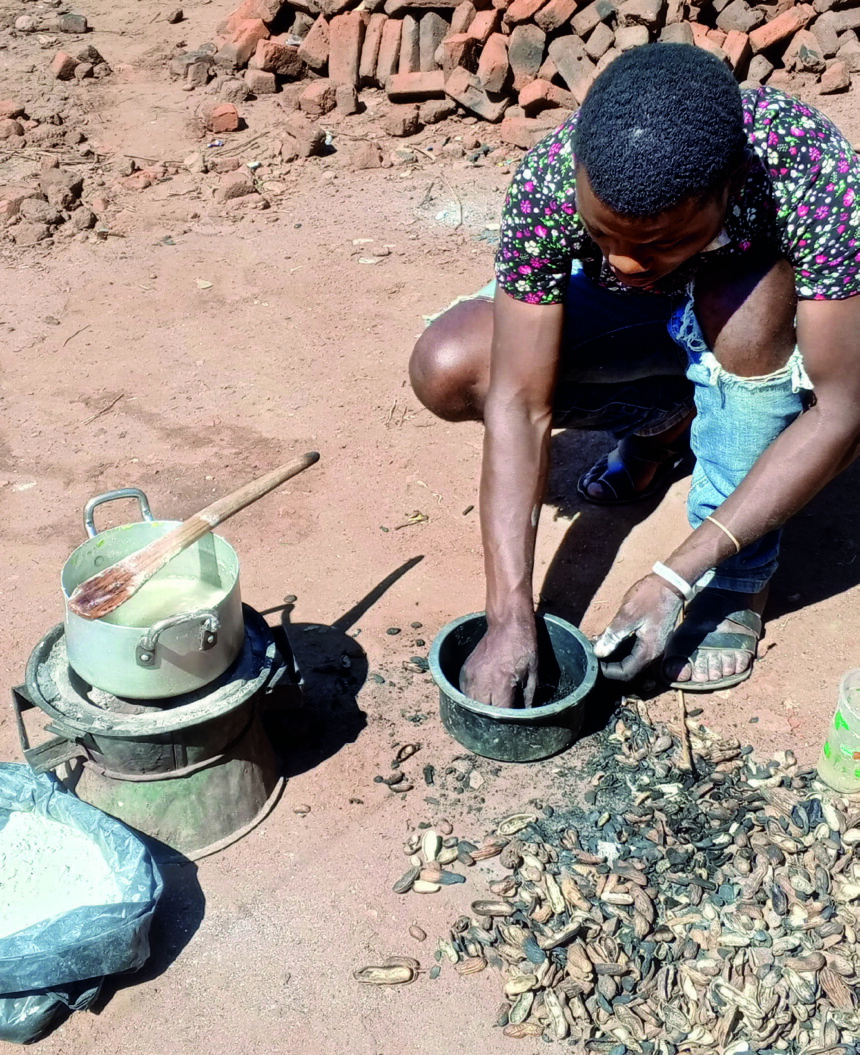
Driven by the dual desire to earn an income and support efforts to reduce charcoal use, Taferanji learned how to make fire briquettes by mixing porridge prepared from cassava flour, popularly known as kondoole, with groundnut shells.
- Advertisement -

From this unlikely blend, he produces an alternative source of energy that is slowly gaining acceptance among urban consumers.
- Advertisement -
The business has become his lifeline. Each month, Taferanji produces about three 50-kilogramme (kg) bags of briquettes, which he sells to vendors, who later resell them at higher prices in markets such as Wakawaka within the city.
From this modest operation, he earns between K90,000 and K150,000 per month.
“When I sell the briquettes, it helps me to invest the proceeds in other businesses. I do produce organic fertilisers and, so, money realised from briquettes is invested in organic fertilisers and irrigation farming that I do,” he said.
Beyond income generation, Taferanji believes the briquettes offer tangible benefits to households that are struggling due to rising fuel costs.
- Advertisement -
“Briquettes are cheaper and durable,” he said.
However, Taferanji’s dream of becoming a major supplier remains clouded by persistent challenges, chief among them being limited access to markets and low production capacity caused by the absence of machinery.
“It takes me time to produce these briquettes. To produce a bag of briquettes weighing 50 kilogrammes is not that simple,” he said.
Taferanji’s struggle mirrors that of 21-year-old Tadala Phiri, who runs a similar business from her home along the Mitundu- Bunda Road in Lilongwe.
Although she earns about K100,000 per month, her ambitions are equally constrained by manual production methods.
“On average I produce about 15kg of the briquettes because I use manual production methods. Manual production is not easy and, by the end of a week, I produce a bag weighing 50kg and, by the end of the month, I produce about three or four bags,” she said.
Taferanji and Phiri represent thousands of young Malawians who are navigating unemployment through innovation and resourcefulness.
According to the Malawi Labour Force Survey of 2024 conducted by the National Statistical Office, the unemployment rate stands at 19.7 percent while youth unemployment among those aged 15 to 35 is at 21.5 percent.
At the same time, Malawi remains heavily dependent on charcoal and firewood.
The National Charcoal Strategy (2017-27) indicates that more than 97 percent of households rely on illegally and unsustainably sourced biomass for cooking and heating.
This dependence has fueled widespread deforestation, forest degradation and downstream effects on water availability, hydropower generation and climate resilience.
The strategy promotes renewable energy alternatives such as fire briquettes, noting that when properly produced, briquettes can offer a concentrated, cost-effective, renewable and cleaner fuel.
Still, questions linger as to whether Malawi can significantly reduce its reliance on charcoal by embracing such innovations.
Youth Action for Success and Development Executive Director Edward Msiska believes expanded briquette production could help create jobs for the youth and reduce charcoal use.
His organisation has trained about 100 young people, including Taferanji and Phiri, in briquette production across Lilongwe and surrounding areas.
“We know that the government is the main provider of social services at national level. So, we are asking the government to establish flexible funding mechanisms for youth-led initiatives,” he said.
Msiska added that briquette production could ease pressure on urban waste management systems.
“As highlighted in the Lilongwe City Council strategic plan, which indicates that one of the key challenges that the council is encountering is poor waste management, these young people are helping in addressing the problem because they are using dry organic waste and turning it into fire briquettes. That means we are addressing the issue of poor waste management,” he said.
Meanwhile, Ministry of Industrialisation, Business, Trade and Tourism spokesperson Patrick Botha has said the government is implementing several interventions to support small and medium enterprises, including capacity building and improved access to finance.
“The ministry has been engaging financial institutions to remove the burden that was there—for instance, the requirement of collateral—because it is not easy for most youths to own a house or a car. So, what the ministry has been doing is to encourage the youth to form cooperatives as it is easy for them to get loans and ensure compliance when it comes to paying back the loans,” Botha said.
Youth and Sports Minister Patricia Wiskes told Parliament that her ministry was championing the development and mainstreaming of the National Youth Services Strategy to address persistent youth challenges such as unemployment, limited access to finance and inadequate skills development.
As Malawi grapples with challenges such as unemployment, environmental degradation and energy insecurity, the slow-burning promise of fire briquettes continues to flicker.