
By Isaac Kambwiri:
Looking calm, simple and humble, one can hardly realise that 57-year-old McUnnex Khendulo Tchezani is one of well-to-do men at Namitete, a trading centre located about 55 kilometers west of Lilongwe City as one heads towards the bordering district of Mchinji.
Originally from Mchinji, he grew up in Mphandura Village, Traditional Authority Kalolo, in Lilongwe Rural West.
Tchezani began his farming journey humbly, as a smallholder farmer, some 35 years ago, growing crops that included tobacco, maize and groundnuts, among others, in his quest to earn a living.
But despite working hard, most of the times toiling in the sun, his farming enterprise hardly gave him the much anticipated rewards as he did not get enough money to turn around his economic fortunes.
- Advertisement -
“I started farming soon after getting married, which is about 40 years ago.
“However, despite working hard, I did not realise much profit until I started cultivating tobacco under contract farming agreement with Alliance One Tobacco some 15 years ago. Since I joined the contract farming arrangement, I have successfully transformed my family’s living standards, both socially and economically,” Tchezani points out.
Tchezani— who now owns several properties including trucks, houses and some commercial buildings in Lilongwe City, Mchinji and Namitete Trading Centre— is also a proud owner of the 100-hectare Yankholanu Estate, where he is cultivating several crops including tobacco as well as rearing some livestock, notably cattle, goats and pigs.
According to Tchezani, cultivating tobacco under the Integrated Production System (IPS), popularly known as contract farming locally, has greatly benefitted him as the arrangement provides him with a ready market as well as a set minimum purchasing price of his tobacco, which allows him to realise more profit than growing the crop on non-contract farming basis.
- Advertisement -
- Advertisement -
He discloses that through the 15 years he has been growing tobacco under the contract arrangement, he has, so far, managed to buy a fleet of vehicles including a truck, tractors which he uses at his estate, some residential houses in the low density suburbs of Lilongwe City as well as commercial buildings which he rents out to traders in Mchinji, Lilongwe and at Namitete Trading Centre.
“Through contract farming, especially that of flue-cured tobacco with Alliance One, I now own several properties including this Yankholanu Estate, where I have employed about 71 workers who help me with daily activities on this farm. 50 hectares of this estate are for tobacco cultivation, hence tobacco is the backbone of this estate,” says the soft-spoken Tchezani.
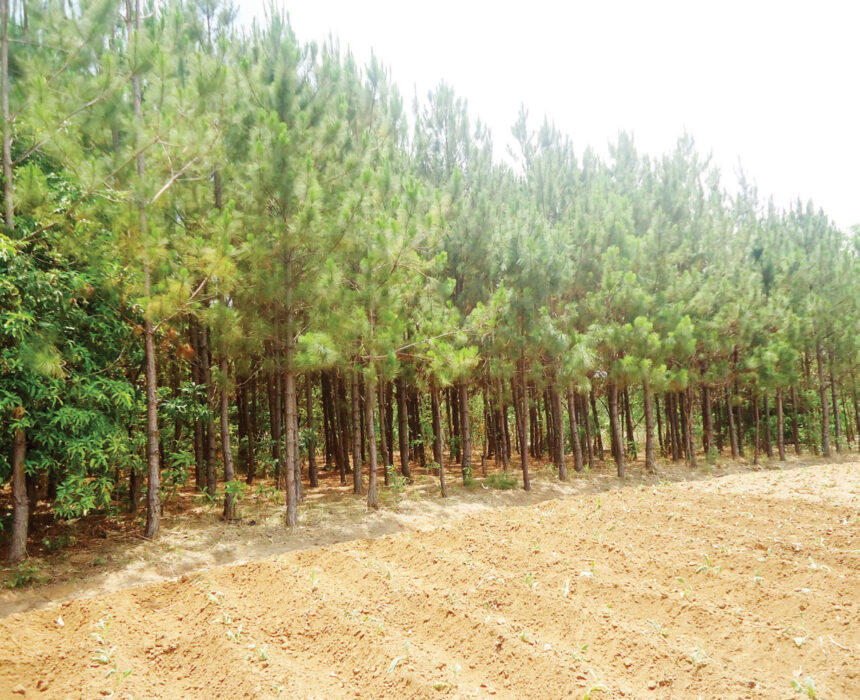
Considering that he cultivates flue-cured tobacco, which normally demands the use wood for curing, Tchezani has a 10-hectare woodlot near his estate.
He has turned it into a source of firewood for curing his flue-cured tobacco as well as construction materials for his tobacco bans, hence protecting the environment in the process.
“During this year’s marketing season, I made a profit of over K60 million from flue-cured tobacco sales alone and I also realised a considerable profit after selling burley tobacco too. Cultivating tobacco under the contract arrangement is more profitable than using other arrangements because, at the end of the day, one produces quality leaf which fetched an attractive price,” he explains.
Just like Tchezani, 70-year-old Mchinji-based John Haynes is a long-time tobacco farmer who has also made a profit from his tobacco cultivation this year.
Haynes, who uses 15 hectares of his Nenazako Farm for cultivating flue-cured tobacco, managed to get about K57 million as profit upon selling about 2,500 kilogrammes of the green gold. He used the money to buy a brand-new Toyota Hilux from Toyota Malawi.
According to Haynes, he joined contract farming with Alliance One in 2012 and, so far, he has acquired a number of properties out of the profits he realised from both tobacco and maize cultivation.
Among many properties, Haynes owns two commercial three-storey buildings at Mchinji Boma as well as several residential houses.
He explains that he would continue cultivating tobacco under contract farming because it is only through such kind of arrangement that growers can earn more profits because buyers offer good prices.
“I urge fellow farmers, especially smallholder growers, to consider joining the contract farming system because that is the only way they can benefit more from their farming endeavours. Nowadays, many tobacco buyers, including Alliance One, are interested in purchasing tobacco from contracted growers since the arrangement does not allow children, who are under the age of 18, to be involved in tobacco cultivation, among several restrictions,” Haynes narrates.
He adds that farmers are provided with technical expertise from field technicians Alliance One has deployed to most tobacco-growing areas, hence contracted growers produce quality tobacco which is sold at attractive prices at the auction floors.
“Let me urge everyone who is interested in tobacco farming to consider joining the contract farming arrangement with buyers such as Alliance One because that’s the only way they can benefit more as the arrangement enables them to get farm inputs and other chemicals on loan.
“In addition, farmers are required to follow internationally recommended practices of tobacco farming,” he stresses.
Haynes also discloses that he has a woodlot covering 10 hectares, pointing out that it serves as his source of firewood for curing his flue-cured tobacco.
The farmer indicates that some of the tree seedlings were provided, free-of-charge, by Alliance One some years back. He, therefore, says tobacco farming is, in his case, safe and clean as it does not degrade the environment in anyway.
“Through contract tobacco farming system with Alliance One, I have managed to employ about 41 people here at my Likasi Farm. These guys help me with the whole arrangement in as far as tobacco cultivation is concerned,” he says.
Another farmer who has fallen in love with the arrangement is Zeka Vierra, who says he and his workers strictly follow all the seven recommended Agriculture Labour Practices (ALP), describing them as the core principles of IPS.
They include the provision of a safe work environment for workers, no use of child labour, fair treatment, acceptable income and work hours, among others.
Corporate Affairs Manager for Alliance One Tobacco Malawi, Fran Malila, indicates that during the past two selling seasons (2022 and 2023), her company has bought approximately 33 million kilogrammes and 34 million kilogrammes, respectively, of tobacco from its contracted growers.
According to Malila, through its field technicians, who have been deployed to workstations across the country, her company emphasises that its contracted tobacco growers be adhering to all the seven internationally recommended ALP principles in the course of tobacco production.
“We, as a responsible company, don’t allow children who are below the age of 18 years to be involved in any process of tobacco production among our contracted growers because our aim is to ensure that children are attending classes. We also make sure that our contracted growers are following all the ALP principles,” Malila stresses.
And, so, as children drink from the cup of knowledge in class, contracted farmers are earning truckloads of cash at the auction floors— a win-win situation.