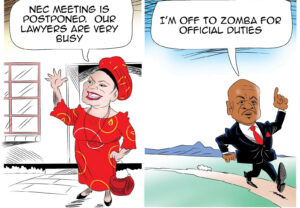
 This is likely to be my final commentary on the disarray within the once well-organised UTM, a party now grappling with a significant leadership void following the passing of its leader and State Vice-President Saulos Chilima.
Recently, in a hurried manner, the party’s leadership — excluding Vice-President Michael Usi, who now serves as interim president by virtue of his previous vice-presidential role prior to Chilima’s untimely death on June 10 — announced their decision to exit the Tonse Alliance.
Apparently, the decision had already been made by UTM’s National Executive Committee (Nec) during Chilima’s funeral and was simply formalised by the Central Executive Committee.
Yesterday, the Nec was scheduled to meet in Lilongwe to endorse their decision, as announced by the central committee.
UTM spokesperson Felix Njawala said Usi, who is supposed to chair Nec meetings or appoint a delegate if unavailable, had been informed about the Lilongwe event.
- Advertisement -
One wonders how a party president, even in an interim capacity, is informed about but not the one convening such a crucial Nec meeting.
It was evident that Usi would not attend the meeting, as it was publicly known he had travelled to the Southern Region accompanying President Lazarus Chakwera on government duties.
Yesterday, the planned meeting failed to materialise reportedly because UTM’s legal advisors, who, according to Secretary General Patricia Kaliati and company, had previously indicated the legality of exiting the alliance, failed to appear at the last minute.
Supporters of UTM maintain that the party remains unified.
- Advertisement -
- Advertisement -
Some of us wish them well on their uncertain path ahead.
In less than a month after Chilima’s demise, it became apparent that the party was heading down a perilous path.
Its enthusiastic supporters envisioned how UTM would retaliate against governing Malawi Congress Party (MCP) in the September 2025 elections, feeling betrayed by the party post-2020 elections.
Their frustrations were understandable, yet they often led to irrational political anger that rarely accomplishes anything meaningful.
The truth remains that Chilima was UTM and UTM was Chilima. Others were disgruntled hangers-on who left the Democratic Progressive Party (DPP) after failing to secure government positions for themselves or their relatives.
Their perpetual complaints echo loudly: DPP was nepotistic and only favoured the cronies of its leaders.
Similar sentiments arose when MCP excluded them from government affairs despite gaining power with UTM’s significant votes.
They have consistently lamented being sidelined. Perhaps now they are learning political lessons because failure to do so risks further turmoil within their group, as the party’s future appears increasingly uncertain.
UTM seems unwilling to acknowledge internal dissent.
The party aims to portray itself as the savviest player in Malawian politics, choosing to brush aside its internal conflicts as pragmatic.
This approach is not sustainable!
These disagreements may persist beyond the forthcoming elective convention, as some within UTM are poised to exploit political opportunities.
One cannot dismiss MCP’s potential interest in a fractured UTM should the alliance withdrawal proceed.
Such brutish politics has plagued Malawi for decades.
Now, supporters of UTM are linking former Reserve Bank of Malawi governor Dalitso Kabambe with the party’s leadership, dissatisfied with Usi and desperate for a new leader.
Within the supposed vastness of the party, members have yet to identify a credible leader and are clamouring for an outsider.
Yet, they seem oblivious to the risk of being swallowed up by the DPP, fixated solely on ousting the MCP – a party also so obsessed with power that it has overlooked the suffering of Malawians, who may seize any opportunity to vote them out.
Unless UTM members and its leaders shed their self-importance as supposed kingmakers, they risk continued instability, both within and beyond their party.
In the interim, the party must engage in serious introspection and approach politics realistically.
Lessons should have been learnt from the mistreatment by MCP over the past four years, guiding a path that ensures its survival.
Meanwhile, UTM risks becoming yet another chaotic entity, its relevance fading into obscurity.
There are many aspects of the party that cannot function effectively without Usi’s involvement, and its sulking leaders must acknowledge this reality.
Ultimately, it is up to Usi to relinquish the party leadership.
However, it is evident that MCP may utilise him in some capacity to prevent Kaliati and company from gaining full control of the party.
These realities should be put under consideration by several UTM supporters who are disillusioned by grandiose fantasies.